

Microbiome-friendly skincare is defined as any practice or product that protects and nurtures the beneficial microbial community living on your skin’s surface. This community, known in dermatology as the skin microbiome, regulates barrier function, controls inflammation, and keeps pathogenic bacteria in check. When you learn microbiome friendly skincare, you shift from the old goal of sterilizing skin to the more effective goal of supporting its natural balance. The science behind this approach is growing rapidly, with clinical reviews, dermatological guidance, and formulation research all pointing in the same direction: gentle, intentional care restores radiance far more reliably than aggressive treatments.
What are prebiotics, probiotics, and postbiotics in skincare?
Three ingredient categories define microbiome-friendly beauty: prebiotics, probiotics, and postbiotics. Each plays a distinct role, and understanding them helps you read labels with confidence.
Prebiotics are compounds that feed beneficial bacteria already living on your skin. Common examples include inulin, beta-glucan, and certain plant-derived sugars. They do not introduce new microbes. Instead, they create conditions where your skin’s existing good bacteria can thrive.
Probiotics are live microorganisms. In theory, they sound ideal. In practice, live probiotics rarely survive in topical formulations because packaging, preservatives, and pH shifts kill them before they reach your skin. This is a formulation challenge the industry has not fully solved.
Postbiotics are the solution. These are the byproducts and structural components left behind after bacteria ferment or are processed. Fermentation filtrates, bacterial lysates, and short-chain fatty acids all qualify. Because they are not alive, they remain stable in a jar or bottle. Postbiotics offer more stable and consistent skin benefits than live probiotic formulations.
The most effective approach combines both prebiotics and postbiotics in what researchers call a synbiotic formulation. Synbiotic skincare combining postbiotics and prebiotics is a clinically rational and effective approach to microbiome support, according to expert commentary from Dr. Jane Yoo. That combination outperforms either ingredient category used alone.
The clinical evidence for these ingredients is meaningful. A systematic review of 33 studies found that topical prebiotics, probiotics, and postbiotics for acne management are safe and effective, with pooled mean total lesion reductions up to 49.5%. That figure represents a significant reduction in visible acne, achieved without the dryness or irritation associated with retinoids or benzoyl peroxide.
- Prebiotics: Feed existing beneficial bacteria; look for inulin, beta-glucan, oat extract
- Probiotics: Live microorganisms; limited stability in most topical products
- Postbiotics: Stable fermentation byproducts; the most reliable delivery format currently available
- Synbiotics: Prebiotic and postbiotic combinations; the most clinically supported approach
Pro Tip: When shopping for microbiome-conscious products, scan the ingredient list for “ferment filtrate,” “lysate,” or “lactobacillus extract.” These signal postbiotic content, which is far more likely to survive in the formula and reach your skin intact.
How do you build a microbiome-friendly beauty routine?
A microbiome-friendly beauty routine follows a clear principle: protect the barrier at every step and introduce nothing that disrupts the microbial balance your skin has spent years building. The skin barrier’s role in this process is foundational. Every product you apply either supports or undermines it.
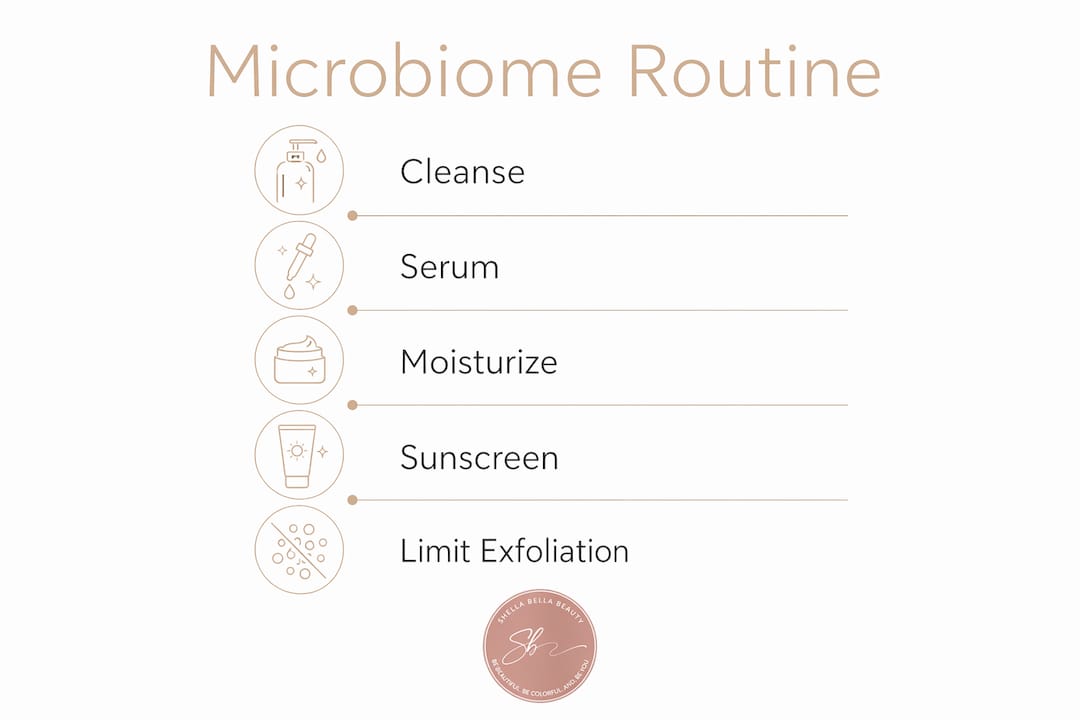
Step one: Cleanse gently and at the right pH. The skin’s natural surface sits at a pH of roughly 4.5 to 5.5. Cleansers that fall outside this range, even those labeled “gentle,” can disrupt the microbiome within a single wash. Cleansers with pH 4.5–5.5 optimize microbiome restoration, and many labeled “gentle” cleansers fail this test. Use pH strips to check your cleanser if you are unsure.
Step two: Apply a prebiotic or postbiotic serum. After cleansing, your skin is receptive. A lightweight serum containing lactobacillus ferment filtrate, niacinamide, or beta-glucan feeds beneficial bacteria and begins restoring balance. Refer to the skincare ingredient pairing checklist for guidance on combining these actives without conflict.
Step three: Moisturize with barrier-supporting ingredients. Look for ceramides, panthenol, and niacinamide in your moisturizer. These ingredients restore the lipid matrix between skin cells, reduce water loss, and create a physical environment where beneficial microbes can settle. Cushioned creams with ceramide NP or ceramide AP are particularly effective for this purpose.
Step four: Protect with sunscreen. UV exposure degrades the skin barrier and alters microbial diversity. A broad-spectrum SPF 30 or higher applied as the final morning step preserves the work done by every product beneath it.
Step five: Resist the urge to over-exfoliate. The goal of microbiome-friendly skincare is to protect the barrier and avoid aggressive practices that strip natural microbiota, according to dermatologist Dr. Rachel Moore. Limit exfoliation to once or twice per week at most, and choose lactic acid or polyhydroxy acids over harsh physical scrubs.
Pro Tip: If you use multiple active ingredients, apply them from thinnest to thickest texture and allow 60 seconds between layers. This prevents pH interference and gives each ingredient time to absorb before the next one alters the skin’s surface environment.
What mistakes should you avoid when switching to microbiome skincare?
Switching to a microbiome-conscious routine is generally gentle, but several common errors slow progress or cause unnecessary irritation. Knowing what to watch for protects your skin during the transition.
- Expecting a purging phase. Unlike retinoids, no adjustment phase is expected with microbiome-friendly skincare. If your skin worsens after introducing a new product, that is a sign of irritation, not purging. Discontinue the product promptly.
- Using cleansers with a high pH. Soap bars and many foaming cleansers sit above pH 7. A single wash with a high-pH cleanser can shift the skin’s microbial balance for hours. Check your cleanser’s pH before committing to it.
- Layering too many new products at once. Introducing three or four new products simultaneously makes it impossible to identify which one is causing a reaction. Add one product at a time, spaced one to two weeks apart.
- Ignoring ingredient conflicts. Certain actives, including high-concentration vitamin C and strong AHAs, lower the skin’s surface pH sharply. This can create an environment hostile to beneficial bacteria if used without care.
- Skipping patch testing. Apply any new product to the inner arm for 48 hours before using it on your face. This simple step catches sensitivities before they become full-face reactions.
“If burning or worsening redness occurs when starting microbiome-friendly skincare, it indicates irritation from harsh ingredients rather than an expected adjustment phase. Persistent irritation is always a signal to stop and reassess, not to push through.” — Health Beyond Age, clinical dermatology guidance, 2026
Troubleshooting a reaction starts with the ingredient list. Look for sodium lauryl sulfate, alcohol denat, and synthetic fragrance as the most common barrier disruptors. Removing one offending product often resolves redness within days.
What ingredients have the strongest scientific support for skin microbiome health?
Certain ingredients stand apart from the broader category because clinical research has examined their effects on specific bacterial populations and barrier function. These are the compounds worth prioritizing when you choose microbiome products.
Niacinamide is one of the most studied. At a concentration of 4–5%, niacinamide selectively supports beneficial Staphylococcus epidermidis over pathogenic S. aureus. This selective action is rare in skincare. Most ingredients either affect all bacteria indiscriminately or have no measurable microbial effect at all.
Plant-based prebiotics show rapid antimicrobial effects in recent research. Flaxseed, garlic, and mango ginger inhibit the growth of common skin pathogens within hours of application. These plant extracts work by selectively starving harmful bacteria of the nutrients they need, while leaving beneficial strains unaffected.
Ceramides and humectants restore the physical barrier that microbes depend on for a stable environment. Ceramide NP, ceramide AP, hyaluronic acid, and glycerin all contribute to this restoration. Without an intact barrier, even the best postbiotic serum cannot maintain microbial balance for long.
| Ingredient | Primary Function | Key Evidence |
|---|---|---|
| Niacinamide (4–5%) | Selectively favors S. epidermidis over S. aureus | Clinical guidance, April 2026 |
| Lactobacillus ferment filtrate | Postbiotic; stabilizes barrier and reduces inflammation | Systematic review, 33 studies |
| Flaxseed extract | Plant prebiotic; inhibits pathogenic bacteria | Nature research, June 2026 |
| Garlic extract | Antimicrobial prebiotic; rapid pathogen inhibition | Nature research, June 2026 |
| Ceramide NP / AP | Restores lipid barrier; supports microbial habitat | Formulation evidence, Blush Picks |
| Beta-glucan | Prebiotic; feeds beneficial bacteria, calms inflammation | Widely documented in clinical literature |
Fermentation filtrates and bacterial lysates deserve special mention as postbiotics. These compounds are produced when beneficial bacteria are cultured and then processed. The resulting material contains peptides, enzymes, and organic acids that calm inflammation, reinforce the barrier, and shift the skin’s surface chemistry toward conditions that favor beneficial microbes. For a deeper look at how these active skincare ingredients function alongside each other, the science is both accessible and worth your time.
One important caution: the skincare industry currently lacks standardized testing protocols for “microbiome-friendly” claims. That gap means marketing language can outpace the actual formulation. Seek products that list specific postbiotic ingredients by name rather than relying on vague “microbiome-friendly” branding alone.
Key Takeaways
Microbiome-friendly skincare works by protecting beneficial bacteria through pH-balanced cleansing, postbiotic and prebiotic ingredients, and consistent barrier support rather than aggressive treatment.
| Point | Details |
|---|---|
| Postbiotics over live probiotics | Live probiotics rarely survive in formulas; choose ferment filtrates and lysates instead. |
| pH-balanced cleansing is foundational | Use a cleanser with pH 4.5–5.5 to preserve your skin’s microbial balance from the first step. |
| Synbiotic formulas perform best | Combining prebiotics and postbiotics delivers stronger results than either ingredient alone. |
| No purging phase expected | Any irritation signals a product problem, not a transition phase. Discontinue and reassess. |
| Niacinamide at 4–5% is a standout | It selectively supports beneficial bacteria while discouraging pathogenic strains. |
What I’ve learned from years of watching the microbiome trend mature
The conversation around microbiome skincare has shifted considerably over the past few years, and not always in the direction the marketing suggested it would. When “probiotic” first appeared on product labels, the assumption was that live bacteria in a bottle would somehow colonize your skin and fix everything. That idea was appealing. It was also largely impractical, because most live organisms cannot survive the conditions inside a sealed cosmetic product.
What the science has actually delivered is more nuanced and, I think, more interesting. Postbiotics, the stable byproducts of bacterial activity, are where the real clinical progress lives. They do not need to be alive to work. They carry the biochemical signals that calm inflammation, reinforce the barrier, and shift the skin’s surface toward balance. That is a meaningful distinction, and it changes how you should shop.
The other thing I have come to appreciate is how much the barrier matters before any biotic ingredient can do its job. A disrupted barrier is like a cracked vessel. You can pour the finest ingredients into it, and they will simply drain away before they can take effect. Gentle cleansing, consistent moisturizing, and restraint with exfoliation are not glamorous steps. They are, however, the foundation that makes everything else work.
My honest recommendation is to resist the pull of complex, multi-product routines when you are starting out. A pH-correct cleanser, a postbiotic serum, a ceramide moisturizer, and a reliable SPF will outperform a ten-step routine built on trend-driven products. Patience and consistency are the two ingredients no formula can replace. For readers who want to see how this translates into a full multi-step skincare ritual, the principles above apply regardless of skin type.
— Marshella
Skincare that honors your skin’s natural balance
Shellabellabeauty builds its formulations around the same principles this guide describes: gentle ingredients, barrier-first thinking, and respect for the skin’s natural state. The Renewal and Smoothing Skincare Rituals collection brings together barrier-supporting moisturizers and calming treatments suited to anyone building a microbiome-conscious routine. For those whose skin craves deeper nourishment, the Deep Hydration Skincare Rituals collection offers cushioned creams and silky serums formulated to restore moisture balance without disrupting the microbial environment your skin depends on.

Every product in these collections is chosen with intention, reflecting Shellabellabeauty’s belief that radiance is not created but returned to. Browse both collections and find the ritual that fits your skin’s rhythm.
FAQ
What is microbiome-friendly skincare?
Microbiome-friendly skincare refers to products and practices that protect and support the beneficial bacteria living on your skin’s surface. The goal is to preserve the skin’s microbial balance rather than disrupt it with harsh ingredients.
Are postbiotics better than probiotics in skincare?
Postbiotics are more reliable in topical formulations because live probiotics rarely survive the conditions inside a sealed product. Fermentation filtrates and bacterial lysates deliver stable, consistent benefits without the stability challenges of live organisms.
How do I know if a cleanser is microbiome-friendly?
Check that your cleanser has a pH between 4.5 and 5.5, which matches the skin’s natural surface pH. Many cleansers labeled “gentle” fall outside this range, so testing with pH strips is a practical step.
Can microbiome skincare help with acne?
A systematic review of 33 studies found that topical prebiotics, probiotics, and postbiotics reduced total acne lesions by up to 49.5% on average. These ingredients are considered safe and effective for acne management alongside other treatments.
What ingredients should I avoid in a microbiome-friendly routine?
Avoid sodium lauryl sulfate, alcohol denat, and synthetic fragrance, as these are among the most common barrier disruptors. High-pH cleansers and aggressive physical exfoliants also strip the microbial layer that your skin depends on for protection.