

Use this night-time retinol skincare routine checklist to start safely: cleanse, wait for dry skin, apply a pea-sized retinol, seal with moisturizer, and wear SPF 30+ every morning. That is the bare minimum. The ramp-up rule is just as simple: start with low frequency and increase gradually, progressing only when your skin feels settled.
Your essential evening checklist:
- Cleanse gently with lukewarm water and pat dry
- Wait a short period for skin to fully dry
- Optional: apply a thin layer of moisturizer as a buffer
- Dot a pea-sized amount (~0.25 mL) of retinol across forehead, cheeks, and chin
- Spread gently upward; avoid the eye margin, nostrils, and mouth corners
- Seal with your moisturizer
- Add a targeted occlusive on sensitive spots if needed
- Morning: broad-spectrum SPF 30+ without exception
Pro Tip: On nights when your skin feels reactive, try the sandwich method: apply moisturizer first, then retinol, then moisturizer again. This buffers the active without canceling its benefits.
Table of Contents
- What is retinol, and which strength should you start with?
- Who should wait before starting retinol?
- How to follow your night-time retinol routine step by step
- What ramp-up schedule should you follow?
- Which actives should you avoid mixing with retinol?
- How do you manage irritation and safely resume?
- Why is sunscreen non-negotiable when using retinol?
- What are the gentler alternatives to retinol?
- Common beginner mistakes to stop making right now
- Key Takeaways
- The case for going slowly with retinol
- How LumineRx™ and Opuliss™ fit your retinol checklist
- Useful sources and further reading
- FAQ
What is retinol, and which strength should you start with?
Retinol is a vitamin A derivative that accelerates cellular turnover, which over time can soften fine lines, calm acne, and fade hyperpigmentation. It does not work overnight. The visible refinement most people seek takes weeks to months of consistent use, and that timeline is by design.
Over-the-counter retinol follows a conversion chain: retinol converts to retinaldehyde, which then converts to retinoic acid, the form your skin actually uses. Each step reduces potency, which is precisely why lower-strength OTC retinol is a sensible starting point. You get real retinol benefits with a gentler introduction to the active.
For most beginners, a low-concentration formula (typically 0.025%–0.1%) applied infrequently is far more productive than reaching for a higher strength too soon. Frequency matters more than concentration in the early weeks. Once your skin has adapted, you can consider a modest step up.
Who should wait before starting retinol?
Retinol is not right for every skin at every moment. Delay starting, or speak with a clinician first, if any of the following apply to you:
- You are pregnant or breastfeeding (vitamin A derivatives are contraindicated during pregnancy)
- Your skin is actively sunburned, broken, or inflamed
- You are using prescription topicals such as tretinoin or adapalene
- You have severe eczema, active rosacea flares, or contact dermatitis
- You have not yet done a patch test on a small area
Patch testing a new retinol product on a small area for a couple of days before full-face use helps catch severe reactions early. For those with dry or sensitive skin, a barrier-first approach before introducing any active is worth the extra patience.
Stop use immediately and seek care if you experience severe burning, significant swelling, or open skin lesions. Mild flaking and transient redness are part of the adaptation process; those symptoms are not. When in doubt, consult a board-certified dermatologist before resuming.
How to follow your night-time retinol routine step by step
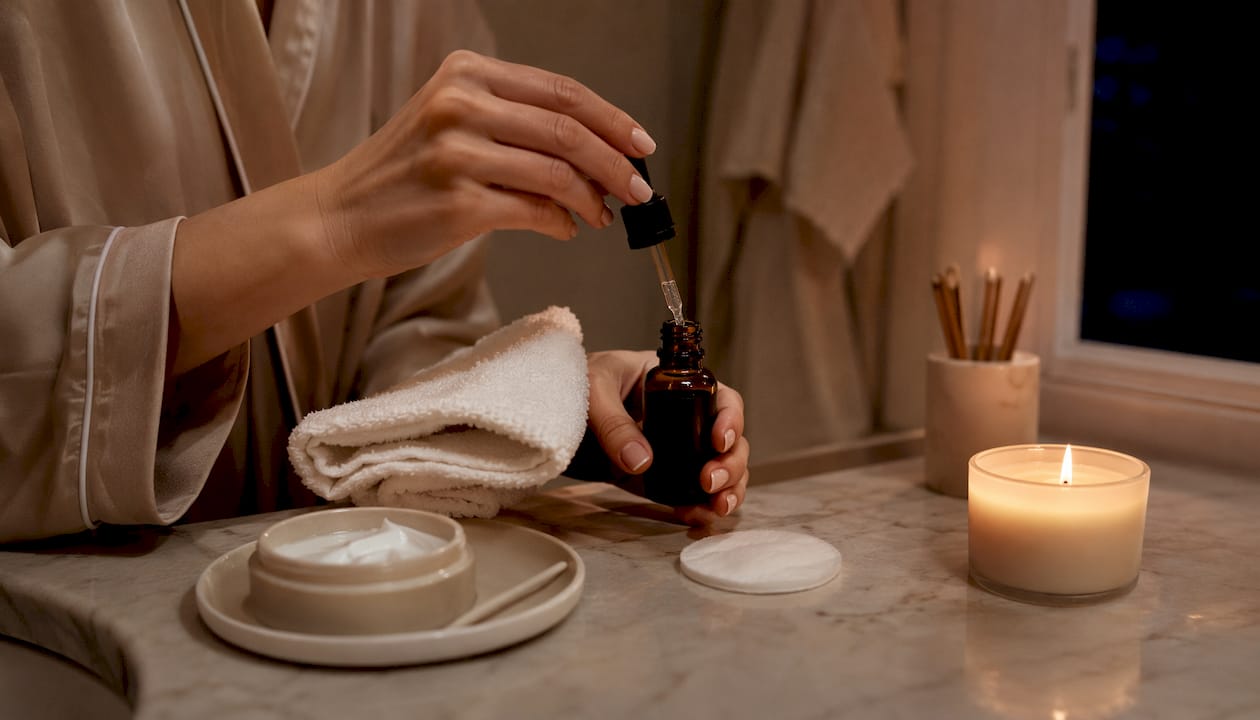
The order of application matters as much as the products themselves. Layering from lightest to heaviest allows each product to absorb properly, and placing retinol after serums but before your sealing moisturizer keeps it effective without overwhelming the barrier. A well-structured skincare routine order is the foundation everything else rests on.
Step-by-step evening application:
- Cleanse with a gentle, pH-balanced cleanser using lukewarm water; pat dry with a clean towel.
- Wait 5–30 minutes. Applying to damp skin increases penetration rate and irritation risk, so patience here pays off.
- Optional buffer: smooth a thin layer of moisturizer over dry skin if you are new or reactive.
- Dispense a small, pea-sized amount of retinol. Dot it onto your forehead, both cheeks, and chin, then spread gently using upward motions. Never rub aggressively or use an abrasive tool on the same night.
- Avoid the immediate eye margin, corners of the mouth, and nasolabial folds in the early weeks; protect those zones with a targeted occlusive or eye treatment if needed.
- Wait a few minutes for the retinol to settle, then apply your moisturizer to seal and support the barrier.
- Add a small amount of occlusive balm to any particularly sensitive spots.
Dosing note: A pea-sized amount (~0.25 mL) covers the entire face. Using more raises irritation risk without delivering greater benefit.
Pro Tip: The sandwich technique — moisturizer before and after retinol — reduced irritation complaints substantially in practice while preserving efficacy. It works for both beginners and those who have been using retinol for months.
For skin-type-specific variations on this order, the multi-step ritual guide at Shellabellabeauty covers oily, combination, and dry skin adjustments in detail.
What ramp-up schedule should you follow?
The goal of the early weeks is not transformation; it is retinization, meaning guiding your skin to tolerate faster cellular turnover without compromising the barrier. Patience with a slow ramp-up protects that barrier in the long run, and dermatologists consistently recommend starting at a low frequency and titrating gradually.
A typical ramp-up schedule starts with infrequent application initially, gradually increasing to more frequent use over several weeks, progressing according to skin tolerance.
Signs to slow down or pause:
- Persistent redness that does not resolve within 24 hours
- Open cracks, peeling beyond light flaking, or raw patches
- Stinging that lasts more than a few minutes after application
- Visible swelling or hive-like reactions
For reactive skin, an “every third night” or skin cycling approach works well: one retinol night, one recovery night focused on ceramides and hydration, one exfoliation night (if tolerated), then repeat. This rhythm gives the barrier time to restore between active nights.
Visible changes — smoother texture, reduced breakouts, softer lines — typically begin to appear after several weeks of consistent use, with more pronounced results emerging over months. The cellular turnover retinol drives is a gradual process, and that measured pace is what makes the results lasting.
Which actives should you avoid mixing with retinol?
The short answer: keep retinol’s application window clean. Avoid layering strong chemical exfoliants (AHAs and BHAs), high-concentration vitamin C, and benzoyl peroxide in the same session as retinol, especially while your skin is still adapting.
Avoid on the same night as retinol:
- AHAs (glycolic acid, lactic acid) and BHAs (salicylic acid)
- High-concentration ascorbic acid (vitamin C) serums
- Benzoyl peroxide
- Physical exfoliating scrubs or tools
Safe to use alongside retinol or on alternating nights:
- Peptides and growth factors (excellent for barrier support)
- Niacinamide at moderate concentrations
- Gentle hydrating serums with hyaluronic acid or glycerin
- Antioxidant serums used in the morning rather than at night
For a deeper look at compatible ingredient pairings and layering order, Shellabellabeauty’s guide to skincare layering walks through the logic clearly.
Pro Tip: Schedule exfoliating acids and retinol on separate nights. On recovery nights between them, focus entirely on hydration: a ceramide moisturizer, a gentle serum, nothing that challenges the barrier. If you want a well-tolerated exfoliating toner to rotate in, a refining toner used on non-retinol nights can support turnover without compounding irritation.
How do you manage irritation and safely resume?
Mild flaking and transient redness are a normal part of retinization. Persistent burning, swelling, or skin that feels raw and cracked is a different signal entirely, and it warrants a pause.
If irritation appears, follow these steps:
- Pause retinol for 5–7 days
- Focus on ceramide-rich moisturizers and barrier-repair formulas
- Avoid all physical exfoliation and other active ingredients during the break
- Keep the routine minimal: gentle cleanser, moisturizer, SPF
When you are ready to resume:
- Go back one step in the ramp-up schedule (for example, from twice weekly to once weekly).
- Use the sandwich method for the first two to three sessions back.
- Consider a lower-strength product if irritation was significant.
- Patch-test again if you have switched products.
For those with reactive or sensitized skin, the sensitive skin routine guide at Shellabellabeauty offers a gentler framework that pairs well with a conservative retinol restart.
Pro Tip: Keep a short diary: note the date, the product used, and any reaction. A few weeks of entries makes it far easier to identify triggers and gives your dermatologist something concrete to work with if you need guidance.
Why is sunscreen non-negotiable when using retinol?
Retinol increases photosensitivity, making daily broad-spectrum SPF 30+ not a suggestion but a requirement. Skipping sunscreen while using retinol undermines the very cellular renewal the active is working to support.
Daily SPF rules to follow:
- Apply broad-spectrum SPF 30+ every morning, even on overcast days
- Use at least a nickel-sized amount for the face; more for the neck
- Reapply every two hours when outdoors or after sweating
- Wear a hat or seek shade as added physical protection
- Do not rely on tinted moisturizer or makeup alone as SPF coverage
Your morning routine should feel like a natural extension of the care you gave your skin the night before. A full morning skincare checklist that sequences SPF correctly is available at Shellabellabeauty for reference.
What are the gentler alternatives to retinol?
Bakuchiol and adenosine are the most studied gentler alternatives, both cited for delivering smoothing and firming benefits with a lower irritation profile. They are worth considering during pregnancy or nursing (always confirm with your provider), when retinoid intolerance persists despite buffering, or simply as an interim step while building tolerance.
- Bakuchiol: A plant-derived active that mimics some of retinol’s cellular effects with less photosensitivity and a gentler feel on reactive skin
- Adenosine: Supports skin firmness and smoothness; well tolerated by most skin types, including sensitive
- Fermented ingredients: Common in K-beauty formulations, these can support radiance and texture with minimal barrier disruption
You can use these alternatives as a full swap or alongside a very low-frequency retinol schedule. Try a single-alternative night for four to eight weeks and track skin comfort and visible changes before deciding whether to reintroduce retinol or continue with the gentler route. For more on gentle alternatives and ingredient swaps, that resource covers the K-beauty perspective in useful detail.
Pro Tip: If you are pregnant or nursing, bakuchiol is the most commonly recommended retinol substitute, but confirm the choice with your OB or midwife before starting any new active.
Common beginner mistakes to stop making right now
- Applying to damp skin. Wait the full 5–30 minutes after cleansing. Wet skin drives deeper, faster penetration and more irritation.
- Using more than a pea-sized amount. More product does not mean faster results; it means a higher chance of contact dermatitis.
- Mixing acids and retinol on the same night. Separate them onto different nights until tolerance is well established.
- Skipping sunscreen. Retinol and unprotected sun exposure work against each other. SPF is part of the routine, not optional.
- Advancing frequency too quickly. Follow the ramp-up table. Jumping ahead when skin seems fine is the most common reason routines stall.
- Applying to damaged or inflamed skin. Active breakouts, sunburn, or a compromised barrier need healing time before retinol re-enters the picture.
Key Takeaways
A safe, effective retinol routine requires a pea-sized dose, a slow ramp-up from once to three times weekly, the sandwich buffering method, and daily SPF 30+ without exception.
| Point | Details |
|---|---|
| Pea-sized dose only | Use ~0.25 mL for the whole face; more raises irritation risk without added benefit. |
| Follow the 1-2-3 ramp-up | Start once weekly, progress to twice, then three times, only when skin feels settled. |
| Sandwich method for buffering | Moisturizer before and after retinol reduces irritation while preserving efficacy. |
| SPF 30+ every morning | Retinol increases photosensitivity; broad-spectrum sunscreen is non-negotiable daily. |
| Shellabellabeauty’s approach | LumineRx™ Retinol Renewal Serum paired with Opuliss™ Nocturnal Renewal Creme maps directly to the checklist steps above. |
The case for going slowly with retinol
The most common mistake I see is not choosing the wrong product. It is choosing the right product and then rushing it.
Retinol’s reputation for delivering visible results has created an expectation that more, sooner, is better. The opposite tends to be true. The skin’s barrier is not a problem to push through; it is the very structure that makes everything else work. When the barrier is intact, retinol can do its job steadily and with far less drama. When it is compromised from overuse or impatient layering, you spend weeks in repair mode instead of renewal mode.
The conservative, buffered ramp-up described here is not a cautious workaround for people with sensitive skin. It is the approach that produces the most consistent results across all skin types, because it keeps the barrier functional throughout the process. Patch-test every new product. Keep the routine minimal in the early weeks. And trust that the skin’s capacity for renewal, given the right conditions, is genuinely remarkable.
How LumineRx™ and Opuliss™ fit your retinol checklist
Shellabellabeauty’s LumineRx™ Retinol Renewal Serum is formulated to slot directly into step four of the checklist above: a silky, precisely dosed retinol serum designed for the evening application window. For beginners, the recommended starting frequency is once weekly, following the ramp-up schedule in this guide, with the sandwich method in place for the first several sessions.
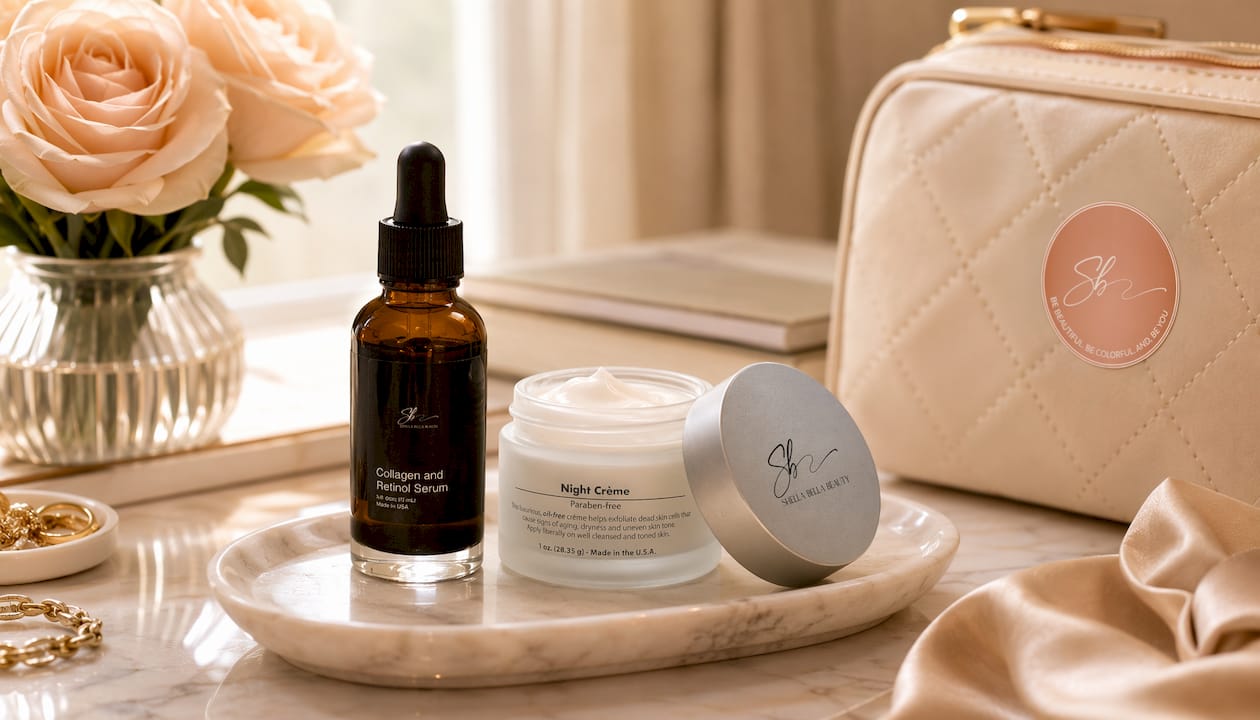
The Opuliss™ Nocturnal Renewal Creme serves two roles in this routine. On retinol nights, it is the sealing moisturizer applied after LumineRx™, cushioning the barrier and locking in hydration. On recovery nights, it becomes the primary treatment: a richer, barrier-focused creme that supports the ceramide and hydration work the skin needs between active sessions.
Together, these two products give you a complete evening ritual that honors the checklist without requiring a cabinet full of separate actives. Explore both at Shellabellabeauty and find the routine that fits your skin’s rhythm.
Useful sources and further reading
The guidance in this article draws on the following sources. For complex cases or persistent reactions, a board-certified dermatologist remains the most reliable resource.
- Cleveland Clinic: Retinol overview and sunscreen guidance
- Cleveland Clinic: Correct skincare product order
- Geisinger Health: Beginner skincare routine guide
- Dr. Flavio Oliveira: Complete retinol protocol
- Wirecutter/NYT: What to know before starting retinol
- Shellabellabeauty: Product and routine resources
General information notice: This article is for educational purposes and does not constitute medical or dermatological advice. Confirm any new skincare active with a qualified clinician, particularly if you have a diagnosed skin condition, are pregnant, or are using prescription topicals.
FAQ
What is the correct retinol routine order at night?
Cleanse, wait for skin to fully dry (5–30 minutes), apply a pea-sized retinol, then seal with moisturizer. For sensitive skin, add a thin moisturizer layer before the retinol as a buffer.
What is the 1-2-3 rule for retinol?
Start retinol once weekly for the first two weeks, increase to twice weekly for weeks three and four, then move to three times weekly from week five onward, progressing only when your skin shows no persistent irritation.
What should you never mix with retinol in the same session?
Avoid combining retinol with AHAs, BHAs, benzoyl peroxide, and high-concentration vitamin C in the same application window. Schedule exfoliating acids on separate nights until tolerance is fully established.
What do K-beauty routines use instead of retinol?
Bakuchiol and adenosine are the most common gentler alternatives favored for sensitive or reactive skin, offering smoothing benefits with a lower irritation profile and no increased photosensitivity.
How much retinol should you apply to your face?
A pea-sized amount, approximately 0.25 mL, is the standard dose for the entire face. Using more increases irritation risk without delivering greater benefit.
Recommended
- Morning Skincare Routine Checklist for Glowing Skin – Shella Bella Beauty™
- Guide to Skin Cycling for Beginners – Shella Bella Beauty™
- Morning Skincare Routine Order Made Simple – Shella Bella Beauty™
- 7 Best Morning Skincare Essentials – Shella Bella Beauty™
- Join Glow Chronicles™ — Continue the Glow™ with editor’s picks, seasonal beauty rituals, exclusive skincare insights, and new editions delivered to your inbox.