

A skincare ampoule is a super-concentrated treatment booster, originally housed in sealed glass vials, that delivers a higher density of active ingredients than a standard serum — and because of that potency, it calls for intentional, targeted use rather than daily application.
Think of it as a precision tool in your routine, not a replacement for your everyday products. Three things to hold onto before reading further:
-
Ampoules are intensive by design. They are best suited to short programs or targeted moments when your skin needs more than maintenance can offer.
-
The key difference from serums is concentration and frequency. Serums are formulated for daily use; ampoules deliver higher concentrations of actives and are meant to be used strategically, not indefinitely.
-
Treat them like potent actives. Patch test before starting, limit frequency, and avoid layering multiple strong actives at once — the same mindset you would bring to retinol or a high-dose vitamin C.
Table of Contents
What exactly is a skincare ampoule?
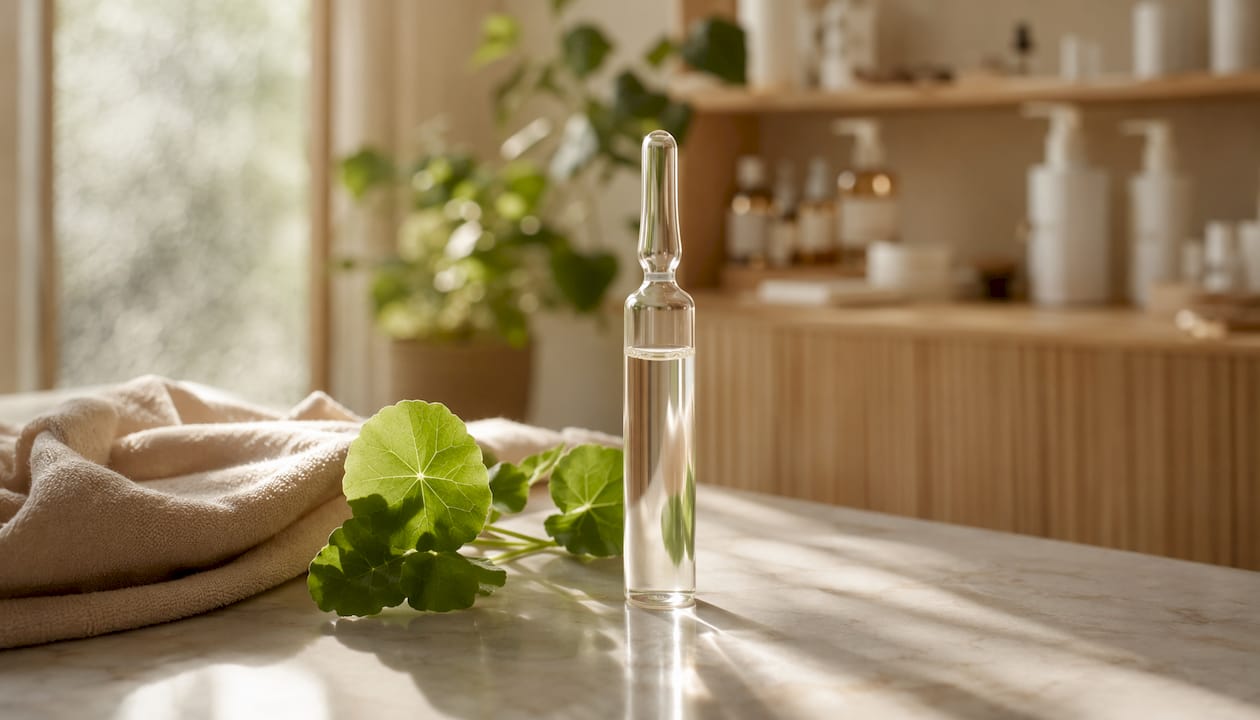
The word “ampoule” comes from pharmaceutical packaging: small, hermetically sealed glass vials used to preserve sterile solutions. Skincare borrowed both the name and the concept, centering the format on one idea — that sealing a formula away from air and light keeps unstable actives fresher and more potent until the moment of use. Sealed packaging reduces oxidation and preserves the integrity of ingredients that would otherwise degrade in an open dropper bottle over weeks of daily exposure.
Modern ampoules have expanded well beyond glass vials, though the philosophy of concentrated, protected delivery remains. You will encounter them in several formats:
-
Single-use glass vials with a snap-off or pre-scored neck — the classic apothecary format, one application per vial.
-
Multi-dose snap-top vials designed for two to three applications before discarding.
-
Dropper or pump bottles marketed as “ampoule-style,” offering a more concentrated formula than a standard serum in a familiar format.
-
Capsules or pods that release a single measured dose when pressed or twisted open.
Retail presentation often signals intended use. 7–14 day intensive kits supply one vial per application over a defined treatment period, building portion control directly into the packaging. Single bottles labeled “ampoule” tend to function more like a daily booster serum, which is worth noting when you are comparing products. The format shapes the experience as much as the formula does.
How do ampoules and serums actually differ?
The line between ampoules and serums has blurred considerably in recent years. Industry commentary describes ampoules as “serum on steroids,” and that framing is useful — but it also points to the inconsistency in how brands use the term. A product called an ampoule may behave like a serum, and vice versa. Reading the directions and the ingredient list matters more than the label alone.
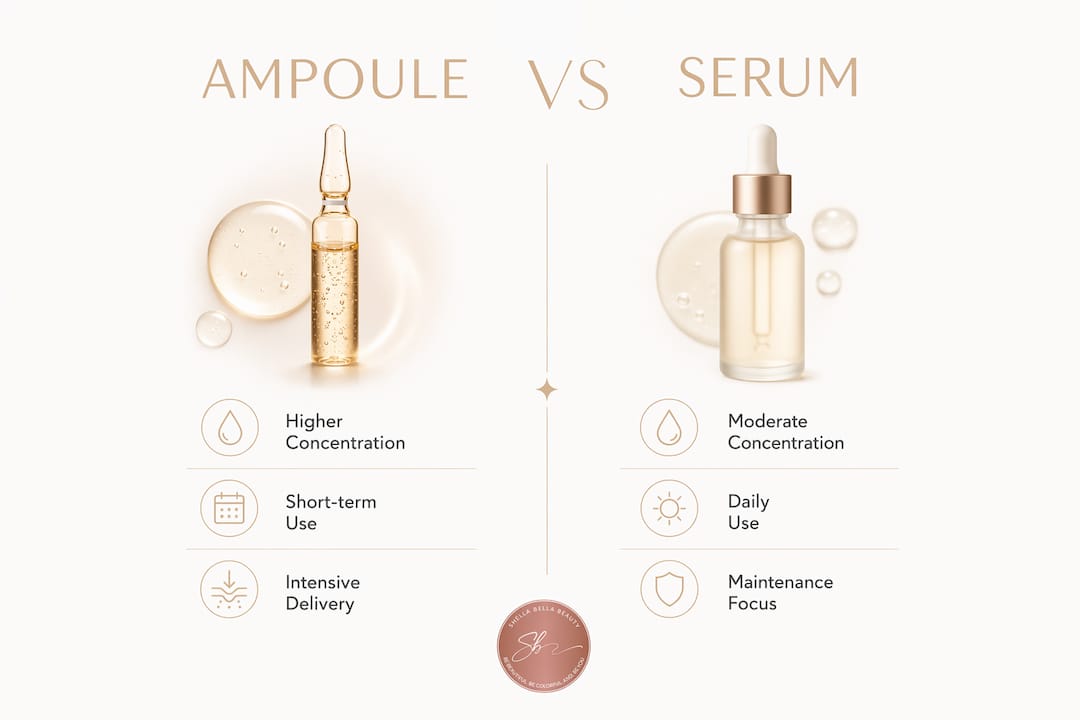
That said, meaningful practical differences do exist:
| Feature | Ampoule | Serum |
|---|---|---|
| Concentration of actives | Higher; formulated for intensive delivery | Moderate; designed for daily tolerance |
| Recommended frequency | Targeted programs or periodic boosts | Daily maintenance |
| Packaging | Sealed vials, single-use or short-use formats | Open dropper or pump bottles |
| Best use case | Short resets, pre-event prep, targeted concerns | Ongoing skin maintenance |
| Typical actives | High-dose vitamin C, peptides, hyaluronic acid | Broad range at maintenance concentrations |
The practical decision is straightforward. Reach for an ampoule when your skin needs a concentrated reset — after travel, before an event, or when a specific concern like dullness or dehydration flares. Return to your daily facial serum for ongoing maintenance once the program is complete. Some routines layer both: the ampoule runs as a short program, while the serum continues as the daily foundation, applied after the ampoule has absorbed.
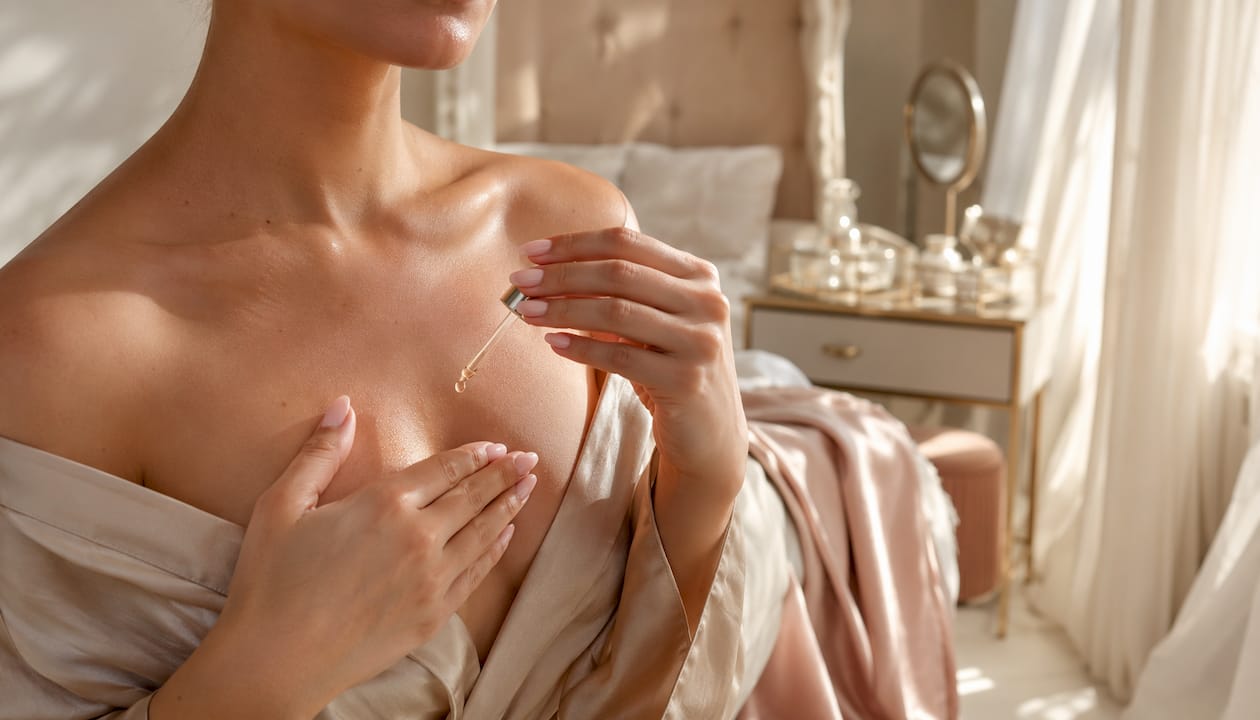
When and how to apply an ampoule, step by step
Knowing when to introduce an ampoule is as important as knowing how to apply it. The clearest situations:
-
A 1–4 week intensive program when your skin needs a targeted reset.
-
Pre-event preparation, when you want your skin to look its most luminous.
-
Post-travel recovery, when barrier stress and dehydration call for something more restorative than your usual routine.
-
A flare of a specific concern — sudden dullness, dehydration, or uneven tone — that your daily serum is not addressing quickly enough.
Step-by-step application:
-
Cleanse thoroughly. Begin with clean skin so nothing interferes with absorption.
-
Apply toner or essence. A hydrating essence prepares the skin and, on slightly damp skin, can help draw the ampoule’s actives deeper.
-
Open the ampoule carefully. For glass snap-off vials, wrap the neck in a tissue, hold the body firmly, and snap away from your face. Twist-cap and pre-scored styles require less force — follow the manufacturer’s instructions to avoid breakage or spillage.
-
Apply the ampoule. Dispense a few drops onto your fingertips or directly onto skin, then press gently rather than rubbing. Work from the center of the face outward.
-
Allow it to absorb. Give it 30–60 seconds before the next step.
-
Follow with serum or moisturizer as directed, or use the ampoule alone if the product instructions specify it as a complete treatment.
For storage: single-use vials should be used in one sitting. If the format allows splitting a dose between morning and evening, recap or seal the vial immediately and use the remainder within 24 hours. Discard any opened ampoule that shows a change in color, texture, or scent — these are signs of oxidation or degradation.
Pro Tip: If your ampoule contains vitamin C or another oxidation-sensitive active, apply it in the morning when antioxidant protection is most useful, and keep unopened vials away from direct light and heat.
Safety, potency, and what dermatologists want you to know
Higher concentration does not mean better results at any frequency. Board-certified dermatologist Dr. Lauren Moy advises treating ampoules like potent actives — use them with intention and avoid daily overuse to prevent barrier irritation.
“Ampoules are highly concentrated, so they should be used strategically rather than as an everyday product. Think of them the way you would think about a potent active like retinol — with care, with a patch test, and with attention to how your skin responds.”
— Dr. Lauren Moy, as cited by Vogue
Patch testing is non-negotiable before starting any ampoule program:
-
Apply a small amount to the inner forearm or behind the ear.
-
Wait 24 hours without washing the area.
-
Check for redness, itching, or swelling before applying to your face.
-
If any reaction appears, discontinue and consult a dermatologist.
Those who need extra caution include:
-
Sensitive or reactive skin types. Lower frequency or dilute the ampoule with a gentle serum before applying.
-
Compromised skin barrier. If your skin is already inflamed, flaking, or stinging, repair the barrier first before introducing a concentrated active.
-
Post-procedure skin. After chemical peels, laser treatments, or microneedling, wait until your provider clears you for active ingredients.
-
Those already using retinoids or exfoliating acids. Avoid layering multiple potent actives in the same routine — the cumulative load can overwhelm the skin’s tolerance.
Delivery method also shapes results. Research into topical delivery technologies like sonophoresis illustrates why concentrated formats can feel more potent — the skin’s response to a high-dose topical depends on both the formula and the condition of the barrier receiving it.
What ingredients do ampoules contain, and what does each target?
Ampoules are formulated around a specific concern, which makes matching the active to your skin’s need the most important selection step. A look at the most common actives and what they address:
-
Hyaluronic acid: Draws moisture into the skin and plumps the appearance of fine lines. Hydration ampoules often layer multiple molecular weights of hyaluronic acid for surface and deeper hydration.
-
Vitamin C (ascorbic acid and derivatives): Brightens uneven tone, reduces the appearance of dark spots, and provides antioxidant protection. Sealed packaging is especially valuable here, since vitamin C is highly prone to oxidation.
-
Peptides: Signal the skin to support its own collagen and elastin, contributing to a firmer, more refined appearance over time. Well-suited to anti-aging programs.
-
Retinoids and retinol derivatives: Accelerate cell turnover, smooth texture, and address fine lines. Among the most potent ampoule actives — frequency limits apply strictly.
-
Niacinamide: Supports the skin barrier, reduces the appearance of pores, and contributes to a more even tone. Generally well-tolerated, making it a good entry point for those new to ampoule formats.
-
Centella asiatica and panthenol: Calming and barrier-supporting actives, often found in soothing ampoules designed for reactive or post-procedure skin.
-
Botanical antioxidants: Fermented extracts, green tea, and resveratrol appear frequently in K-Beauty ampoule formulations, offering antioxidant and brightening support.
When reading a product, look for the active listed prominently in the name or directions, and check whether the concentration is disclosed. A vitamin C ampoule at 10–20% ascorbic acid is a meaningful dose; one that lists vitamin C derivatives far down the ingredient list may behave more like a maintenance serum. Pair your selection with your skin’s active ingredient tolerance for the best outcome.
Can you skip your serum and use an ampoule instead?
Yes, sometimes — but with clear conditions. K-Beauty guidance confirms that ampoules can substitute for serums during short, targeted programs, particularly when the ampoule is formulated to function as a complete treatment step. During a 7–14 day intensive, many people set their daily serum aside and let the ampoule carry that step entirely.
The situation where substitution becomes less advisable:
-
Long-term replacement. Ampoules are not designed for indefinite daily use. If your skin relies on consistent hydration, barrier support, or antioxidant maintenance, a daily serum is the more appropriate vehicle.
-
Irritant actives. If the ampoule contains retinoids, high-dose vitamin C, or exfoliating acids, daily use as a serum replacement will likely cause irritation over time.
-
Ongoing maintenance needs. Some skin concerns — persistent hyperpigmentation, chronic dryness — respond better to the steady, daily delivery a serum provides than to periodic intensive programs.
The most balanced approach: use the ampoule as a focused program, then return to your serum for maintenance. If you are uncertain whether your skin needs a serum at all, the serum vs. moisturizer guide from Shellabellabeauty can help clarify the distinction.
Key Takeaways
Ampoules deliver higher concentrations of actives than serums and are designed for intentional, time-limited use — not daily maintenance — making patch testing and frequency limits non-negotiable.
| Point | Details |
|---|---|
| Ampoule definition | A super-concentrated treatment booster, originally in sealed vials, used for targeted skin programs. |
| Ampoule vs. serum | Ampoules carry higher active concentrations and suit short programs; serums are calibrated for daily use. |
| Application order | Apply after cleansing and toning, before serum or moisturizer, on slightly damp skin when directed. |
| Safety first | Patch test before every new ampoule; avoid layering multiple potent actives in the same routine. |
| Shellabellabeauty option | The Opuliss™ Infusion Toning Elixir is positioned as a gentle intensive option for a 7–14 day program or targeted boost. |
The case for slowing down with ampoules
There is a tendency in skincare culture to treat concentration as a proxy for effectiveness — the higher the dose, the faster the result. Ampoules invite that thinking, and it is worth examining carefully. A sealed vial with a high-dose active is not inherently better for your skin than a well-formulated daily serum; it is simply different in purpose and intensity.
What ampoules do well is create a moment of focused attention. A 7–14 day program asks you to be deliberate: one vial, one application, one concern addressed with care. That structure is genuinely useful, not just as a delivery mechanism but as a practice of noticing how your skin responds when you give it something specific and then step back. The results of a well-chosen ampoule program tend to be visible precisely because the format enforces restraint — you cannot accidentally overuse a single-dose vial.
The caution worth holding onto is this: more is not more when it comes to potent actives. An ampoule used too frequently, layered carelessly with other strong ingredients, can set your skin back rather than forward. The ritual matters as much as the formula. Approach it with patience, and your skin will reflect that intention.
The Opuliss™ Infusion Toning Elixir from Shellabellabeauty
Radiance that feels restored rather than forced — that is the sensibility behind the Opuliss™ Infusion Toning Elixir from Shellabellabeauty. Formulated as a gentle yet intensive infusion treatment, it is designed to address dullness, uneven tone, and surface dehydration with the kind of concentrated care that a short program delivers best.
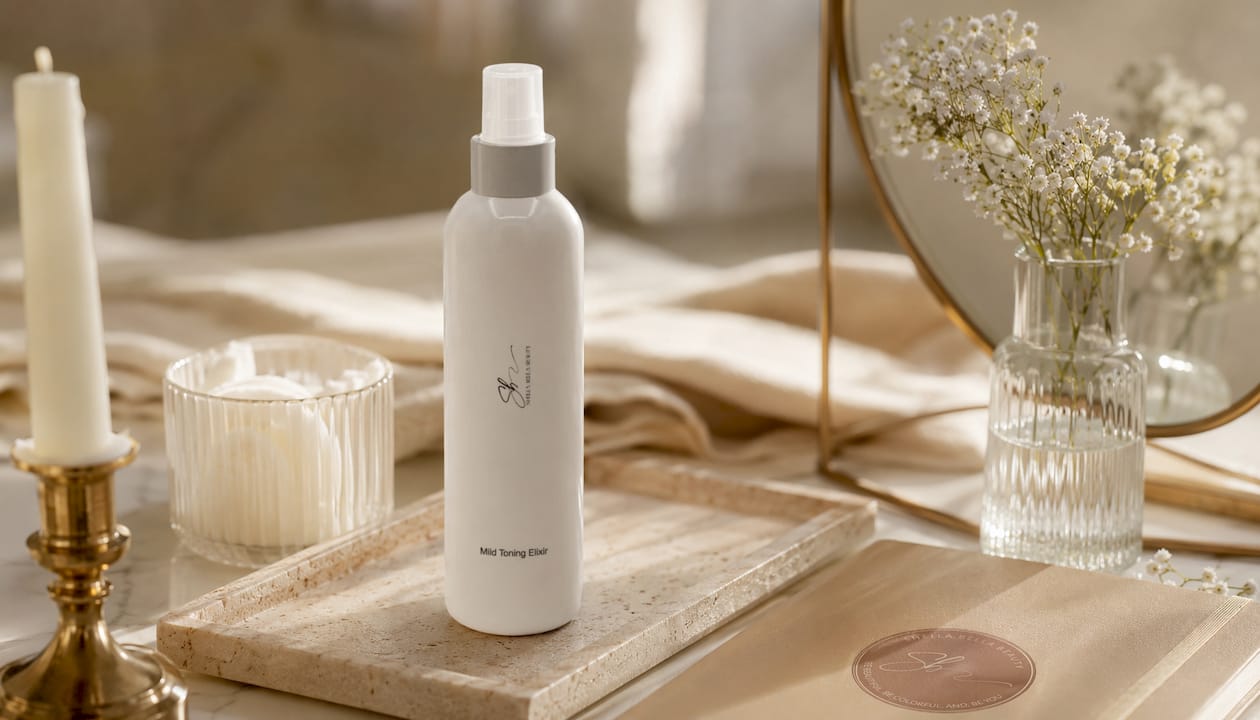
Used as a 7–14 day intensive or as a periodic booster within an existing routine, the Opuliss™ Infusion Toning Elixir fits naturally into the application order covered above: after cleansing and toning, before your moisturizer, on skin that is ready to receive something restorative. It is a considered option for those who want the benefits of an ampoule-style program without navigating the potency risks of high-dose retinoids or acids — particularly useful when your skin needs renewal rather than correction.
Visit the product page to review the full ingredient list and usage directions, and decide whether it belongs in your next intentional skin ritual.
Sources and further reading
The following sources informed this guide and are recommended for deeper reading on ampoule skincare, ingredient science, and safe usage:
-
Everything You Need to Know About Korean Ampoules — Vogue: Supports potency claims, dermatologist guidance, and targeted-use framing.
-
Ampoules Have Changed My Skin — Byrdie: Program-style usage, single-use formats, and common active ingredients.
-
How to Use Serum Ampoules for Skin — L’Oréal Paris: Sealed packaging benefits and split-use storage guidance.
-
What Are Ampoules in Skin Care? — NewBeauty: Marketing variance and the ampoule-vs-serum terminology blur.
-
Korean Ampoule vs. Serum — Koreabe: K-Beauty comparative guidance and serum substitution advice.
-
K-Beauty Trends 2026 — Soneda Skincare: Trend context for ampoule formats in global markets.
-
All About Sonophoresis for Skincare — Soneda Skincare: Topical delivery science relevant to understanding concentrated formats.
-
Ampoule — Wikipedia: Origin and definition of the pharmaceutical ampoule format.
-
When to Use Ampoule in Skincare Routine — Banila Co: Practical routine placement guidance.
-
How to Use Ampoules in Your Skincare Routine — ISDIN: Step-by-step application and safety notes.
FAQ
Can I skip my serum and use an ampoule instead?
Yes, during a short targeted program, an ampoule can replace your serum step. For long-term daily maintenance, a serum formulated for consistent use is the more appropriate choice.
How often should I use a skincare ampoule?
Most ampoule programs run once daily for a limited period, then pause. Using a potent ampoule indefinitely or more than once a day risks barrier irritation, particularly with actives like retinoids or high-dose vitamin C.
Can I mix an ampoule with other active ingredients?
Use caution when layering. Avoid combining an ampoule that contains retinoids or exfoliating acids with other strong actives in the same routine — the cumulative load can overwhelm skin tolerance. Gentler actives like hyaluronic acid or niacinamide layer more safely.
How do I choose an ampoule for sensitive skin?
Look for ampoules centered on calming actives such as centella asiatica, panthenol, or niacinamide, and avoid formulas with high-dose retinoids or acids. Always patch test first, and consider the sensitive skin routine guide from Shellabellabeauty for additional adjustments.
Do ampoules need to be refrigerated?
Most ampoules do not require refrigeration, but they should be stored away from direct light and heat to preserve unstable actives. Single-use vials that have been opened should be used within 24 hours or discarded.
Recommended
-
What Is Slugging Skincare? Benefits and Method Guide – Shella Bella Beauty™
-
What Is Essence Skincare and How to Use It – Shella Bella Beauty™
-
Types of Skincare Active Ingredients: Your 2026 Guide – Shella Bella Beauty™
-
The Role of Antioxidants in Skincare Explained – Shella Bella Beauty™
- Join Glow Chronicles™ — Continue the Glow™ with editor’s picks, seasonal beauty rituals, exclusive skincare insights, and new editions delivered to your inbox.