

Waterless skincare is defined as beauty products formulated entirely without water, replacing the 70–80% water found in conventional products with concentrated oils, butters, waxes, or powders. The industry term for this approach is “anhydrous formulation,” and it represents a meaningful shift in how active ingredients reach your skin. Rather than diluting actives in a water base, anhydrous products deliver them in a purer, more concentrated form. Shellabellabeauty explores this formulation philosophy through its Glow Chronicles, because understanding what goes into your products is the first step toward genuinely caring for your skin.
What is waterless skincare, and how does it differ from traditional products?
Waterless skincare, also called anhydrous formulation, excludes water entirely as a base ingredient. Conventional moisturizers, serums, and cleansers are primarily water-based, with water making up the majority of the formula before any active ingredient is added. That water acts as a carrier, but it also dilutes every beneficial compound in the product.
Anhydrous formulations replace that water with lipid-rich carriers: plant oils like rosehip or marula, butters like shea or mango seed, waxes like candelilla or beeswax, and powdered botanical extracts. Each of these alternatives delivers the formula to your skin while contributing its own nutritional value. The result is a product where nearly every ingredient serves a direct purpose for your skin.
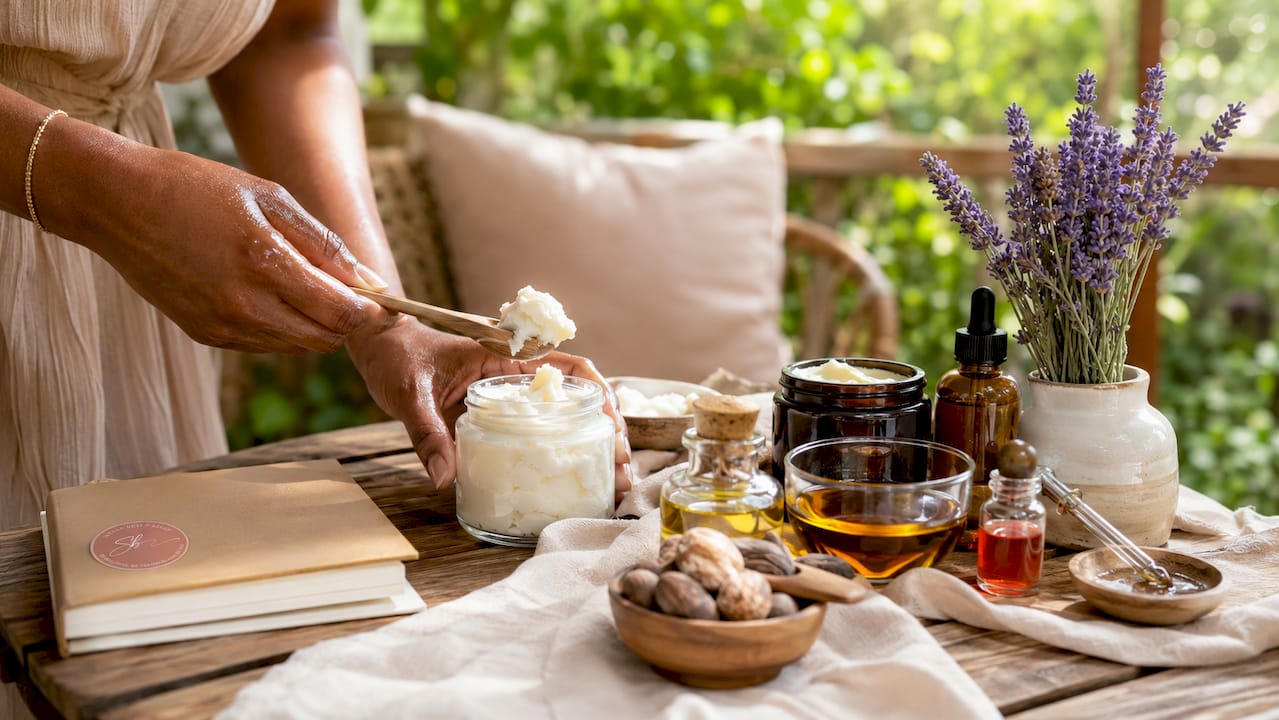
Removing water is both a chemistry decision and a practical one. Without water, there is no environment for bacteria or mold to grow, which means formulators can reduce or eliminate broad-spectrum preservatives. That reduction matters for people with reactive or sensitive skin, since preservatives are among the most common causes of product-related irritation.
What ingredients replace water, and what do they do for your skin?
The ingredients that replace water in anhydrous formulations are not just fillers. They are active contributors to skin health, each with a distinct function.
Common waterless base ingredients include:
- Plant oils such as rosehip, jojoba, squalane, and sea buckthorn, which deliver fatty acids, antioxidants, and vitamins A, C, and E directly to the skin.
- Butters such as shea, cocoa, and mango seed butter, which provide occlusive protection and skin-softening lipids that mimic the skin’s natural barrier fats.
- Waxes such as beeswax and candelilla wax, which create a protective film that seals moisture already present in the skin.
- Powdered botanical extracts such as turmeric, niacinamide powder, or vitamin C in ascorbic acid form, which require water activation at the point of use to release their therapeutic effect.
- Concentrated actives such as retinol dissolved in oil, which remain stable in lipid environments far longer than in water-based formulas.
The lipid-rich nature of these ingredients means they interact directly with the skin’s own barrier fats, called ceramides and fatty acids. This compatibility supports the skin barrier in a way that water-based emulsions often cannot, because emulsions require emulsifiers that can disrupt the barrier over time.
Pro Tip: When choosing a waterless facial oil or balm, look at the first three ingredients listed. If all three are oils or butters, the product is genuinely anhydrous. If you see “aloe vera juice” or “hydrosol” in that top tier, the product still contains water and will require preservation.
What are the main benefits of waterless skincare?
The advantages of waterless beauty products are grounded in formulation science, not marketing language. Three benefits stand out above the rest: potency, stability, and skin barrier support.
Higher concentration of active ingredients
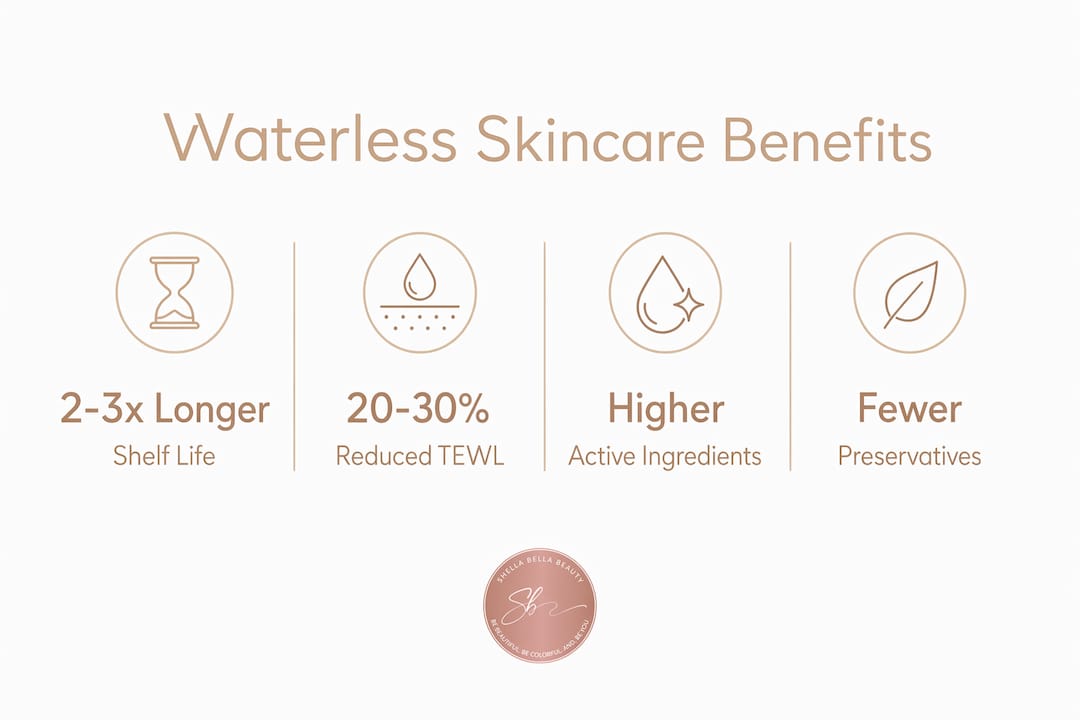
Without water diluting the formula, every milliliter of a waterless product contains a greater proportion of active ingredients. A rosehip oil serum, for example, delivers its vitamin A and linoleic acid content at full strength. A water-based version of the same product might contain 5% rosehip oil suspended in a largely aqueous base.
Extended shelf life and stability
Waterless products last 2–3 times longer than their water-based equivalents. Water triggers hydrolysis, a chemical reaction that breaks down active ingredients over time. It also creates the conditions for microbial growth. Remove water, and both problems are largely eliminated.
Skin barrier support and reduced moisture loss
Anhydrous lipid systems reduce transepidermal water loss (TEWL) by 20–30% by reinforcing the skin’s barrier lipids directly. TEWL is the rate at which water evaporates through your skin. A lower TEWL means your skin retains more of its own moisture. This is particularly valuable for dry, mature, or compromised skin. For a deeper understanding of how this works, Shellabellabeauty’s guide to skin barrier support explains the underlying biology clearly.
Reduced preservatives and gentler formulas
Fewer preservatives mean less risk of irritation, contact dermatitis, and sensitization over time. Formulators use waterless systems specifically to eliminate emulsifiers and broad-spectrum preservatives, which are frequent irritants for people with sensitive or reactive skin.
| Feature | Waterless formulation | Water-based formulation |
|---|---|---|
| Active ingredient concentration | High | Diluted by water base |
| Preservative requirement | Minimal to none | Required |
| Shelf life | Extended (2–3x longer) | Standard |
| TEWL reduction | 20–30% improvement | Variable |
| Texture | Rich, balm, or oil-like | Lightweight, lotion-like |
| Sustainability | Smaller packaging, less water use | Higher water and packaging demand |
Pro Tip: Store your waterless products away from direct sunlight and humidity. The absence of preservatives means they are stable against microbial growth, but some oils can oxidize when exposed to heat and light. A cool, dark cabinet extends their already impressive shelf life.
What are the downsides of water-free skincare products?
A balanced view of anhydrous formulations requires acknowledging their limitations. Not every skin type or concern is best served by a fully waterless approach.
Key considerations include:
- Texture and feel. Waterless products tend to be richer and more occlusive than water-based ones. People with oily or acne-prone skin may find them heavy or pore-clogging, particularly if the formula uses comedogenic oils like coconut oil or cocoa butter.
- Pore compatibility. Waterless oils can clog pores if poorly formulated for oily or acne-prone skin. The solution is to look for non-comedogenic oils like squalane, jojoba, or hemp seed oil in the ingredient list.
- Potency and patch testing. High concentration means higher potency. Products containing retinol, vitamin C, or exfoliating acids in an anhydrous base can cause irritation if introduced too quickly. Patch testing on the inner arm for 24–48 hours before full application is the responsible first step, especially for those with sensitive skin.
- Not all actives work without water. Hyaluronic acid, for example, requires water to function. It draws moisture from the environment into the skin, and without water present, it has nothing to work with. Some actives are simply not suited to anhydrous delivery.
- Misleading labels. True anhydrous means absolutely no water or water-based ingredients like aloe juice or hydrosols. Products containing these still require preservation, even if marketed as “waterless.” Reading the full ingredient list, not just the front label, is the only reliable way to verify a product’s true formulation.
- Cost. Concentrated ingredients cost more to source and process. Genuine anhydrous products are often priced higher than their water-based equivalents, though the extended shelf life partially offsets that investment.
Pro Tip: If you have oily or combination skin and want to try waterless products, start with a lightweight facial oil like squalane rather than a thick balm. Squalane is structurally similar to your skin’s own sebum and absorbs quickly without adding excess oil.
How to build a water-free skincare routine that actually works
Integrating waterless products into your daily ritual does not require abandoning everything water-based. The most effective approach is a hybrid routine that uses both, in the right order.
-
Start with a gentle, water-based cleanser. Cleansing with water removes surface impurities and prepares the skin to receive treatment products. This step does not need to be waterless.
-
Apply water-based serums to damp skin. Hydrating serums containing hyaluronic acid or niacinamide work best when the skin is still slightly damp. Apply them immediately after cleansing, before the skin fully dries. This locks in surface moisture before you seal it.
-
Layer your waterless treatment on top. A facial oil, balm, or anhydrous serum goes on after your water-based layers. The lipid-rich formula acts as a seal, trapping the hydration from the previous step and reinforcing the barrier. This is the principle behind the hybrid routine that skin experts consistently recommend.
-
Activate powder products correctly. If you use a powdered botanical or vitamin C powder, mix it with a few drops of water or your water-based serum in your palm immediately before applying. Powder actives need water activation to release their therapeutic effect. Applying them dry reduces their efficacy significantly.
-
Adjust by skin type. Dry and mature skin benefits from richer waterless balms and butters applied as the final step. Oily skin does better with a single drop of lightweight oil pressed gently into the skin after serums, rather than a full occlusive layer.
For a practical example of how this layering works in a full routine, Shellabellabeauty’s skincare routine for dehydration walks through the sequencing in detail.
Pro Tip: Avoid mixing a waterless oil directly into a water-based moisturizer in your palm. Without an emulsifier, they will not blend, and you will apply an uneven, separated mixture to your skin. Layer them separately, one after the other, for consistent results.
Key Takeaways
Waterless skincare delivers higher concentrations of active ingredients, better barrier support, and longer shelf life than conventional water-based formulas, making it most effective when layered thoughtfully into a hybrid routine.
| Point | Details |
|---|---|
| Core definition | Waterless products replace the 70–80% water in conventional formulas with oils, butters, waxes, or powders. |
| Shelf life advantage | Anhydrous formulas last 2–3 times longer by eliminating hydrolysis and microbial growth. |
| Barrier and moisture retention | Anhydrous lipid systems reduce transepidermal water loss by 20–30%, supporting the skin’s own moisture balance. |
| Label literacy matters | True anhydrous products contain zero water or water-based ingredients; aloe juice and hydrosols still require preservation. |
| Best routine approach | Layer water-based serums on damp skin first, then seal with a waterless oil or balm for optimal hydration and barrier care. |
Why waterless skincare deserves more than a trend label
I have watched the beauty industry cycle through enough “revolutionary” formulation claims to approach most of them with measured skepticism. Waterless skincare is different, and not because the marketing is louder. It is different because the chemistry is genuinely sound.
The argument for anhydrous formulations is not complicated. When you remove water from a product, you remove the primary reason that product needs preservatives, emulsifiers, and stabilizers. Those supporting ingredients are not inherently harmful, but they are also not doing anything for your skin. They exist to keep the formula stable. A waterless product sidesteps that entire category of ingredients and puts more of the formula’s weight behind actives that actually work.
What I find most interesting is how this formulation approach aligns with ingredient literacy, which is the single most undervalued skill in skincare. Readers who understand what “anhydrous” means on a label are far less likely to be misled by a product claiming to be waterless while listing aloe vera juice as its second ingredient. That kind of knowledge protects you from paying a premium for a product that is functionally no different from a standard lotion.
My honest advice: do not go fully waterless unless your skin genuinely calls for it. Dry, mature, or barrier-compromised skin responds beautifully to anhydrous formulations. Oily or acne-prone skin needs more care in product selection. The hybrid approach, water-based hydration sealed with a thoughtful waterless layer, serves the widest range of skin types and is where I would encourage most people to begin. Choosing the right facial oil for your skin type is a good starting point for that second step.
— Marshella
Shellabellabeauty’s approach to concentrated skincare
Shellabellabeauty’s renewal and smoothing skincare rituals collection reflects the principles behind anhydrous formulation: concentrated actives, skin-nourishing ingredients, and textures designed to honor your skin rather than overwhelm it. Each product in the collection is built around the idea that your skin’s radiance is already present. The right formula simply helps restore the conditions for it to show.
If you are ready to bring more intention to your skincare ritual, the renewal collection offers a thoughtful place to begin. The formulations prioritize barrier support, ingredient potency, and the kind of sensory refinement that makes a routine feel like genuine self-care rather than a chore.
FAQ
What does “waterless” mean in skincare?
Waterless skincare means the product contains no water as a base ingredient, using oils, butters, waxes, or powders instead. The industry term is “anhydrous formulation.”
Is waterless skincare effective for all skin types?
Waterless products work best for dry, mature, or barrier-compromised skin. Oily or acne-prone skin requires careful selection of non-comedogenic oils like squalane or jojoba to avoid pore congestion.
Do waterless products need preservatives?
Genuinely anhydrous products require no preservatives because bacteria and mold cannot grow without water. Products containing aloe juice, hydrosols, or other water-based ingredients still require preservation, regardless of their label claims.
How long do waterless skincare products last?
Waterless formulas last 2–3 times longer than water-based products because the absence of water prevents hydrolysis and microbial growth. Storing them away from heat and light preserves their stability further.
Can I use waterless products with my existing water-based routine?
Yes. A hybrid routine, applying water-based serums to damp skin first and sealing with a waterless oil or balm, delivers the benefits of both approaches and is the method most skin experts recommend.