

Yes, fragrance irritates skin, and it does so through two distinct pathways: allergic contact dermatitis and irritant contact dermatitis, according to the Cleveland Clinic. If your skin is reacting right now, the most caring thing you can do is stop using the suspect product immediately, rinse the area gently with cool water, and apply a plain, fragrance-free emollient to restore the skin’s moisture barrier. If symptoms spread, blister, or persist beyond a few days, a dermatologist visit is the right next step.
Before reaching for a replacement product, consider these immediate priorities:
- Stop all use of the product you suspect is causing the reaction.
- Rinse the affected area with cool, gentle water — no scrubbing.
- Apply a bland, fragrance-free emollient (plain petroleum jelly or a ceramide-based cream works well).
- Avoid applying any new scented products to the area while it heals.
- Patch-test any replacement product on a small area of skin before full use.
- Consult a board-certified dermatologist if the reaction is severe, spreading, or does not resolve within a week.
The U.S. Food and Drug Administration (FDA) notes that fragrances are complex chemical mixtures, and cosmetics containing them are not subject to premarket approval in the United States, which means the burden of identifying a problematic ingredient often falls on the consumer. The American Contact Dermatitis Society (ACDS) recognizes fragrance as one of the most common causes of allergic contact dermatitis in the U.S. population.
Table of Contents
- How allergic and irritant contact dermatitis differ from each other
- What fragrance-related skin reactions look and feel like
- Why fragrance ingredients irritate skin: the chemistry behind the reaction
- How clinicians diagnose fragrance reactions: patch testing and clinical assessment
- How to avoid fragrance irritation and choose safer products
- When to see a dermatologist or seek urgent care
- A practical routine for recovering skin and preventing re-sensitization
- Key Takeaways
- Why this guide reflects what Shellabellabeauty believes about skin
- Fragrance-free skincare, thoughtfully chosen
- FAQ
How allergic and irritant contact dermatitis differ from each other
Not every fragrance reaction is an allergy, and that distinction shapes everything from how you treat the reaction to whether it will recur for life.
Irritant contact dermatitis is a non-immune response. Fragrance chemicals damage the outer skin barrier directly, depleting moisture and triggering inflammation. The reaction tends to appear within minutes to hours of exposure and is dose-dependent: the more concentrated the product, the more frequent the use, the worse the response. People with eczema or psoriasis are particularly vulnerable because their barrier function is already compromised.
Allergic contact dermatitis is immune-mediated. On first exposure, the immune system becomes sensitized to a fragrance molecule without producing visible symptoms. On subsequent exposures, a delayed hypersensitivity reaction unfolds, typically appearing 12–72 hours after contact. Once sensitized, the reaction is lifelong — even trace amounts of the allergen can trigger a flare.
| Feature | Irritant contact dermatitis | Allergic contact dermatitis |
|---|---|---|
| Mechanism | Barrier damage, no immune involvement | Delayed immune (T-cell) response |
| Onset after exposure | Minutes to hours | 12–72 hours |
| Dose dependency | Yes — higher dose, worse reaction | No — trace amounts can trigger |
| Lifelong sensitization | No | Yes |
| Who is most at risk | Anyone with frequent or heavy use | Anyone previously sensitized |
“The location and pattern of a rash are often the first clues a dermatologist uses to connect a reaction to a specific product. A rash that mirrors where a perfume is applied — the neck, wrists, or underarms — strongly suggests fragrance as the source, even before patch testing confirms it.” — Clinical guidance aligned with DermNet NZ
Understanding which type of reaction you are experiencing matters because irritant reactions often resolve once exposure stops, while allergic reactions require permanent avoidance of the specific allergen.
What fragrance-related skin reactions look and feel like
Recognizing the signs early allows you to respond with care rather than confusion. Fragrance reactions can range from mild and transient to persistent and deeply uncomfortable, and they often appear in predictable locations.
Common signs to watch for:
- Redness and warmth at the site of contact
- Itching, which may be intense and precede visible changes
- Stinging or burning, particularly with irritant reactions
- Dry, flaking, or scaling skin as the barrier breaks down
- Small fluid-filled blisters (vesicles) in allergic reactions
- Swelling, especially around the eyes or lips if a facial product is involved
- Chronic thickening of the skin (lichenification) with repeated, prolonged exposure
Where reactions typically appear:
The face, neck, hands, and underarms are the most common sites, reflecting where fragranced products are most often applied. Fragrance allergens frequently affect the hands, face, and underarms, according to the California Department of Public Health. Transfer pathways matter too: fragrance applied to the hands can migrate to the face when you touch it, producing a secondary reaction in an area you never directly treated.
Timeline for improvement:
Irritant reactions often begin to calm within 24–48 hours of stopping exposure, provided the barrier is supported with a gentle emollient. Allergic reactions take longer, sometimes 2–3 weeks to fully resolve, and may flare again with any re-exposure to the allergen.
Why fragrance ingredients irritate skin: the chemistry behind the reaction
Fragrance is rarely a single chemical. A finished perfume or scented lotion may contain dozens of individual molecules, and several of them are well-documented sensitizers.
| Fragrance chemical | Common sources | Reaction type |
|---|---|---|
| Linalool (oxidized) | Perfumes, lotions, shampoos | Allergic (prohapten) |
| Limonene (oxidized) | Citrus-scented products, cleaning sprays | Allergic (prohapten) |
| Citral | Lemon and verbena fragrances, deodorants | Allergic |
| Geraniol | Rose-scented products, body lotions | Allergic |
| Cinnamal | Cinnamon-scented products, perfumes | Allergic |
| Isoeugenol | Clove and carnation fragrances, perfumes | Allergic |
These chemicals function as haptens: small molecules that bind to skin proteins, creating a new compound the immune system learns to recognize as foreign. Some, like linalool and limonene, are technically prohaptens — they are not sensitizing in their pure form but become so after air oxidation produces reactive hydroperoxides. This is why a product that seemed fine when new can begin causing reactions as it ages.
The EU’s updated cosmetic regulation EU 2023/1545 now treats prohaptens and prehaptens as equivalent to direct allergens for labeling and restriction purposes, a standard the U.S. has not yet adopted under current FDA cosmetic rules.
Pro Tip: Check the manufacture date on your fragranced products. Terpene-based fragrance chemicals like linalool and limonene oxidize faster in warm, light-exposed storage. A half-used bottle kept in a sunny bathroom for a year may be significantly more sensitizing than when it was first opened.
How clinicians diagnose fragrance reactions: patch testing and clinical assessment
Patch testing is the only definitive way to distinguish true fragrance allergy from skin irritation, and it requires a dermatologist’s interpretation to be meaningful.
What to expect at a patch testing appointment:
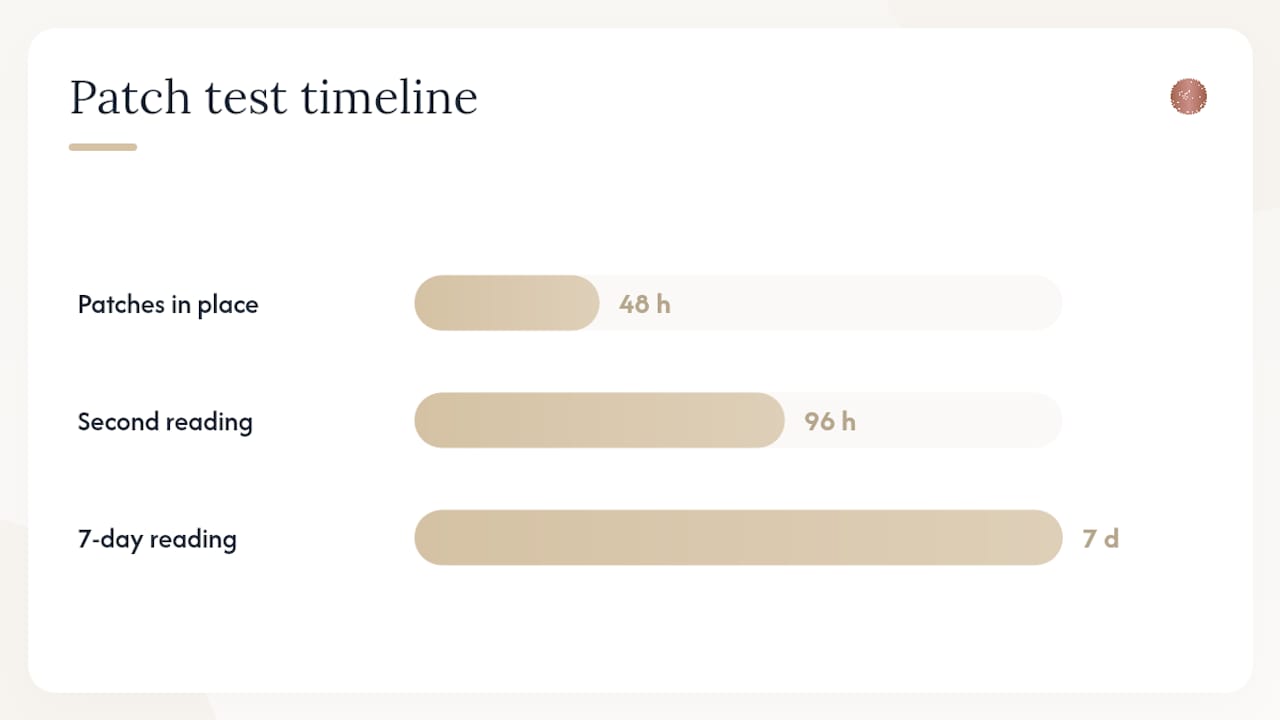
- Your dermatologist applies a standardized panel of fragrance allergens (including fragrance mix I, fragrance mix II, and individual chemicals like cinnamal and isoeugenol) to your upper back using adhesive chambers.
- The patches remain in place for 48 hours — you must keep the area dry during this time.
- At 48 hours, the patches are removed and an initial reading is taken.
- A second reading occurs at 96 hours (and sometimes at 7 days) to capture delayed reactions that appear after removal.
- Your dermatologist evaluates each positive reaction for clinical relevance: does this allergen match the products you actually use and the location of your rash?
Patch test positivity must always be interpreted against the patient’s exposure history. A weak positive reaction may represent an irritant response to the test material itself rather than a true allergy. This is why bringing a list of every product you use, including ingredient lists, to your appointment matters.
Selecting the right panel is genuinely challenging. Fragrance contact allergy is complex, and emerging fragrance markers are used to improve detection beyond the traditional fragrance mix, because the traditional mix does not capture all clinically relevant allergens.
What to bring to your appointment: product ingredient lists, photos of the rash at its worst, and a timeline of when reactions occur relative to product use.
How to avoid fragrance irritation and choose safer products
Prevention is where the most lasting protection lives, and it begins with how you read a label.
- Choose “fragrance-free” over “unscented.” Unscented products can still contain masking fragrances that neutralize odor without adding scent, and those masking agents can still irritate sensitive skin. Fragrance-free means no fragrance ingredients were added at all.
- Scan ingredient lists for “parfum” or “fragrance.” In the U.S., these umbrella terms can legally cover dozens of individual chemicals without disclosure, per FDA cosmetic labeling rules. If either term appears in the first five ingredients, the fragrance load is high.
Pro Tip: When transitioning away from fragranced products, change one product at a time rather than switching your entire routine at once. This way, if a reaction occurs, you can identify the source with confidence rather than guessing among several new additions.
When to see a dermatologist or seek urgent care
Self-care is appropriate for mild, localized reactions that are clearly linked to a single product. These situations call for professional attention:
- The rash spreads beyond the original contact area or appears on skin that was never exposed.
- Blistering is widespread or the blisters are large and fluid-filled.
- Swelling involves the face, especially around the eyes or lips.
- You experience difficulty breathing, throat tightness, or dizziness — these are signs of a systemic reaction and require emergency care immediately.
- The rash shows signs of infection: increasing pain, warmth, pus, or fever.
- Symptoms persist beyond 2–3 weeks despite stopping exposure and using appropriate home care.
- You need confirmation of which specific ingredient is responsible, so you can avoid it in all future products.
A board-certified dermatologist or allergist can perform formal patch testing, prescribe appropriate treatment, and provide a written list of allergens to avoid — a document that becomes genuinely useful every time you shop for skincare.
A practical routine for recovering skin and preventing re-sensitization
Rebuilding your skin’s balance after a fragrance reaction calls for patience and a deliberate, step-by-step approach. This sequence reflects guidance aligned with Shellabellabeauty’s philosophy of gentle, intentional care.
Step one: Eliminate all fragrance exposure. Go through every product in your current routine — cleanser, moisturizer, sunscreen, makeup, deodorant, hair products — and replace any that list “fragrance,” “parfum,” or botanical extracts known to contain fragrance chemicals.
Step two: Perform a home patch test on each new product. Before introducing any replacement, apply a small amount to the inner forearm and observe for 48–72 hours. Shellabellabeauty’s guide to patch testing skincare walks through this process with care and clarity.
Step three: Build a minimal, barrier-focused routine.
- Cleanser: A fragrance-free, low-pH gel or cream cleanser that does not strip the skin. Look for sensitive-skin cleanser ingredients like glycerin and panthenol.
- Moisturizer: A ceramide-rich, fragrance-free cream applied while skin is still slightly damp to lock in hydration. Niacinamide at 2–5% supports barrier repair without irritation.
- Targeted repair: A plain occlusive layer (petroleum jelly or a squalane-based balm) over the most affected areas at night.
Step four: Reintroduce products one at a time. Wait at least one week between adding each new product so you can identify any new trigger clearly.
Step five: Avoid these ingredients during recovery.
- Fragrance and parfum (all forms)
- Essential oils, including lavender, eucalyptus, and citrus
- Alcohol denat. in high concentrations
- Exfoliating acids on broken or actively inflamed skin
For a fuller guide to caring for sensitive skin texture during recovery, including ingredient pairings that support rather than stress a healing barrier, Shellabellabeauty’s Glow Chronicles offers thoughtful, evidence-aligned guidance.
Key Takeaways
Fragrance irritates skin through two distinct mechanisms, and knowing which one you are dealing with determines both your treatment and your long-term prevention strategy.
| Point | Details |
|---|---|
| Two reaction types | Irritant contact dermatitis damages the barrier directly; allergic contact dermatitis is immune-mediated and lifelong once sensitized. |
| Act immediately | Stop the suspect product, rinse gently, and apply a fragrance-free emollient as first-line care. |
| Patch testing is definitive | Only a dermatologist-administered patch test can confirm true fragrance allergy; clinical relevance must match your exposure history. |
| Choose fragrance-free, not unscented | “Unscented” products may still contain masking fragrances; “fragrance-free” means no fragrance ingredients were added. |
| Shellabellabeauty | Offers fragrance-free skincare options and educational resources, including a step-by-step patch-testing guide, to support sensitive skin recovery. |
Why this guide reflects what Shellabellabeauty believes about skin
The conversation around fragrance sensitivity tends to get oversimplified in two directions: either dismissed as “just sensitivity” or treated as a rare, dramatic allergy. Neither framing serves the person standing in front of a mirror wondering why their skin keeps reacting.
What the evidence actually shows is more nuanced and, in some ways, more empowering. Fragrance reactions exist on a spectrum. Some are irritant responses that resolve quickly with the right care. Others are true allergic sensitizations that, once established, require permanent, informed avoidance. The distinction matters not because one is more “real” than the other, but because the path forward is different for each.
The part that most guides underemphasize is the role of product age and oxidation. Linalool and limonene, two of the most ubiquitous fragrance terpenes in personal care products, become significantly more sensitizing as they oxidize. A product that caused no reaction when new can become a genuine allergen after months of exposure to air and warmth. This means that a “safe” product from last year may not be safe today, and that storage conditions are a legitimate part of fragrance risk management.
Shellabellabeauty publishes this kind of guidance because radiance, in the truest sense, is not something applied from the outside. It is what returns when the skin is given the conditions it needs to restore itself: the right ingredients, the right information, and the patience to let healing happen at its own pace.
Fragrance-free skincare, thoughtfully chosen
Sensitive skin deserves more than a label that says “gentle.” At Shellabellabeauty, the fragrance-free skincare options are formulated with the same care that goes into every product in the collection: ceramide-rich moisturizers, barrier-supporting cleansers, and targeted repair treatments that work without the chemical load your skin is trying to recover from.

If you are rebuilding your routine after a fragrance reaction, the clearest starting point is a routine built around one principle: fewer, better ingredients. Browse the Shellabellabeauty collection to find fragrance-free formulations suited to sensitive and reactive skin, and pair your shopping with the brand’s patch-testing guide so every new product earns its place in your routine before it stays.
FAQ
Why is my skin suddenly sensitive to fragrance?
Fragrance sensitivity can develop at any point in life because sensitization is cumulative. Repeated exposure to fragrance chemicals, particularly oxidized terpenes like linalool and limonene, can eventually trigger an immune response even in skin that tolerated the same products for years.
Why does perfume irritate my skin but not everyone else’s?
Individual skin barrier integrity, frequency of product use, and prior sensitization all affect how your skin responds to fragrance. People with eczema, psoriasis, or a history of contact dermatitis carry a higher baseline risk because their barrier allows deeper allergen penetration.
What is the best antihistamine for a fragrance allergy?
Oral antihistamines like cetirizine (Zyrtec) or loratadine (Claritin) can reduce itching associated with allergic contact dermatitis, but they do not treat the underlying reaction. The most effective management is permanent avoidance of the specific allergen, confirmed through patch testing.
How do I know if I am allergic to fragrance?
A rash that appears 12–72 hours after using a fragranced product, in the area where the product was applied, is a strong clinical indicator. Formal patch testing performed by a dermatologist is the only definitive way to confirm a true fragrance allergy and identify the specific chemical responsible.
Recommended
- Patch Test Skincare: Why It’s Your First Step to Radiance – Shella Bella Beauty™
- Sensitive Skin Cleanser Ingredients to Know – Shella Bella Beauty™
- Makeup for Sensitive Skin: Formulas That Feel as Good as They Look – Shella Bella Beauty™
- Join Glow Chronicles™ — Continue the Glow™ with editor’s picks, seasonal beauty rituals, exclusive skincare insights, and new editions delivered to your inbox.