

Why patch testing skincare products is a non-negotiable first step
Patch testing is the practice of applying a small amount of a new skincare product to a limited area of skin before using it fully, giving your skin the opportunity to reveal any sensitivity before a reaction spreads. Think of it as a quiet conversation between you and your skin, one that can spare you days of redness, swelling, or discomfort. Dermatologists consistently recommend this step for every new product, not only for those with known sensitivities.
The core reason to patch test skincare is prevention. Skincare products can trigger both allergic contact dermatitis, an immune-mediated reaction, and irritant contact dermatitis, caused by direct damage to the skin barrier. Both conditions are avoidable with a simple, intentional test before full application.
Key benefits of patch testing before committing to a new product:
- Identifies potential allergens before they affect your entire face or body
- Detects irritant reactions from active ingredients like retinol or glycolic acid
- Builds confidence in a new product’s compatibility with your unique skin chemistry
- Protects the skin barrier from unnecessary inflammation and damage
- Reduces the risk of worsening existing conditions like eczema or rosacea
How to perform a skincare patch test properly at home
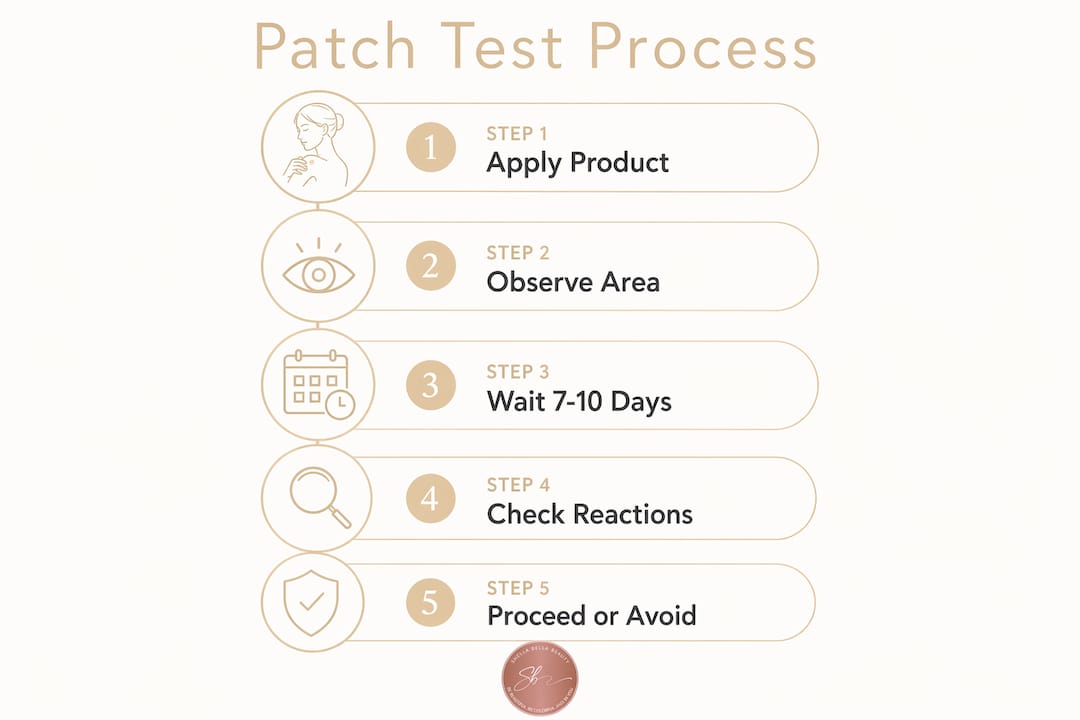
The American Academy of Dermatology recommends a clear, consistent method for at-home patch testing that anyone can follow with patience and care.
-
Choose your test site. Select a quarter-sized area of clean, dry skin, such as the inner forearm or the bend of your elbow. For facial products, the area behind the ear or along the neck is preferable, since facial skin absorbs differently than forearm skin and reflects sensitivity more accurately.
-
Apply the product as you normally would. Use the same amount and thickness you would apply in your regular routine. Avoid the temptation to use less, as a thin layer may not trigger a detectable response.
-
Maintain the application twice daily for 7–10 days to allow delayed reactions to develop. Consistency across this window is what allows delayed reactions to surface. A single application rarely tells the full story.
-
Leave wash-off products on longer than usual. For cleansers or masks, keep the product on for five minutes, or as long as the instructions specify, before rinsing. This mimics real-world contact time.
-
For active ingredients, maintain full contact duration. Products containing retinols or acids should remain on the skin for their full recommended time before removal. Rinsing too early can produce a false sense of safety.
-
Observe the area carefully each day. Note any changes in texture, color, or sensation, even subtle ones. Do not scrub or aggressively wash the test area during the testing period.
-
If no reaction appears after 7–10 days, the product is likely safe to incorporate into your full routine with measured confidence.
Pro Tip: Do not assess the test site after just two or three days and assume you are in the clear. Delayed hypersensitivity reactions from allergic contact dermatitis can take 48–96 hours or longer to appear, and some reactions only emerge with repeated exposure over the full testing window.
Common allergens and irritants found in skincare products
Knowing what to look for on an ingredient label is as protective as the patch test itself. Several ingredient categories account for the majority of skin reactions in personal care products.
- Fragrances: The leading cause of allergic contact dermatitis in skincare, fragrances appear in both scented and supposedly unscented formulas as masking agents.
- Preservatives: Formaldehyde-releasing preservatives, parabens, and methylisothiazolinone are frequent triggers, particularly in leave-on products.
- Dyes and colorants: Synthetic dyes used for aesthetic appeal can sensitize skin over time, especially with repeated use.
- Metals: Nickel, cobalt, and gold appear in some cosmetic pigments and can provoke contact reactions in susceptible individuals.
- Natural extracts and essential oils: Despite their wholesome reputation, plant-derived ingredients like balsam of Peru, tea tree oil, and lavender are well-documented allergens. Natural does not mean safe for every skin type.
- Propylene glycol: A common humectant that can irritate sensitive skin, particularly at higher concentrations.
The “hypoallergenic” label carries no regulatory definition in the United States, so it offers no guarantee of safety. Products marketed as fragrance-free may still contain masking scents or preservatives capable of triggering a reaction, making ingredient review and patch testing equally necessary steps.
How contact dermatitis develops from skincare products

Understanding the two main forms of contact dermatitis helps clarify what your skin is actually responding to during a patch test.

Irritant contact dermatitis (ICD) occurs when a substance directly damages the skin barrier without involving the immune system. It tends to appear quickly, often within hours of exposure, and feels like burning, stinging, or rawness. Strong acids, high-concentration retinoids, and harsh surfactants are common culprits.
Allergic contact dermatitis (ACD) involves an immune system response. The first exposure sensitizes the immune system without visible symptoms, but subsequent contact triggers a reaction that may include redness, itching, swelling, and blistering. This delayed mechanism is why ACD reactions typically appear 48–96 hours after contact, not immediately.
Key distinctions between the two:
- ICD can affect anyone; ACD develops only in individuals who have become sensitized to a specific allergen
- ICD is dose-dependent; ACD can be triggered by even trace amounts of the allergen
- Patch testing is most informative for identifying ACD; ICD is often identified through elimination
Symptoms to watch for during and after patch testing
Your skin communicates clearly when something is not right. Recognizing these signals promptly protects you from prolonged exposure to an incompatible ingredient.
- Redness or flushing at the test site, ranging from mild pink to deep red
- Itching or burning, which may feel disproportionate to the size of the area affected
- Swelling or puffiness around the application zone
- Rash or hives, sometimes spreading slightly beyond the test area
- Blisters or vesicles, which indicate a more significant immune response
- Stinging or tightness that persists after the product has been absorbed
Immediate reactions, appearing within minutes to a few hours, usually suggest irritation rather than allergy. Reactions that surface after 48–96 hours point more strongly toward delayed allergic hypersensitivity. If you notice any of these symptoms, wash the product off gently and apply a cool compress or a thin layer of petroleum jelly to calm the area.
When to see a doctor about a skincare reaction
At-home patch testing is a preventive tool, not a diagnostic one. Specific allergens cannot be identified without professional testing, and certain reactions require medical attention without delay.
Seek care from a dermatologist or allergist when you notice:
- Severe swelling, particularly around the eyes or lips
- Widespread blistering or open sores
- A rash that spreads beyond the test site or persists for more than a few days
- Systemic symptoms such as difficulty breathing, dizziness, or throat tightness
- Reactions that do not improve after removing the product and applying basic soothing measures
Professional patch testing, conducted in a clinical setting, applies a standardized panel of known allergens to the back under controlled conditions, with readings taken at 48 and 96 hours. This process can identify the precise ingredient responsible for a reaction, which at-home testing cannot do. Before a clinical appointment, your dermatologist may advise you to pause certain medications, including antihistamines and corticosteroids, as these can suppress reactions and affect results. For professional skin treatments that involve active ingredients or chemical procedures, consulting a specialist before proceeding is a wise and caring step.
Expert insights on patch testing and skincare allergy prevention
Dermatologists frame patch testing not as a precaution reserved for reactive skin, but as a fundamental wellness ritual for every person who uses skincare products.
Several nuances that practitioners emphasize:
- A product that caused no reaction on first use can still trigger ACD after repeated exposure, because sensitization builds over time
- Premature assessment, checking the test site after only two or three days, is one of the most common mistakes and leads to false confidence
- Washing off active ingredient products too early during testing can produce a false negative, masking a reaction that would otherwise appear
- Patch testing is particularly valuable before introducing potent actives like retinoids, alpha hydroxy acids, or vitamin C derivatives into a sensitive skin routine
How patch testing differs from other allergy tests
Patch testing is distinct from the allergy tests most people associate with a doctor’s visit. A skin prick test, used for environmental or food allergies, introduces a small amount of allergen just beneath the skin’s surface and reads results within 15–20 minutes. It tests for IgE-mediated, or immediate-type, allergic responses.
Patch testing, by contrast, is designed specifically to detect delayed hypersensitivity reactions, the kind driven by T-cells rather than antibodies. These reactions take 48–96 hours to develop, which is why the test window spans several days rather than minutes. Blood allergy tests, such as specific IgE panels, also measure immediate-type responses and are not useful for diagnosing contact dermatitis. For skincare-related reactions, patch testing is the only method that accurately captures how your skin responds to topical ingredients over time.
Patch testing new products versus known irritants
The approach to patch testing shifts depending on whether you are introducing something entirely new or navigating a product category that has caused problems before.
With a new product, apply it to a neutral test site, such as the inner forearm, and observe for the full 7–10 day window before incorporating it into your routine. This is especially wise when building a skincare routine with multiple new additions at once. Introduce one product at a time so that any reaction can be traced clearly.
With a known irritant or a product category that has previously caused sensitivity, test on a more reactive site, such as behind the ear or along the jawline, to get a more accurate read. Use a slightly longer observation period and watch for subtler early signals like mild tightening or faint redness. If you have reacted to a specific ingredient class before, scan the new product’s label for that ingredient and its chemical relatives before testing begins. For those considering skin renewal treatments with active formulations, patch testing is a necessary first step, not an optional one.
Key Takeaways
Patch testing is the most reliable way to protect your skin from allergic and irritant reactions before committing to a new product.
| Point | Details |
|---|---|
| Test duration matters | Apply the product twice daily for 7–10 days to detect delayed reactions accurately. |
| Choose the right test site | Use the inner forearm for most products; test facial formulas behind the ear or on the neck. |
| Fragrances and preservatives lead reactions | These ingredients are the most common triggers, even in “fragrance-free” or “natural” products. |
| At-home testing has limits | Specific allergens can only be identified through professional clinical patch testing. |
| Seek care for severe reactions | Swelling, blistering, or systemic symptoms require prompt medical evaluation. |
Patch testing as an act of devotion to your skin
Patch testing is not a bureaucratic step before the pleasure of a new serum. It is an act of genuine respect for your skin’s individuality. Every person’s skin carries its own chemistry, its own history of exposures, and its own thresholds. What glows on one person’s skin may quietly inflame another’s, and no label, however reassuring, can predict that for you.
What I find most overlooked in conversations about skincare safety is how patch testing builds trust, not just in a product, but in yourself. When you take the time to observe your skin’s response with patience and attention, you develop a more refined understanding of what your skin actually needs versus what marketing suggests it should want. That discernment is worth more than any single ingredient.
The testing window is not an inconvenience. It allows enough time for your immune system to reveal a delayed response, and honoring this duration is the difference between a skincare ritual that restores radiance and one that quietly disrupts it.
FAQ
Should you patch test every new skincare product?
Yes. Dermatologists recommend patch testing any new skincare product, including moisturizers, serums, and cleansers, before full use, since even gentle formulas can trigger reactions in some individuals.
Is skin patch testing worth it?
Patch testing is worth the time because it prevents allergic contact dermatitis and irritant reactions before they affect a larger area of skin. A 7–10-day test is far less disruptive than managing a widespread reaction.
How long does a patch test take to show results?
Reactions from allergic contact dermatitis typically appear within a few days, which is why the full testing window is necessary to catch delayed responses accurately.
Can you patch test if you have sensitive skin?
Patch testing is especially recommended for sensitive skin. Apply the product to a small area behind the ear or on the neck, which reflects facial skin sensitivity more closely than the forearm.
What should you do if a patch test causes a reaction?
Wash the product off gently, apply a cool compress or petroleum jelly to soothe the area, and avoid using the product again. If the reaction is severe or does not resolve, consult a dermatologist promptly.