

Sleep is defined as the body’s primary biological window for skin repair, and no topical product can fully replicate what happens to your skin during those hours of rest. The role of sleep in skin health spans collagen synthesis, barrier restoration, hormonal regulation, and antioxidant defense. Clinical research confirms that sleeping less than 6 hours per night raises inflammatory markers like IL-6 and TNF-α, accelerating visible skin aging. Growth hormone, melatonin, and cortisol each follow precise nighttime cycles that either protect or degrade your skin depending on how well you sleep. Understanding these mechanisms changes how you think about your entire skincare practice.
How does sleep influence skin regeneration and repair?
Skin repair during sleep is not passive. The body enters a state of active biological renewal, orchestrated by hormones and circadian signals that begin within the first hour of falling asleep.
The most significant repair occurs during deep, slow-wave sleep. Growth hormone secretion peaks during this phase, stimulating collagen and elastin production while cortisol drops to its lowest point. Lower cortisol means less collagen degradation and reduced inflammation. This hormonal balance is the biological foundation of what dermatologists call “beauty sleep.” You can read more about collagen’s role in radiance to understand why this nightly production matters so deeply.

Circadian rhythm governs skin cell activity with remarkable precision. Skin cells divide and renew at a higher rate between 11:00 PM and 4:00 AM, aligning with the body’s natural repair window. Disrupting this cycle, even occasionally, shifts cell turnover timing and reduces the quality of renewal.
The skin barrier also rebuilds its lipid matrix during the early hours of the night. This process reduces transepidermal water loss and restores the protective layer that shields skin from environmental stress. A well-functioning skin barrier is the difference between skin that holds moisture and skin that feels perpetually tight and reactive.
Key biological events during quality sleep include:
- Growth hormone release stimulates collagen synthesis and cell regeneration in the dermis
- Cortisol reduction prevents collagen breakdown and lowers systemic inflammation
- Melatonin production neutralizes free radicals accumulated from UV and pollution exposure during the day
- Lipid matrix restoration in the skin barrier reduces overnight moisture loss
- Accelerated cell turnover between 11:00 PM and 4:00 AM renews the skin’s surface layer
Pro Tip: Go to sleep before midnight consistently. Doing so aligns your rest with the peak window for growth hormone release and skin cell division, giving your skin the full benefit of its natural repair cycle.
What are the consequences of sleep deprivation on skin?
Sleep deprivation does not simply leave you looking tired. It triggers a cascade of biological changes that age your skin from the inside out, and some of that damage is not easily undone.
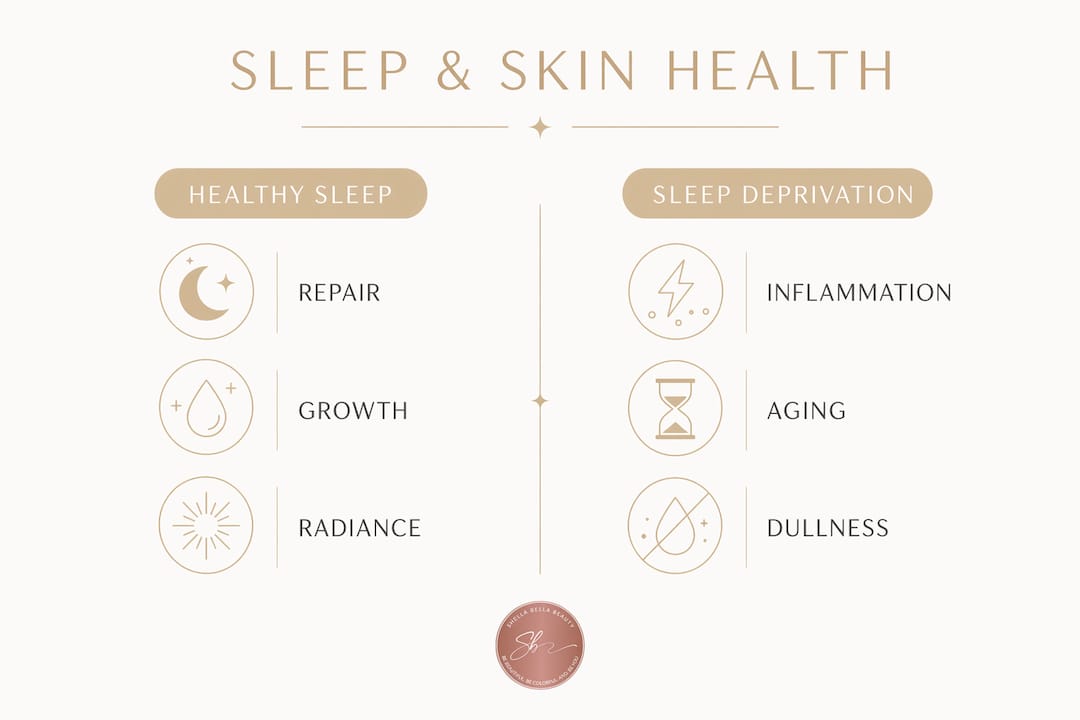
Poor sleep acts as an accelerant for inflammaging, the process by which chronic low-grade inflammation drives accelerated aging. Elevated cortisol degrades existing collagen fibers and increases sebum production, which raises the likelihood of breakouts. Inflammatory cytokines worsen conditions like eczema, rosacea, and psoriasis, making flares more frequent and more severe in people who consistently sleep fewer than 6 hours.
The visible consequences appear quickly. Impaired lymphatic drainage and dilated blood vessels cause puffiness and dark circles after even one poor night. Skin tone becomes uneven, and the complexion loses its natural luminosity. These are not cosmetic inconveniences. They are signals of systemic stress.
The most sobering finding concerns permanence. One night of acute sleep deprivation causes hydration and pigmentation changes that may not fully normalize after 14 days. That single data point reframes how you think about the occasional late night. The damage accumulates faster than it resolves.
The four primary consequences of chronic sleep loss on skin, in order of severity:
- Collagen degradation from sustained cortisol elevation, leading to fine lines and loss of firmness
- Barrier impairment with increased transepidermal water loss, resulting in dryness and sensitivity
- Inflammatory flares of existing skin conditions driven by elevated IL-6 and TNF-α
- Pigmentation irregularity and persistent dullness from impaired cellular renewal
Sleep deprivation damage is cumulative, and topical treatments cannot fully reverse the structural skin aging caused by chronic sleep loss. That is the uncomfortable truth that no serum label will tell you.
What role does melatonin play in skin health during sleep?
Melatonin is far more than a sleep signal. Within the skin, it functions as a potent antioxidant, an anti-inflammatory agent, and a regulator of the skin’s own circadian clock.
The skin produces melatonin locally, independent of the pineal gland. Melatonin’s cutaneous system protects skin from UV radiation and environmental pollution, supports barrier repair, and synchronizes the timing of skin cell activity. This local production means the skin has its own defense network that activates at night, regardless of whether melatonin supplements are taken.
Melatonin also modulates the skin microbiome and reduces the inflammatory signaling that worsens conditions like atopic dermatitis. Its antioxidant capacity neutralizes reactive oxygen species accumulated during the day from sun, pollution, and stress. Without adequate sleep, melatonin production is suppressed, and that neutralization does not happen fully.
Preliminary clinical data on topical melatonin shows promise for improving hydration and elasticity, particularly in skin affected by photoaging. While topical application is still an emerging area, the underlying science is clear. Melatonin is a multi-dimensional skin modulator with antioxidant, immunomodulatory, and circadian synchronization properties that make it central to any serious conversation about skin rejuvenation and sleep.
Pro Tip: Avoid screens for at least 60 minutes before bed. Blue light suppresses melatonin production, which delays the skin’s antioxidant defense cycle and pushes back the entire nighttime repair window.
How can sleep routines and skincare be synchronized for better skin?
Timing your skincare routine to align with your body’s natural rhythms is one of the most underused strategies in skin care. The skin is most permeable at night, which means active ingredients absorb more effectively after the sun goes down.
Skin permeability increases during sleep, and night creams with occlusive ingredients reduce transepidermal water loss during this window. Applying a moisturizer or barrier cream before bed is not optional for skin that tends toward dryness. It is a physiological necessity. An overnight skin renewal routine built around this principle will always outperform a daytime-only approach.
Ingredients that work best at night include:
- Retinoids to accelerate cell turnover and stimulate collagen production during the skin’s peak renewal hours
- Peptides to signal collagen synthesis and support the dermis while cortisol is at its lowest
- Antioxidants such as vitamin C and niacinamide to reinforce melatonin’s free-radical neutralization
- Ceramides and fatty acids to restore the lipid matrix and reduce overnight moisture loss
- Hyaluronic acid to draw and retain water in the skin during the hours of highest permeability
Consistency in sleep timing matters as much as duration. Sleeping 7–9 hours at the same time each night keeps the circadian rhythm stable, which keeps the hormonal cascade predictable. Irregular sleep schedules, even with adequate total hours, disrupt the timing of growth hormone release and melatonin production. The difference between morning and night skincare is rooted in this same circadian logic. Your skin expects different things from you at different hours, and honoring that rhythm is the most refined form of skin care.
Lifestyle factors that protect sleep quality and, by extension, skin quality include stress reduction practices like meditation or breathwork before bed, limiting caffeine after 2:00 PM, keeping the bedroom cool and dark, and maintaining consistent hydration throughout the day rather than compensating at night.
Key Takeaways
Sleep is the biological foundation of skin health, and no skincare regimen reaches its full potential without consistent, quality rest supporting it from within.
| Point | Details |
|---|---|
| Sleep drives skin repair | Growth hormone peaks during deep sleep, stimulating collagen synthesis and cell renewal. |
| One poor night causes lasting damage | Hydration and pigmentation changes from a single sleep-deprived night may persist for up to 14 days. |
| Melatonin protects skin locally | The skin produces its own melatonin to neutralize free radicals and regulate its circadian clock. |
| Night is peak absorption time | Skin permeability increases during sleep, making nighttime the ideal window for active skincare ingredients. |
| Chronic sleep loss is hard to reverse | Cumulative sleep debt causes structural skin aging that topical treatments cannot fully undo. |
Why sleep is the skincare step most people skip
I have spoken with many people who invest thoughtfully in their skincare, layering serums with care and choosing ingredients with real intention. And yet the one variable that consistently separates those who see lasting results from those who plateau is sleep. Not a new product. Not a more expensive formula. Sleep.
What I have come to understand is that topical treatments work with the body’s repair cycle, not instead of it. A retinoid applied to skin that is chronically inflamed from sleep deprivation is working against a current it cannot overcome. The collagen that retinoids stimulate is being degraded faster than it can be built, because cortisol remains elevated and the hormonal conditions for repair never fully arrive.
The misconception I see most often is that skincare can compensate for lifestyle. It cannot. A well-formulated night cream supports barrier repair, but it cannot replicate the growth hormone surge that only deep sleep provides. What skincare can do is work in harmony with sleep, amplifying what the body is already doing rather than trying to replace it.
My honest recommendation is to treat sleep as the first step in your skincare routine, not an afterthought. Protect your melatonin by dimming lights and stepping away from screens an hour before bed. Build your nighttime ritual with that same intention you bring to choosing your serums. The skin you wake up with reflects the care you gave it the night before, and that care begins long before you apply anything to your face.
— Marshella
Shellabellabeauty’s nighttime skincare collection
Shellabellabeauty designs its skincare with the skin’s natural repair rhythm in mind. The Renewal and Smoothing Skincare Rituals collection is built around barrier repair and overnight renewal, with formulations that work alongside the body’s peak absorption window to restore softness and clarity by morning.

For mornings after, the RadiantBlend™ BB Bliss Creams offer hydrating skin tints that even tone and protect the skin you worked to restore overnight. Each product in the Shellabellabeauty range is conceived as part of a complete skin health practice, one that honors both the science of sleep and the art of intentional care. When rest and ritual work together, radiance follows naturally.
FAQ
How many hours of sleep does skin need to repair itself?
Skin repair is most effective with 7–9 hours of consistent sleep per night, aligned with the body’s circadian rhythm. Deep sleep, which occurs in the first half of the night, is when growth hormone peaks and collagen synthesis is most active.
Can one bad night of sleep damage your skin?
Yes. Research shows that a single night of sleep deprivation causes measurable changes in skin hydration and pigmentation that may not fully normalize for up to 14 days. The impact is immediate and more lasting than most people expect.
What does cortisol do to skin during poor sleep?
Elevated cortisol from poor sleep degrades collagen, increases oil production, and raises inflammatory cytokines that worsen conditions like acne, eczema, and rosacea. Cortisol normally drops during sleep to allow skin preservation and repair.
Does melatonin actually benefit skin?
Melatonin is produced locally in the skin and acts as an antioxidant, neutralizing free radicals from UV and pollution exposure. It also regulates the skin’s circadian clock and supports barrier integrity, making it a key factor in overnight skin health.
What skincare ingredients work best during sleep?
Retinoids, peptides, ceramides, and antioxidants like niacinamide perform best at night because skin permeability increases during sleep, allowing deeper absorption. Occlusive moisturizers applied before bed also reduce transepidermal water loss during this window.