

Comedogenic ratings are a 0–5 laboratory scale that measure an ingredient’s tendency to clog pores when tested in isolation — useful as a directional flag, but not a final verdict on how a finished product will behave on your skin. The scale was established through rabbit ear assay testing in the 1970s and 1980s, and while it remains the most widely referenced system for understanding acne-causing ingredients, its limitations are just as important as its numbers.
The immediate, practical takeaway: if you have acne-prone skin, watch for ingredients rated high risk appearing prominently on an ingredient list. But ratings alone are never the full story. Concentration, formulation, and your skin’s individual response all shape the outcome. Patch testing and product-level observation remain your most reliable guides.
- The scale at a glance: 0 = unlikely to clog pores; 1–2 = low risk; 3 = moderate risk; 4–5 = high risk when tested in isolation.
- Commonly cited high-risk ingredients: isopropyl myristate, isopropyl palmitate, acetylated lanolin alcohol, coconut oil, and cocoa butter frequently appear at ratings of 4–5.
- The critical caveat: a 2025 clinical review in the Journal of the American Academy of Dermatology confirmed that finished products containing high-rated ingredients are often non-comedogenic when tested as complete formulas rather than isolated compounds.
Table of Contents
- What does the 0–5 comedogenic scale mean in practice?
- Where do comedogenic numbers come from?
- Why comedogenic ratings have real limits for your skin
- How to use ratings when choosing or troubleshooting skincare
- Common ingredients grouped by comedogenic risk
- What dermatologists and clinical reviews actually recommend
- Key Takeaways
- The rating number is only half the conversation
- Thoughtfully formulated skincare, guided by ingredient science
- Useful sources
- FAQ
What does the 0–5 comedogenic scale mean in practice?
The numeric scale maps an ingredient’s pore-clogging potential across six bands, each carrying a distinct practical meaning. Understanding where an ingredient lands helps you make more considered choices, particularly when your skin is prone to congestion or closed comedones.
| Rating | Interpretation | Representative Ingredients |
|---|---|---|
| 0 | Unlikely to clog pores | Dimethicone, niacinamide, glycerin |
| 1 | Very low risk | Mineral oil, petrolatum, zinc oxide |
| 2 | Low risk | Jojoba oil, shea butter (refined), squalane |
| 3 | Moderate risk | Lactic acid, mink oil, cotton seed oil |
| 4 | High risk | Coconut oil, cocoa butter, isopropyl palmitate |
| 5 | Very high risk | Isopropyl myristate, acetylated lanolin alcohol |
These bands were historically used by researchers to rank isolated ingredients, most often applied at full concentration to rabbit ear skin. The numbers offer a useful starting framework for reading labels and flagging potential concerns, but they were never designed to predict how a blended, diluted formula will interact with human skin.
A note on concentration: Several studies show that acetylated lanolin alcohol, rated 4–5 at 100% concentration, drops significantly in comedogenic potential when diluted within a formula. Isopropyl myristate follows a similar pattern. A rating assigned at full concentration is not the same as a rating for that ingredient at 0.5% in a moisturizer.
Where do comedogenic numbers come from?
The ratings you see on ingredient databases trace back to research conducted primarily in the 1970s and 1980s, when dermatologists sought a reproducible method to screen cosmetic ingredients for pore-clogging potential. The rabbit ear assay became the standard tool: researchers applied neat, undiluted ingredients directly to the inner surface of rabbit ears and observed follicular changes over several weeks.
The model was chosen for its sensitivity and speed. Rabbit ear skin reacts more readily to comedogenic stimuli than human skin, which made it practical for screening large numbers of ingredients. The problem is that same sensitivity produces false positives when results are extrapolated to people. An ingredient that triggers follicular hyperkeratosis on a rabbit ear may cause no visible response on a human cheek, particularly when used at cosmetic concentrations in a finished formula.
“The lack of standardized, human-based testing for comedogenicity, combined with the absence of regulatory oversight, makes ‘non-comedogenic’ labeling unreliable. Testing isolated ingredients rather than finished formulas represents a fundamental methodological gap.”
— 2025 clinical review, Journal of the American Academy of Dermatology (source)
Some later research moved toward human back-skin testing and formula-level evaluation, which produced more clinically relevant results. Those studies consistently showed that the vehicle, the emulsifiers, and the overall formulation context change how an ingredient behaves in a pore. The nononsensecosmethic.org investigation into comedogenicity and irritancy of commonly used ingredients found that medium-chain fatty acids show higher comedogenic activity than shorter or longer chain variants, and that chemical modifications alter pore-plugging behavior considerably.
Why comedogenic ratings have real limits for your skin
Understanding the limits of the scale is where the real value lies. The numbers are directional, not definitive, and several factors consistently reduce their predictive accuracy.
- Rabbit ear vs. human skin: The assay’s sensitivity means many ingredients score higher than they would in human testing. Results do not translate directly to your face.
- Isolated ingredients, not finished formulas: Ratings reflect a single ingredient applied neat. A finished moisturizer is a blend of dozens of components, and formulation context is decisive — certain emulsifiers and solvents actively reduce pore-plugging potential.
- Concentration effects: Formulators often use higher-rated emollients at concentrations below 1–2% for texture or stability. At those levels, comedogenic risk in the finished product is typically low.
- Ingredient refinement: Unrefined coconut oil and refined coconut oil are not the same ingredient in practice. Processing changes fatty acid profiles and can shift comedogenic behavior. This matters when comparing natural skincare ingredients across different product types.
- Individual skin variability: Pore size, sebum production, skin barrier integrity, and hormonal cycles all influence whether an ingredient triggers congestion for you specifically.
The regulatory picture adds another layer of complexity. In the United States, “non-comedogenic” is an unregulated marketing term. Brands can apply it to any product without standardized clinical testing of the finished formula. A product labeled non-comedogenic may still cause breakouts; a product containing a moderate-rated ingredient may suit your skin perfectly.
Pro Tip: Use comedogenic ratings as a shortlist tool during troubleshooting, not as a binary pass/fail filter. When a new product coincides with breakouts, check whether any high-rated ingredient appears in the top half of the ingredient list. That narrows your suspects without requiring you to avoid entire ingredient families.
How to use ratings when choosing or troubleshooting skincare
A measured, step-by-step approach turns the scale from abstract numbers into a practical decision-making tool.
- Read the ingredient list from the top. Ingredients are listed from highest to lowest concentration until components fall below 1%, after which manufacturers may list them in any order. Focus your attention on the first five to seven ingredients — these represent the bulk of what your skin actually absorbs.
- Flag high-rated ingredients by position. An ingredient rated 4–5 appearing in position two or three warrants more caution than the same ingredient listed near the bottom, where its concentration is likely minimal.
- Cross-reference with the ingredient label guide to understand INCI naming conventions and spot aliases for commonly flagged ingredients.
- Patch test every new product for 7–14 days. Apply a small amount to a consistent area (inner arm or jaw) and watch for new closed comedones, small bumps, or irritation. Patch testing is a more reliable indicator of how a finished formula will behave on your skin than any rating database.
- Introduce one new product at a time. Adding several products simultaneously makes it impossible to identify the source of a reaction.
When breakouts appear after introducing a new product:
- Remove one product at a time and allow 4–6 weeks to observe changes. This window helps distinguish cosmetic-induced comedones from natural acne cycles.
- Re-check the ingredient list of the suspected product and note the position of any high-rated ingredients.
- Log your skin’s response in a simple journal — date, product, and observation.
- Consult a board-certified dermatologist for persistent acne, cystic lesions, or breakouts that do not resolve after removing the suspected product.
Common ingredients grouped by comedogenic risk
The ingredients below appear frequently on skincare labels. Their ratings reflect historical testing data; always consider concentration and formulation context alongside the number.
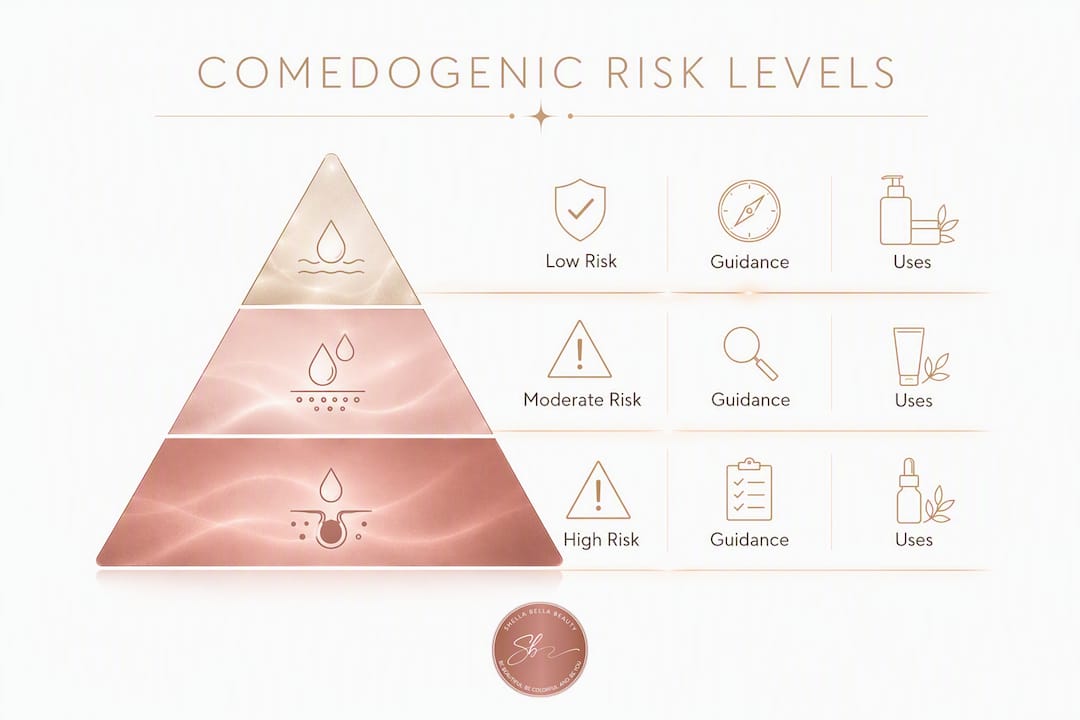
Low-risk ingredients (rated 0–1)
These are generally well-tolerated even on congestion-prone skin. Mineral oil and petrolatum, despite persistent myths, consistently score low in comedogenic testing when pharmaceutical-grade. Dimethicone, a silicone used widely in primers and serums, sits at 0 and rarely causes follicular issues.
Moderate-risk ingredients (rated 2–3)
Shea butter in its refined form typically rates around 2 and performs well in most formulations. Squalane, derived from olives or sugarcane, sits at 1–2 and is broadly compatible with acne-prone skin. Lactic acid rates around 3 but functions as an exfoliant, which can actually support pore clarity when used appropriately.

High-risk ingredients (rated 4–5)
| Ingredient | Typical Rating | Common Uses | Guidance |
|---|---|---|---|
| Isopropyl myristate | 5 | Emollient, texture agent | Avoid high on face product lists |
| Acetylated lanolin alcohol | 4–5 | Emollient, moisturizer | Concentration-dependent; check list position |
| Coconut oil (unrefined) | 4 | Moisturizer, cleansing oil | Better suited to body than face |
| Cocoa butter | 4 | Emollient, lip and body products | Use on body; patch test on face |
| Isopropyl palmitate | 4 | Emollient, skin-feel enhancer | Flag when in top five ingredients |

For body moisturizers, a higher-rated ingredient may be entirely appropriate — the skin on your arms and legs is less prone to follicular congestion than facial skin. A practical body moisturizer checklist for acne-prone skin can help you evaluate whether a product’s ingredient profile suits its intended use area.
What dermatologists and clinical reviews actually recommend
The 2025 JAAD clinical review is the most current and rigorous assessment of comedogenicity science available. Its conclusions are direct: historical testing methods contain methodological flaws, isolated-ingredient ratings do not reliably predict finished-formula behavior, and the absence of regulatory standards for “non-comedogenic” claims leaves consumers without meaningful protection.
“Standardized human-based testing of finished formulations is needed to improve clinical relevance and the reliability of non-comedogenic labeling. Current ratings, largely derived from rabbit ear models, should be interpreted with caution.”
— Journal of the American Academy of Dermatology, 2025 (source)
For acne-prone skin, dermatologist-backed priorities include:
- Favor skincare actives with established clinical tolerability for acne-prone skin, including AHAs, BHAs, and adapalene.
- Avoid products where multiple high-rated ingredients (4–5) appear in the top half of the ingredient list simultaneously.
- Prioritize product performance and tolerability over ingredient ratings alone — a formula that your skin responds well to is more valuable than a theoretically “clean” ingredient list.
- For sensitive or reactive skin, layer new products gradually and give each one adequate time before evaluation.
The Lab Muffin Beauty Science analysis reinforces this approach: the comedogenic scale is a directional tool, most useful for spotting probable offenders during troubleshooting rather than for making blanket ingredient bans.
Key Takeaways
Comedogenic ratings are a useful starting point for acne-prone skin, but concentration, formulation, and individual response determine whether an ingredient actually causes breakouts.
| Point | Details |
|---|---|
| Ratings are directional, not definitive | The 0–5 scale reflects isolated ingredient testing, not finished formula behavior. |
| Ingredient position matters | Focus on the first five to seven ingredients; high-rated ones lower on the list pose less risk. |
| Concentration changes everything | High-rated ingredients used below 1–2% in a formula typically carry low comedogenic risk. |
| Patch test for 7–14 days | Product-level testing on your own skin is more reliable than any rating database. |
| Shellabellabeauty prioritizes formulation | Shellabellabeauty’s products and Glow Chronicles guides are built around clinical tolerability and thoughtful ingredient selection for acne-prone and sensitive skin. |
The rating number is only half the conversation
The skincare world has a tendency to treat comedogenic ratings as a kind of ingredient verdict — a number that settles the question of whether something belongs on your face. That framing misses the point almost entirely. A rating of 4 assigned to coconut oil in 1979, applied neat to rabbit ear tissue, tells you something about that ingredient’s chemical structure. It tells you very little about a moisturizer where coconut oil appears eighth on the ingredient list, blended with niacinamide, ceramides, and a water base.
What the scale genuinely offers is a shortlist. When your skin starts congesting after a new product, the ratings help you narrow down which ingredient to investigate first. That is a real and practical use. But the leap from “this ingredient has a high rating” to “this product will break me out” skips over formulation chemistry, concentration, and the simple fact that skin is individual.
The most grounded approach is also the most patient one: introduce products one at a time, observe your skin over weeks rather than days, and use ratings as one signal among several rather than the deciding factor. Dermatologists consistently emphasize product-level tolerability over theoretical ingredient profiles, and the 2025 JAAD review makes clear that the science itself supports that priority.
Thoughtfully formulated skincare, guided by ingredient science
Shellabellabeauty was built on the understanding that radiance returns when skin is treated with care, intention, and the right ingredients in the right proportions. Every product in the collection is developed with formulation integrity at its center, which means high-rated ingredients are evaluated not just by their isolated scores but by their concentration, their role in the formula, and their clinical tolerability for acne-prone and sensitive skin.

The Glow Chronicles ingredient education series extends that same philosophy into every article, giving you the context to read a label with confidence and choose products that genuinely suit your skin. Whether you are building a new routine or troubleshooting persistent congestion, Shellabellabeauty’s collection and educational content are designed to support that process with clarity and care. Visit Shellabellabeauty to explore the full range of premium, thoughtfully formulated skincare and find the products that align with your skin’s needs.
Useful sources
- How to Use Comedogenicity Ratings — Lab Muffin Beauty Science: A thorough, evidence-based analysis of the 0–5 scale, its origins in rabbit ear testing, concentration effects, and practical guidance for acne-prone skin. Supports the scale explainer, limitations, and patch-testing sections.
- Comedogenicity in Cosmeceuticals: A Review of Clinical Relevance, Regulatory Gaps, and Future Directions: The 2025 JAAD clinical review that identifies methodological flaws in historical testing and calls for standardized human-based formula testing. Supports the origins, limitations, and expert takeaway sections.
- What Is Comedogenicity and What Ingredients Are Comedogenic? — Acne.org: Explains ingredient list ordering rules and concentration-based reading strategies. Supports the how-to-use-ratings section.
- PubMed — PMID 16488305: Peer-reviewed research on comedogenicity and skin testing methodology; primary literature supporting the historical context section.
- PubMed — PMID 6223652: Early peer-reviewed study on comedogenic ingredients and the rabbit ear model; foundational reference for the origins section.
FAQ
What is a comedogenic rating?
A comedogenic rating is a number on a 0–5 scale that indicates how likely an ingredient is to clog pores, based on historical laboratory testing. Zero means unlikely to cause comedones; five means high probability when the ingredient is tested in isolation.
Does a high comedogenic rating mean a product will break me out?
Not necessarily. Finished products containing high-rated ingredients are often non-comedogenic when tested as complete formulas, because concentration, formulation, and vehicle all change how an ingredient behaves in a pore.
What are the most commonly cited high-risk comedogenic ingredients?
Isopropyl myristate, isopropyl palmitate, acetylated lanolin alcohol, coconut oil, and cocoa butter are frequently listed at ratings of 4–5 and are worth flagging when they appear high on an ingredient list.
Is “non-comedogenic” a regulated claim in the United States?
No. “Non-comedogenic” is an unregulated marketing term in the U.S., meaning brands can apply it without standardized clinical testing of the finished formula.
How long should I patch test a new skincare product?
Patch test for 7–14 days on a small, consistent area of skin, watching for new closed comedones, bumps, or irritation. This window gives a more reliable read on how the finished formula interacts with your skin than any ingredient rating alone.
Recommended
- Sensitive Skin Cleanser Ingredients to Know – Shella Bella Beauty™
- Types of Skincare Active Ingredients: Your 2026 Guide – Shella Bella Beauty™
- How to Read Skincare Ingredient Labels in 2026 – Shella Bella Beauty™
- Skincare Ingredient Pairing Checklist: 10 Best Combos – Shella Bella Beauty™
- Join Glow Chronicles™ — Continue the Glow™ with editor’s picks, seasonal beauty rituals, exclusive skincare insights, and new editions delivered to your inbox.