

Skincare ingredient synergy is defined as the measurable improvement in skin outcomes when two or more compatible actives work together, producing results neither could achieve alone. Understanding why mix skincare ingredients matters is the foundation of any thoughtful routine. Dermatologists Mark Strom and Sam Ellis both confirm that pairing ingredients intentionally outperforms stacking products without regard for compatibility. The goal is not more products. The goal is the right combinations, applied with care and intention.
Why mix skincare ingredients instead of using them separately?
Mixing skincare ingredients works because complementary actives address multiple skin concerns at once while reducing the irritation that high-potency single ingredients often cause. Dermatologist Mark Strom describes this as combination therapy, a clinical approach that prioritizes synergistic pairings over isolated, high-dose treatments. The skin’s barrier has a finite tolerance for active ingredients. When you exceed that tolerance, you get redness, peeling, and sensitivity rather than radiance.

The benefits of mixing skincare extend beyond convenience. A well-paired routine can address oiliness, uneven tone, and dehydration within the same regimen, without overwhelming your skin. Dr. Neera Nathan reinforces this, noting that ingredient pairing matters as much as ingredient selection itself. Choosing azelaic acid alongside niacinamide, for example, delivers brightening and barrier support simultaneously. That is the quiet power of intentional formulation.
How do skincare ingredients interact, and why are some combinations incompatible?
Not all ingredients coexist peacefully on your skin. Chemical and pH conflicts are the two primary reasons certain pairings reduce efficacy or cause harm. L-ascorbic acid, the active form of Vitamin C, requires a low pH environment to remain stable and penetrate effectively. Retinoids function optimally at a higher pH. Applying both in the same step creates a pH conflict that reduces absorption for both actives, leaving you with less benefit and more potential irritation.
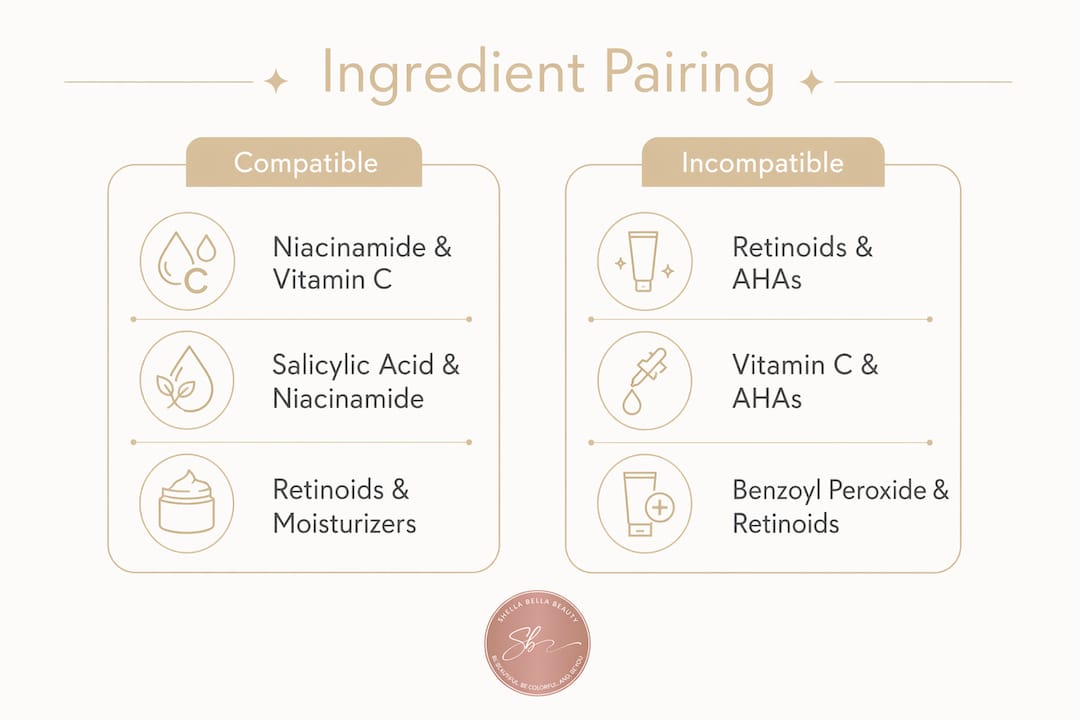
Chemical reactivity is a separate concern. Benzoyl peroxide oxidizes Vitamin C on contact, degrading the ingredient before it can act. Real Simple, citing dermatological guidance, confirms that retinoids and acids should never be applied in the same routine step due to compounded irritation risk. The skin reads this combination as an assault rather than care.
The most common incompatible pairings include:
-
Vitamin C + retinoids in the same step: pH conflict degrades both actives
-
AHAs/BHAs + retinoids simultaneously: elevated irritation and barrier disruption
-
Benzoyl peroxide + Vitamin C: oxidation destroys the ascorbic acid
-
Multiple exfoliating acids layered together: Dr. Mariwalla notes that layering AHAs and BHAs causes excessive dryness and sensitivity
Pro Tip: If you are unsure whether two actives are compatible, apply them at different times of day rather than eliminating one entirely. Separation preserves the benefit of each without the risk of conflict.
What are the benefits of intentional ingredient pairing in skincare routines?
Intentional pairing replaces the “more is better” mindset with a smarter, more measured approach. When you combine skincare products with purpose, each ingredient supports the others rather than competing with them. Salicylic acid clears pores and reduces oil production. Niacinamide, applied alongside it, calms the inflammation that exfoliation can trigger and reinforces the skin barrier. Together, they deliver clearer, calmer skin without the rawness that salicylic acid alone often causes.
The benefits of mixing skincare this way are cumulative. Vitamin C paired with azelaic acid addresses both oxidative damage and post-inflammatory pigmentation, two concerns that frequently appear together in acne-prone skin. Hyaluronic acid, when layered beneath a retinoid, cushions the skin against the dryness that retinoids commonly cause. These are not accidental combinations. They reflect a clinical understanding of how skin responds to layered care.
“Ingredient pairing matters as much as ingredient choice. Educating on compatibility principles, including barrier support, pH, and timing, is essential for effective routines.” — Dr. Sam Ellis, board-certified dermatologist
The shift toward synergy also simplifies routines. Rather than reaching for five separate actives, a well-designed two-step pairing can accomplish the same work with less stress on your skin. For those managing dullness and dehydration, pairing a brightening active with a deep hydrator addresses both concerns in a single, cohesive ritual.
How can timing and routine scheduling optimize ingredient compatibility?
Timing is the most underused tool in skincare. The “active lane” concept, drawn from dermatological practice, schedules each potent ingredient into a window where skin surface conditions favor its absorption and stability. Vitamin C belongs in the morning, where its antioxidant properties defend against UV-generated free radicals. Retinoids belong at night, where darkness protects their stability and the skin’s natural repair cycle amplifies their cell-renewal effects.
Scheduling your routine this way is straightforward:
-
Morning: Apply Vitamin C serum after cleansing, before moisturizer and SPF. Avoid applying retinoids or AHAs in the same session.
-
Evening: Use your retinoid or retinol after cleansing. Follow with a barrier-supportive moisturizer containing hyaluronic acid or ceramides to reduce dryness.
-
Alternate nights: If you use exfoliating acids such as glycolic acid or salicylic acid, schedule them on nights when you are not using retinoids. This separation prevents compounded sensitivity.
-
Introduce gradually: Add one new active at a time, observing your skin’s response over two to three weeks before layering a second.
Pro Tip: Apply your retinoid, wait ten minutes, then apply your moisturizer. This “sandwich method” reduces transepidermal water loss without diluting the retinoid’s effectiveness.
The Mayo Clinic notes that tretinoin with benzoyl peroxide is effective for acne when formulated together under medical supervision, but combining them unsupervised at home increases sensitivity significantly. This distinction matters. Formulated products are tested for stability and tolerability. DIY layering is not.
What are some dermatologist-approved ingredient pairings and why do they work?
The most effective combinations in clinical skincare share a common structure: one active that targets a specific concern, paired with one ingredient that supports the barrier or enhances tolerability. The table below outlines four dermatologist-endorsed pairings, each grounded in skin science.
| Pairing | Primary Benefit | Why It Works |
|---|---|---|
| Salicylic acid + niacinamide | Oil control and barrier support | Salicylic acid exfoliates pores; niacinamide calms inflammation and strengthens the barrier |
| Vitamin C + azelaic acid | Brightening and redness reduction | Both address pigmentation through different pathways, compounding the effect |
| Benzoyl peroxide + adapalene | Acne clearance and cell turnover | Antibacterial action combined with increased cellular renewal reduces active breakouts |
| Glycolic acid + urea | Texture refinement and hydration | Glycolic acid resurfaces; urea draws moisture into the newly exposed skin layer |
Dermatologist Mark Strom specifically endorses salicylic acid with niacinamide for acne-prone yet sensitive skin types. This pairing is particularly well-suited to those who have experienced irritation from exfoliants alone. The niacinamide acts as a buffer, preserving the skin’s natural defenses while the salicylic acid does its work. For those addressing uneven skin texture, the glycolic acid and urea combination offers a gentle but effective path to smoother, more luminous skin.
What common mistakes should you avoid when mixing skincare ingredients?
The most frequent mistake in skincare mixing is overloading the skin with multiple potent actives in a single session. Your skin barrier can only process so much at once. When you layer a retinoid, an AHA, and a Vitamin C serum in the same evening routine, the barrier responds with inflammation rather than renewal. Expert protocol consistently recommends limiting potent actives per session and building compatibility partners in gradually.
Other common mistakes include:
-
Ignoring formulation vehicles: A retinoid in a silicone base behaves differently than one in a water-based gel. The vehicle affects how deeply an ingredient penetrates and how it interacts with adjacent layers.
-
Skipping barrier support: Applying actives without a moisturizer containing ceramides or hyaluronic acid leaves the skin exposed and reactive.
-
Assuming “natural” means compatible: Plant-based acids, essential oils, and botanical extracts can conflict with synthetic actives just as readily as any other ingredient.
-
Introducing too many new products at once: When irritation appears, you cannot identify the cause if you changed three products simultaneously.
Pro Tip: Keep a simple skin log for the first two weeks after introducing any new active. Note texture, redness, and hydration levels each morning. Patterns appear quickly, and you will know exactly what to adjust.
Barrier tolerance, as noted by skincare experts, is the governing principle. Starting with limited actives and adding supportive ingredients over time is not timid. It is the most direct path to lasting results.
Key Takeaways
Intentional ingredient pairing, guided by pH awareness, timing, and barrier support, is the most effective approach to building a skincare routine that delivers lasting results.
| Point | Details |
|---|---|
| Synergy over quantity | Two well-paired actives outperform five poorly layered ones by reducing irritation and improving absorption. |
| Timing separates conflicts | Vitamin C belongs in the morning; retinoids at night. This single rule prevents the most common pH and stability conflicts. |
| Barrier support is non-negotiable | Always pair potent actives with hyaluronic acid, ceramides, or niacinamide to protect skin tolerance. |
| Incompatible pairs cause real harm | Benzoyl peroxide with Vitamin C, and AHAs with retinoids in the same step, degrade efficacy and increase sensitivity. |
| Introduce actives gradually | Add one new active at a time and observe your skin’s response before layering a second ingredient. |
What I have learned from years of watching ingredient trends come and go
The skincare world has a short memory. Every season brings a new “hero ingredient,” and the instinct is always to add it to an already full routine rather than reconsider what is already there. I have watched this pattern repeat with niacinamide, with bakuchiol, with peptides. Each time, the readers who saw the best results were not the ones who added the most. They were the ones who paired thoughtfully and gave their skin time to respond.
What dermatologists like Sam Ellis and Mark Strom describe as combination therapy is not a new concept. It is the clinical version of what experienced skincare educators have always known: the skin is not a surface to be treated aggressively. It is a living barrier that responds to care, consistency, and respect for its own chemistry.
The insight that changed how I think about this topic came from watching what happened when people removed an ingredient rather than added one. A reader who had been layering three acids and a retinoid every night saw her sensitivity resolve within two weeks of switching to a single acid on alternating nights. Her skin did not need more. It needed space. That is the lesson ingredient synergy teaches, quietly and persistently, to anyone willing to listen.
Beauty educators carry a particular responsibility here. Teaching the principles of pH, timing, and barrier support gives people a framework they can apply to any product, any brand, any routine. That knowledge lasts far longer than any trend.
— Marshella
Shellabellabeauty’s curated collections for intentional skincare mixing
Shellabellabeauty was built on the belief that radiance is already present in your skin. The role of a well-designed routine is to restore the conditions that allow it to surface.

Each collection at Shellabellabeauty is formulated with ingredient compatibility in mind. The renewal and smoothing rituals collection pairs resurfacing actives with barrier-supportive hydrators, reflecting the same synergy principles outlined by dermatologists. For those with reactive or delicate skin, the sensitive skincare collection offers gentle formulations designed to work alongside actives without disrupting the skin’s natural balance. If deep hydration is your focus, the deep hydration rituals collection provides the cushioning layer that every active-based routine needs. Each product is chosen to complement, not compete.
FAQ
What does skincare ingredient synergy mean?
Skincare ingredient synergy means two or more compatible actives produce a combined benefit greater than either would achieve alone. Dermatologist Mark Strom describes this as combination therapy, where pairings target multiple concerns while reducing irritation.
Can you mix Vitamin C and niacinamide?
Yes. Vitamin C and niacinamide are compatible when used in well-formulated products. Apply Vitamin C in the morning and niacinamide can be used in either session as a barrier-supportive partner.
Why should retinoids and AHAs not be used together?
Retinoids and AHAs used simultaneously increase irritation risk and can reduce the efficacy of both actives. Real Simple, citing dermatological guidance, recommends scheduling them on separate nights to preserve tolerability.
How do I know if a skincare combination is causing irritation?
Persistent redness, tightness, or flaking that appears within 24–48 hours of applying a new combination signals barrier stress. Remove one active at a time to identify the cause, and reintroduce it slowly once the skin has calmed.
Does mixing skincare products always improve results?
Mixing skincare products improves results only when the combination is intentional and compatible. Randomly layering actives without regard for pH, timing, or barrier support can reduce efficacy and cause harm rather than benefit.