
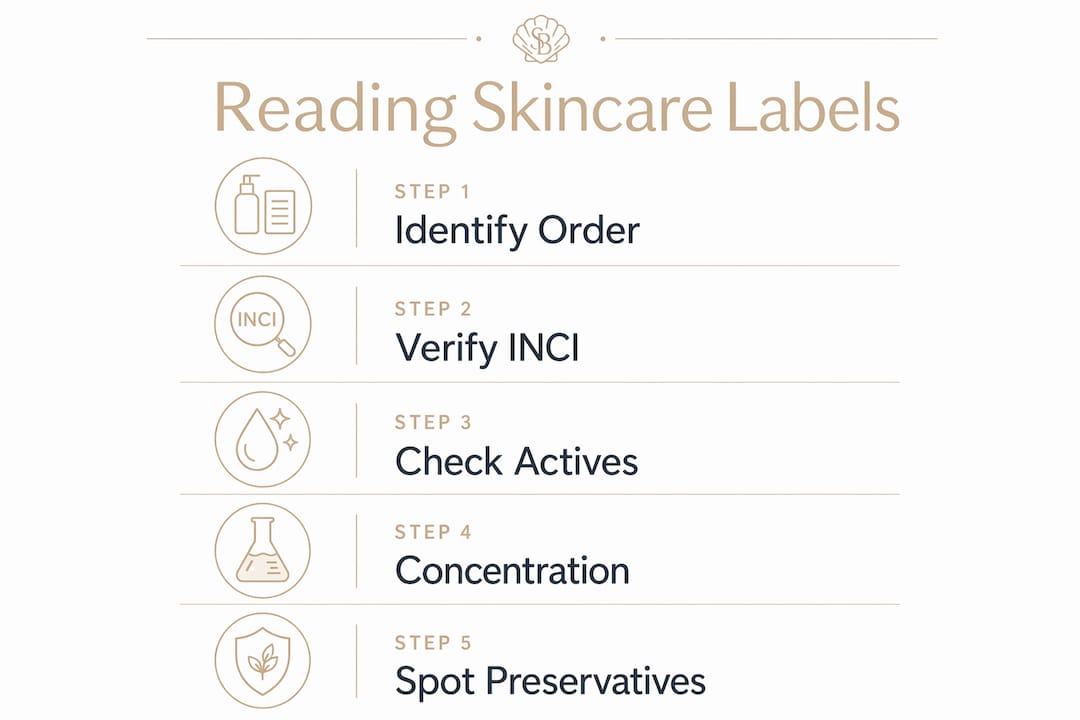
Reading skincare ingredient labels is the process of decoding ingredient order, concentration, and standardized nomenclature to understand what a formula actually contains, regardless of what the packaging claims. The International Nomenclature of Cosmetic Ingredients system, known as INCI, governs how every ingredient is named on labels sold in the United States and the European Union. Both the FDA under 21 CFR Part 701 and EU Regulation EC No 1223/2009 require brands to list ingredients in descending order by weight. Once you understand these three foundations, reading any product label becomes a clear, repeatable skill rather than a guessing game.
What does ingredient order on skincare labels actually mean?
Ingredient order is the single most reliable signal on any skincare label. Both EU and US regulations require that ingredients appear in descending order by weight, meaning the first ingredient listed is present in the highest concentration. The last several ingredients are typically present in the smallest amounts.

The critical threshold to understand is 1%. Ingredients present above 1% concentration must appear in strict descending order. Ingredients below 1% may be listed in any order after the higher concentration group. This matters because a brand can legally place a trendy active ingredient near the top of the sub-1% group, making it appear more prominent than it truly is.
Here is what this ordering tells you in practice:
-
First 1–3 ingredients: These form the base of the formula. Water (Aqua), glycerin, and silicones like dimethicone are common examples.
-
Ingredients 4–7: These are typically the secondary functional ingredients, such as emollients, thickeners, or key actives present in meaningful amounts.
-
Middle of the list: Specialty actives like niacinamide or hyaluronic acid often appear here, ideally above the 1% line.
-
Near the end: Preservatives, fragrance, and colorants typically fall at or below the 1% threshold.
-
Very last entries: These are often colorants, parfum, or trace botanical extracts added for marketing appeal.
Pro Tip: Phenoxyethanol is one of the most reliable marker ingredients for locating the 1% line. It is almost always used at concentrations at or below 1%. When you spot phenoxyethanol, every ingredient listed after it is likely present below 1% as well.
Understanding this ordering removes the guesswork from label reading. A moisturizer that lists water, glycerin, and shea butter in the first three positions is genuinely a hydration-focused formula. One that lists water followed immediately by fragrance is telling you something very different about its priorities.
How do INCI names work, and why do they matter?
INCI names are globally standardized ingredient identifiers that appear the same way on every label, regardless of brand or country of origin. INCI naming reduces translation risk and minimizes confusion when comparing products across different markets. A consumer in New York and one in Paris will see the same spelling for the same ingredient.
The practical benefit is significant. Without INCI standardization, a brand could call vitamin C “ascorbic acid,” “L-ascorbic acid,” “ascorbate,” or any number of trade names. With INCI, you know exactly what you are looking at. Here are a few common examples:
-
Hyaluronic acid appears as Sodium Hyaluronate in INCI.
-
Vitamin C appears as Ascorbic Acid or Ascorbyl Glucoside, depending on the form used.
-
Retinol appears as Retinol in INCI, though derivatives like Retinyl Palmitate are distinct entries.
-
Niacinamide appears as Niacinamide, which is one of the few cases where the common name and INCI name match.
-
Aloe vera appears as Aloe Barbadensis Leaf Juice in INCI, its botanical Latin form.
The EU also requires a specific disclosure for nanomaterials. Under EU nanomaterial rules, any ingredient in nano form must be followed by the word “nano” in brackets. This is a detail most consumers overlook, yet it carries real significance for those evaluating advanced formulas.
For reliable INCI verification, CosIng is the official European Commission cosmetic ingredient database. You can search any ingredient by its exact INCI spelling and access regulatory details, function descriptions, and restriction status. It is free to use and far more authoritative than informal ingredient glossaries.
Pro Tip: When a product uses a marketing nickname like “bio-retinol” or “plant-based collagen,” search the actual INCI name on CosIng or a trusted database before drawing conclusions. Marketing language is not regulated the same way INCI names are.
How to identify active ingredients and their effective concentrations
The first 5–7 ingredients on a label typically represent the highest concentration portion of the formula. This is where the real work of a product happens. If your skin goal is hydration, you want humectants like glycerin or sodium hyaluronate in this group. If your goal is brightening, you want niacinamide or ascorbic acid appearing well before the 1% threshold.
Here is a practical framework for evaluating active ingredient placement:
-
Locate the active you care about. Search for its INCI name, not its marketing name.
-
Count its position on the list. If it appears in the first seven ingredients, it is likely present in a meaningful concentration.
-
Find phenoxyethanol or a similar preservative. Any active listed after this marker is almost certainly below 1%.
-
Compare across products. A niacinamide serum with niacinamide listed third is meaningfully different from one where it appears fifteenth.
-
Check for multiple forms of the same active. Brands sometimes split an ingredient across two forms to keep each entry lower on the list while the combined amount is actually significant.
Actives present below 1% and listed far down the label may deliver little to no clinical benefit, despite prominent placement in marketing copy. Retinol is a clear example. A product marketed as a “retinol treatment” with retinol listed after fragrance and phenoxyethanol contains a trace amount at best. Effective retinol formulas typically list it in the top half of the ingredient list, above preservatives.
Vitamin C in the form of ascorbic acid requires a concentration of at least 10% to show meaningful brightening results in clinical literature. If ascorbic acid appears near the bottom of a label, the formula likely falls well short of that threshold. Position on the label is your clearest available signal for concentration.
Common mistakes when decoding product labels
The most frequent mistake is treating marketing claims as ingredient truth. Label order transparency does not guarantee clinical performance. A product labeled “with retinol” is not required to contain retinol at any specific concentration. The label tells you it is present. It does not tell you it is present at a level that does anything for your skin.
Several other misconceptions are worth addressing directly:
-
“Natural” does not mean non-irritating. Essential oils, botanical extracts, and plant-derived fragrances are among the most common contact irritants in skincare. Their natural origin offers no protection from sensitivity reactions.
-
“Fragrance-free” is not the same as “unscented.” An unscented product may still contain masking fragrances. Fragrance-free means no fragrance compounds were added at all.
-
Ingredient order does not reflect interaction effects. Two ingredients may each appear in effective concentrations but work against each other at the same pH. Vitamin C and niacinamide, for example, are often cited in this context, though modern formulations have largely addressed this.
-
Short ingredient lists are not always better. A minimal formula can still contain a high-irritation ingredient. Length alone tells you nothing about safety.
Labels declare ingredient presence but do not measure irritation risk. Natural or fragrance-free claims do not assure non-irritation for every skin type. — Dewique on label realities
Patch testing remains the most reliable safety check, regardless of how well you read a label. Apply a small amount of any new product to the inner forearm or behind the ear for 24–48 hours before full use. Label knowledge and patch testing work together. Neither replaces the other.
Key Takeaways
Reading skincare ingredient labels with confidence requires understanding three things: ingredient order by concentration, INCI standardized naming, and the 1% threshold that separates primary formula components from trace additions.
| Point | Details |
|---|---|
| Ingredient order reflects concentration | The first ingredient is present in the highest amount; the last is present in the smallest. |
| The 1% rule is the key threshold | Ingredients above 1% must appear in strict descending order; those below may appear in any order. |
| INCI names are universal | The same INCI spelling appears on every brand’s label, making cross-product comparison reliable. |
| Active position signals efficacy | An active listed after phenoxyethanol is almost certainly below 1% and may offer minimal benefit. |
| Labels declare presence, not performance | Patch testing alongside label reading is the only way to confirm both safety and suitability. |
Why label reading changed how I shop for skincare
The first time I truly understood ingredient order, I put back a serum I had been using for months. It was marketed as a niacinamide brightening treatment. Niacinamide appeared sixteenth on the list, well after phenoxyethanol. I had been paying a premium for what amounted to a trace inclusion.
That experience shifted something for me. Label reading is not about becoming a cosmetic chemist. It is about refusing to let marketing language make decisions for you. The INCI system and the 1% rule are tools that already exist on every label you hold. You simply need to know how to use them.
What I have found, after years of reading labels with intention, is that the brands worth trusting are the ones who make this easy. Transparent brands list their key actives high on the label, name them clearly in INCI, and do not hide behind proprietary blends or vague “complex” terminology. When a brand is confident in its formula, the label shows it.
I also want to be honest about the limits of label reading. Concentration matters, but so does formulation science. A 10% vitamin C in an unstable formula degrades before it reaches your skin. A 0.3% retinol in a well-buffered, encapsulated delivery system can outperform a 1% retinol in a poorly constructed base. The label is the starting point, not the final word. Combine what you read with brand transparency, third-party reviews, and your own skin’s response over time.
Patch testing is non-negotiable. I say this not as a disclaimer but as someone who has seen sensitive skin react to a “clean” formula with a short, plant-based ingredient list. Your skin is the final authority.
— Marshella
Shellabellabeauty products worth reading closely
Shellabellabeauty was built on the belief that radiance is inherent, and that belief extends to how the brand formulates and labels its products. Every formula is designed with ingredient transparency in mind, so you can apply what you have learned here directly to the label.
The Opuliss™ Nocturnal Renewal Creme is a strong place to start. Its ingredient list places key actives in the upper portion of the formula, above the 1% threshold, so you can see exactly where the concentration sits. For those focused on hydration, the RadiantRevive™ Hyaluronic Serum lists sodium hyaluronate prominently, giving you a clear example of how a well-formulated serum reads on the label. Both products reflect Shellabellabeauty’s commitment to formulas that hold up to scrutiny, not just to marketing.
FAQ
What is the INCI system in skincare?
INCI stands for International Nomenclature of Cosmetic Ingredients. It is a globally standardized naming system that ensures the same ingredient carries the same name on every product label, regardless of brand or country.
Where does the 1% rule appear on a label?
There is no visible marker, but preservatives like phenoxyethanol are almost always used at or below 1%. Spotting phenoxyethanol on a label tells you that every ingredient listed after it is likely present below 1% concentration.
Does a longer ingredient list mean a less effective product?
No. A longer list reflects formula complexity, not dilution. What matters is where your target active appears on the list, not how many ingredients surround it.
How do I verify an INCI name I do not recognize?
CosIng, the official European Commission cosmetic ingredient database, allows free searches by INCI name and provides function descriptions and regulatory status for each entry.
Can I trust “fragrance-free” claims on skincare labels?
Fragrance-free means no fragrance compounds were intentionally added. It does not mean the product is free of all potential irritants. Natural claims and fragrance-free labels do not guarantee non-irritation, so patch testing remains the most reliable safety check.