

Hyperpigmentation is defined as the overproduction of melanin in localized skin areas, resulting in dark spots, uneven tone, and post-inflammatory marks that resist ordinary correction. To treat hyperpigmentation with luxury skincare, you need scientifically validated actives, specifically Thiamidol, vitamin C, retinol, and niacinamide, layered in a deliberate regimen that works with your skin’s natural rhythm rather than against it. The most effective luxury formulations combine these ingredients with botanical brighteners and broad-spectrum SPF, creating a multi-pathway approach that addresses pigment at its source. Shellabellabeauty’s philosophy holds that radiance is not manufactured. It is restored, patiently and with intention.
Which luxury ingredients are most effective for treating hyperpigmentation?
The most potent brightening ingredient in luxury skincare today is Thiamidol, a human tyrosinase inhibitor identified as the strongest among 50,000 tested compounds, with an IC50 of 1.1 mmol/L. Tyrosinase is the enzyme that triggers melanin production, so blocking it at the source stops dark spots from forming rather than simply masking them. That distinction separates Thiamidol from older lightening agents like kojic acid or arbutin, which work less precisely and less powerfully.
Not all brightening ingredients target tyrosinase specifically, and those that do offer superior efficacy in luxury formulations. Vitamin C, the second cornerstone ingredient, works differently. It neutralizes free radicals that trigger excess melanin production and physically inhibits the enzyme’s activity, making it an ideal morning antioxidant. Understanding how antioxidants protect skin helps clarify why vitamin C belongs at the start of every brightening routine.
Retinoids accelerate cell turnover, pushing pigmented cells toward the surface and clearing them away faster than your skin would on its own. Niacinamide works at a different stage entirely. It reduces melanin transfer from melanocytes to surrounding skin cells, which means it interrupts the delivery of pigment even after it has been produced. Together, these two ingredients address the middle and final stages of the pigmentation cycle.
Additional brightening agents found in premium formulations include:
- Tranexamic acid: Disrupts the communication between UV-exposed skin cells and melanocytes, reducing post-inflammatory pigmentation
- Glycolic acid: An alpha-hydroxy acid that exfoliates the surface layer, accelerating the removal of pigmented cells and improving ingredient absorption
- Botanical extracts (licorice root, bearberry, white peony): Gentle tyrosinase inhibitors that complement synthetic actives with anti-inflammatory properties
- Azelaic acid: Targets abnormal melanocytes selectively, making it particularly effective for rosacea-related discoloration and post-acne marks
Pro Tip: When reading a luxury serum label, look for Thiamidol or niacinamide within the first five listed ingredients. Concentration matters as much as presence. Learning how to read ingredient labels gives you a real advantage when selecting premium products.
How to build a luxury skincare routine for dark spots
A layered regimen is the most effective method for reducing hyperpigmentation safely. Layering antioxidants in the morning and retinoids at night is the approach that accelerates fading while keeping irritation low. This hierarchy exists because vitamin C is photostable and protective in daylight, while retinoids and exfoliants are best applied when UV exposure is absent.
Morning routine: protect and brighten
- Gentle cleanser: Remove overnight residue without stripping the skin’s moisture barrier. A milky or gel cleanser suited to your skin type preserves the acid mantle.
- Vitamin C serum: Apply to clean, slightly damp skin. A concentration of 10–20% L-ascorbic acid delivers the most measurable brightening effect. Pat gently rather than rubbing.
- Niacinamide layer (optional): A lightweight niacinamide serum applied after vitamin C adds melanin-transfer inhibition and calms any reactive redness.
- Moisturizer: Lock in the actives with a cushioned cream or gel that supports barrier integrity. Hydrated skin absorbs actives more evenly.
- Broad-spectrum SPF 30 or higher: This is non-negotiable. Sun exposure acts as a constant reversal mechanism, undoing every gain made by your brightening actives overnight.
Evening routine: renew and correct
- Double cleanse: An oil-based cleanser followed by a water-based cleanser removes SPF, makeup, and pollution thoroughly without over-stripping.
- Exfoliant (2–3 nights per week): Glycolic acid or lactic acid at 5–10% clears pigmented surface cells and prepares skin to receive corrective actives. Combining tyrosinase inhibitors with exfoliants yields significantly faster results than either ingredient used alone.
- Tyrosinase inhibitor or retinoid: On exfoliant nights, apply your Thiamidol treatment. On alternate nights, apply a retinoid to drive cell turnover. Do not layer both on the same evening when starting out.
- Overnight mask or rich moisturizer: Seal the treatment layer with a nourishing formula that supports repair while you sleep. The Shellabellabeauty Opuliss Nocturnal Renewal Creme is formulated specifically for this restorative stage.
- Introduce actives gradually: Begin with two or three evenings per week and increase frequency only when your skin tolerates each step without redness or flaking.
Pro Tip: Daily SPF protection is the single most important step to prevent treatment reversal. Apply it as the final morning step, every day, regardless of cloud cover or time indoors near windows.
What are the best luxury product formats for pigment correction?
Luxury skincare for dark spots comes in several formats, and each delivers actives differently. Choosing the right format for each step of your routine determines how well the ingredients actually reach the skin layers where pigmentation forms.
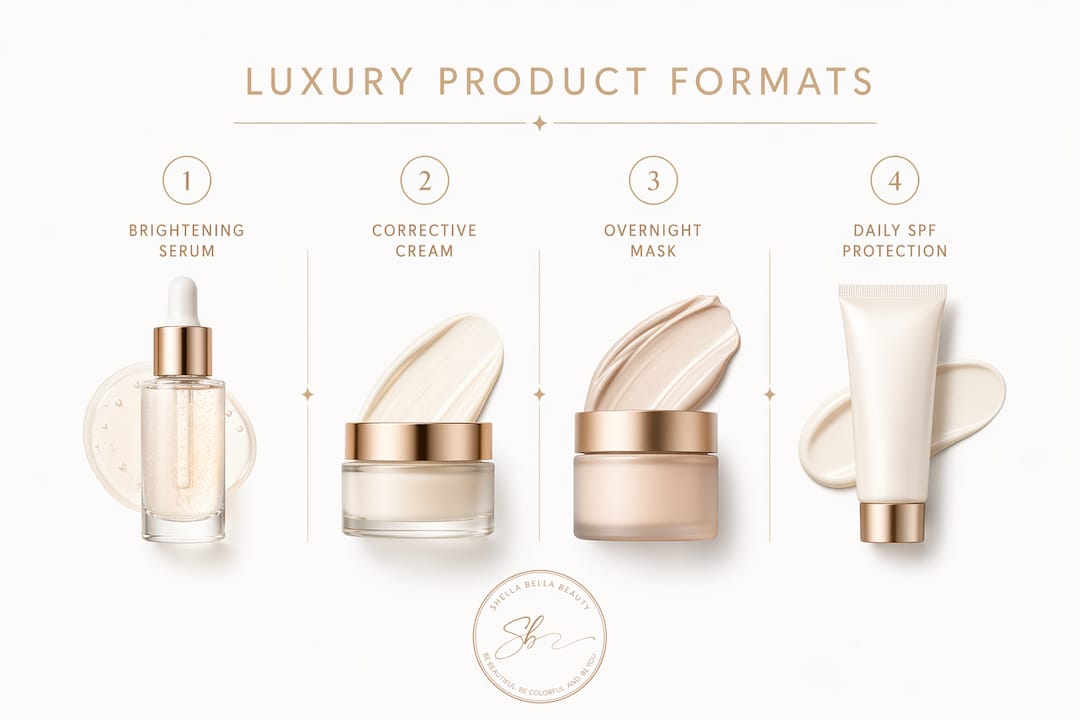
| Product type | Key benefit | Best use case |
|---|---|---|
| Brightening serum | High active concentration, fast absorption | Morning vitamin C or niacinamide step |
| Overnight mask | Extended contact time, deep delivery | Evening treatment for stubborn dark spots |
| Corrective cream | Barrier support with embedded actives | Daily moisturizer with Thiamidol or tranexamic acid |
| Exfoliating toner | Surface renewal, improved absorption | 2–3 nights per week before corrective actives |
Serums carry the highest concentration of actives and penetrate quickly, making them the preferred format for vitamin C, niacinamide, and tranexamic acid. Their lightweight texture allows layering without pilling or interference between ingredients. A well-formulated brightening serum applied consistently outperforms a richer cream with the same actives, simply because the delivery vehicle reaches deeper skin layers faster.
Overnight masks represent a category where luxury skincare genuinely earns its premium. The Chantecaille Blanc Peony Overnight Mask, for example, reduces dark spot appearance by 74% with consistent use. That result reflects the advantage of extended contact time. While a serum absorbs in minutes, an overnight mask works across six to eight hours, allowing actives to penetrate more fully and support the skin’s natural repair cycle.
Corrective creams serve a dual purpose. They deliver actives like Thiamidol or botanical brighteners while simultaneously reinforcing the moisture barrier, which is especially valuable when retinoids or exfoliants are in the routine. Pairing a corrective cream with a wellness-focused skincare ritual turns treatment into a restorative practice rather than a clinical chore.
Common pitfalls when treating hyperpigmentation with luxury skincare
The most frequent reason hyperpigmentation treatment fails is not product quality. It is inconsistency and sun exposure. Experts identify sun as the primary reversal factor, meaning every unprotected UV exposure actively rebuilds the pigment your actives worked to fade. A single week without SPF can set progress back by several weeks.
“Hyperpigmentation treatment is a long-term commitment. Sunscreen is not optional. It is the foundation that makes every other active ingredient work. Without it, you are filling a vessel with a hole at the bottom.”
Over-exfoliation is the second most common mistake. Excess exfoliation disrupts the skin barrier, causing inflammation that paradoxically triggers more melanin production. Post-inflammatory hyperpigmentation from irritation is darker and more persistent than the original spots you were treating.
Additional pitfalls to avoid:
- Layering incompatible actives: Vitamin C and retinol used together in the same application can destabilize both. Keep them separated by AM and PM routines.
- Expecting overnight results: Clinical data shows Thiamidol produces visible results at 4–8 weeks with consistent use. Patience is part of the protocol.
- Skipping patch tests: Introduce one new active at a time and observe for 48–72 hours before adding the next product.
- Ignoring lifestyle factors: Poor sleep, high stress, and hormonal fluctuation all increase melanin production. A mindful skincare ritual that accounts for these factors supports better outcomes.
- Delaying professional consultation: If dark spots worsen, spread, or fail to respond after 12 weeks of consistent treatment, a board-certified dermatologist can assess whether prescription-strength options or in-office procedures are appropriate.
What I have learned about luxury skincare and hyperpigmentation
What I have learned about luxury skincare and hyperpigmentation
The most important shift I made in treating hyperpigmentation was accepting that results are earned slowly and that luxury skincare is not a shortcut. It is a more refined path to the same destination. What separates premium formulations from mass-market options is not the price. It is the stability of the actives, the elegance of the delivery systems, and the care taken to combine ingredients that genuinely work together.
I have seen readers abandon effective routines at week three because they expected week-eight results. The multi-ingredient layering approach requires trust in the process. Vitamin C in the morning and a Thiamidol treatment at night, applied with consistency and protected by SPF, will produce visible change. But only if you give it the time it deserves.
The other truth I return to often is this: skincare is not separate from wellness. The ritual of applying a silky serum or a cushioned overnight mask is itself an act of care that reduces stress, which in turn reduces cortisol-driven melanin spikes. Science and self-care are not in opposition. At Shellabellabeauty, that integration is the whole point.
— Marshella
Shellabellabeauty’s renewal rituals for radiant, even skin
Shellabellabeauty has curated a collection of luxury skincare formulations designed specifically for skin that craves renewal, clarity, and a more even tone. Each product in the Renewal and Smoothing Skincare Rituals collection is selected for its ability to address discoloration thoughtfully, combining high-performance actives with textures that feel as restorative as they are effective.

For skin that is more reactive or prone to sensitivity alongside pigmentation, the Sensitive Skincare collection offers gentler formulations that still deliver meaningful brightening results. Whether your skin calls for intensive correction or a softer, gradual approach, Shellabellabeauty holds a ritual that honors exactly where your skin is right now.
FAQ
What is hyperpigmentation and why does it form?
Hyperpigmentation is the localized overproduction of melanin that creates dark spots, uneven patches, or post-inflammatory marks on the skin. It is triggered by UV exposure, hormonal shifts, inflammation, or skin injury, all of which stimulate melanocyte activity.
How long does luxury skincare take to reduce dark spots?
Clinical data shows that Thiamidol, one of the most potent brightening actives, produces measurable results at two weeks and visible improvement at 4–8 weeks with consistent use and daily SPF protection.
Can I use vitamin C and retinol in the same routine?
Vitamin C and retinol should be separated into morning and evening applications. Vitamin C applied in the AM provides antioxidant protection, while retinol used at night drives cell turnover without UV interference or ingredient destabilization.
What makes luxury serums better for hyperpigmentation than standard options?
Luxury serums typically offer more stable active concentrations, refined delivery systems, and carefully tested ingredient combinations that reduce irritation while maximizing absorption into the skin layers where pigmentation forms.
Is SPF really necessary if I stay indoors?
UV rays penetrate glass and cause melanin stimulation even with indirect exposure. Daily broad-spectrum SPF is the single most important step to prevent treatment reversal, regardless of whether you spend time outdoors.
Key takeaways
Treating hyperpigmentation with luxury skincare requires Thiamidol or vitamin C as your core actives, a layered AM and PM regimen, and daily broad-spectrum SPF without exception.
| Point | Details |
|---|---|
| Thiamidol leads in efficacy | It is the strongest known tyrosinase inhibitor, producing visible results at 4–8 weeks with consistent use. |
| Layer actives by time of day | Apply vitamin C in the morning and retinoids or Thiamidol at night to avoid destabilization and maximize results. |
| SPF is non-negotiable | Sun exposure reverses pigment fading; daily broad-spectrum SPF protects every gain your actives make. |
| Overnight masks deliver depth | Extended contact time allows actives to penetrate more fully, with clinical results showing up to 74% dark spot reduction. |
| Patience protects progress | Over-exfoliation and inconsistency are the leading causes of treatment failure; gradual escalation and consistency define success. |
Recommended
- Why Mix Skincare Ingredients for Better Results – Shella Bella Beauty™
- Uneven Skin Texture & Tone Skincare - Shella Bella Beauty™ – Shella Bella Beauty™ LLC
- The Role of Antioxidants in Skincare Explained – Shella Bella Beauty™ LLC
- Wellness Rituals for Glowing Skin: Your Daily Guide – Shella Bella Beauty™