

Hydration is the single most critical factor in maintaining skin’s elasticity, clarity, and barrier function. Water makes up about 70% of skin cell volume, and every metabolic process your skin depends on requires it. When hydration falls short, the effects show immediately: dullness, tightness, uneven texture, and a complexion that looks older than it is. Understanding why hydration affects skin at a biological level gives you the clarity to care for your skin with real intention, not guesswork.
Why hydration affects skin at the cellular level
Skin hydration, known clinically as cutaneous water homeostasis, operates far below the surface you can see. At the cellular level, water drives the enzymatic reactions that keep skin renewing itself, repairing damage, and maintaining its structure.
Skin cell volume is approximately 70% water, and that proportion is not incidental. Without sufficient intracellular water, enzymes slow down, metabolism stalls, and the skin’s ability to produce new cells weakens. The result is a complexion that appears flat and fatigued rather than luminous.
Two biological structures are central to how your skin holds and uses water:
- Hyaluronic acid: This molecule, produced naturally in the dermis, binds water to maintain dermal volume and skin turgor. Hyaluronic acid supports collagen and elastin networks, and its capacity declines with age, which is why mature skin loses firmness and plumpness over time.
- Aquaporins: These are protein channels embedded in skin cell membranes that regulate water transport between cells. They act as the skin’s internal irrigation system, directing water precisely where it is needed for repair and renewal.
- Kallikrein enzymes: These enzymes control the natural shedding of dead skin cells. Their activity depends directly on ambient hydration and intracellular water content. When hydration drops, kallikrein activity slows, and dead cells accumulate on the surface instead of shedding cleanly.
Collagen and elastin, the proteins responsible for skin’s firmness and bounce, also require a well-hydrated environment to maintain their structure. Dehydration weakens the matrix that holds them in place, accelerating the visible signs of aging.
Pro Tip: Apply a hyaluronic acid serum to damp skin, not dry skin. Hyaluronic acid draws moisture from its environment, so applying it to dry skin in a low-humidity room can actually pull water from deeper skin layers.

Does drinking more water actually hydrate your skin?
The relationship between water intake and skin appearance is more nuanced than most people realize. The body operates on a physiological hierarchy: water distribution prioritizes vital organs and blood volume before directing fluid to peripheral tissues like skin. Your skin is, in biological terms, last in line.
Studies show no significant improvement in skin hydration or texture with extra water intake in people who are already adequately hydrated. Drinking beyond your body’s actual need does not translate into visibly plumper or more radiant skin. The benefit of drinking water is correcting dehydration, not exceeding it.
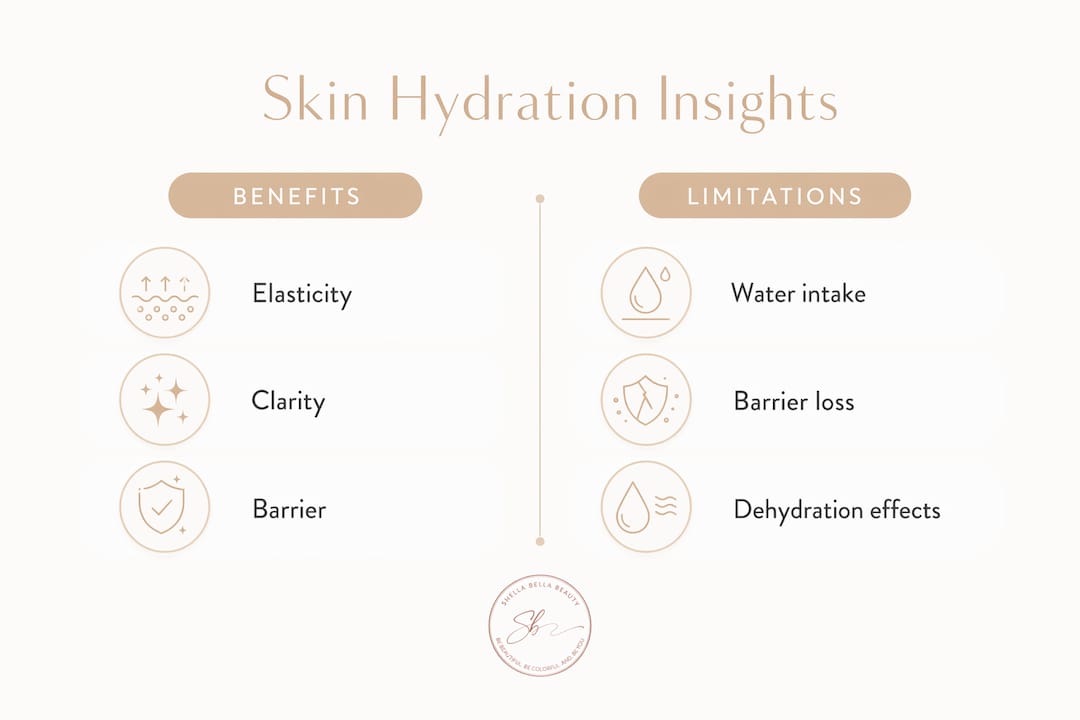
The skin’s outermost layer, the stratum corneum, acts as a selective barrier. It limits how much water can pass inward from the bloodstream and how much escapes outward through a process called transepidermal water loss, or TEWL. The lipid matrix of ceramides and cholesterol within this barrier controls TEWL. When that matrix is disrupted by harsh cleansers, environmental damage, or aging, water escapes rapidly regardless of how much you drink.
| Hydration approach | Primary benefit | Limitation |
|---|---|---|
| Drinking adequate water | Corrects systemic dehydration | No added benefit beyond sufficiency |
| Topical humectants (hyaluronic acid, glycerin) | Draws water into the skin’s surface layers | Requires an intact barrier to retain moisture |
| Occlusive and emollient moisturizers | Seals moisture in and repairs lipid barrier | Does not address internal dehydration |
| Combined internal and topical approach | Supports both cellular function and surface retention | Requires consistency over time |
The most effective approach combines adequate fluid intake with topical products that repair and reinforce the skin’s barrier. Barrier repair products consistently outperform increased water intake alone for visible skin hydration in clinical settings.
Pro Tip: If your skin feels tight after cleansing, your cleanser is likely disrupting your lipid barrier. Switch to a gentle, sulfate-free formula and follow immediately with a moisturizer while skin is still slightly damp.
What dehydration does to your skin’s appearance and function
Dehydration’s effects on skin are both visible and functional. The stratum corneum requires adequate water content to remain supple and smooth. When that content drops, the surface becomes rough, flaky, and tight, and fine lines appear more pronounced because the skin lacks the volume to fill them out.
Beneath the surface, slowed enzyme activity means dead skin cells accumulate rather than shed on schedule. This buildup creates uneven texture and a dull, gray cast to the complexion. The skin’s natural radiance depends on a clean, well-renewed surface, and dehydration interrupts that cycle.
Collagen and elastin resilience also decline when the dermis is chronically under-hydrated. These proteins lose their ability to spring back after movement, which contributes to the formation of fine lines and sagging. Adequate hydration strengthens barrier function and reduces sensitivity, dryness, and inflammation risk, all of which accelerate visible aging.
Dehydration also impairs healing. A moist cellular environment is required for fibroblast migration and collagen synthesis during wound repair. Intercellular signaling for inflammation and immune response depends on aqueous environments. When skin is dehydrated, these repair signals slow, and minor damage lingers longer than it should.
The compounding effect is significant. Dullness, texture, sensitivity, and slower healing are not separate problems. They share a common root in insufficient hydration at the cellular and barrier level. Addressing that root changes the entire picture.
How to support skin hydration through lifestyle and skincare
Restoring and maintaining skin hydration requires attention to both what goes into your body and what you apply to your skin. Neither approach alone is sufficient.
Step one: Meet your fluid intake baseline. The Mayo Clinic recommends 2.7 to 3.7 liters of total fluid daily for healthy adults, which includes water from food and beverages. This range corrects systemic dehydration and supports the cellular metabolism your skin depends on. The “8 glasses a day” rule, as Harvard Health notes, is an arbitrary guideline. Your body regulates hydration efficiently through thirst and diet, so focus on consistency rather than rigid counting.
Step two: Support hydration with electrolytes and diet. Electrolytes like sodium, potassium, and magnesium regulate how water moves in and out of cells. A diet rich in water-dense foods, including cucumbers, leafy greens, and citrus, contributes meaningfully to cellular hydration. Excess caffeine and alcohol increase fluid loss and can tip the balance toward dehydration.
Step three: Choose skincare ingredients that reinforce the barrier. Three categories of ingredients work together to restore and maintain surface hydration:
- Humectants such as hyaluronic acid and glycerin draw water into the skin’s upper layers and hold it there.
- Emollients such as squalane and fatty acids smooth and soften the skin’s surface by filling gaps in the lipid matrix.
- Occlusives such as ceramides and shea butter form a protective seal over the surface, preventing transepidermal water loss.
Step four: Protect the barrier from disruption. Harsh surfactants, over-exfoliation, and prolonged sun exposure all degrade the lipid matrix that keeps moisture locked in. A skin barrier repair routine focused on gentle cleansing and consistent moisturizing does more for long-term hydration than any single product.
Step five: Adapt your routine to your environment. Cold, dry air in winter and air-conditioned spaces year-round increase TEWL significantly. Layering a humectant serum under an occlusive cream creates a two-step defense that addresses both water attraction and retention. For a complete approach to hydrating dull skin, combining these layers consistently is what produces lasting results.
Key Takeaways
Skin hydration is a biological process requiring both adequate fluid intake and topical barrier support to maintain clarity, elasticity, and healthy renewal.
| Point | Details |
|---|---|
| Water drives skin function | About 70% of skin cell volume is water, supporting enzyme activity and cellular renewal. |
| Drinking water has limits | Extra water intake does not improve skin in already-hydrated individuals; barrier repair matters more. |
| Barrier integrity controls moisture | Ceramides and lipid matrix components prevent water loss regardless of how much you drink. |
| Dehydration accelerates aging | Slowed enzyme activity and collagen loss from dehydration contribute directly to dullness and fine lines. |
| Layered skincare works best | Combining humectants, emollients, and occlusives creates the most effective surface hydration defense. |
Hydration is more complex than the wellness world admits
By Marshella
After years of working closely with skincare formulations and ingredient science, the most persistent myth I encounter is the idea that drinking more water will fix your skin. People arrive at this belief because it feels logical, and because it is easy. The truth is more demanding.
Your skin is the last organ to receive water from your bloodstream. By the time you are visibly dehydrated, your skin has already been rationing moisture for some time. Drinking water corrects a deficit. It does not create a surplus that shows up as a glow.
What I have found actually moves the needle is barrier repair. When the lipid matrix is intact, your skin holds onto the moisture it already has. A well-formulated ceramide cream applied consistently does more for skin texture and radiance than doubling your water intake ever will. That is not a dismissal of hydration. It is a more accurate picture of where the work happens.
The other thing I want to be honest about is aging. Hyaluronic acid production declines over time, and no amount of water replaces what the dermis loses naturally. Topical hyaluronic acid and barrier-supporting ingredients slow that decline, but they require patience and consistency. Skin responds to care over weeks and months, not days. The readers who see real change are the ones who commit to a thoughtful, layered routine and give it time to work.
Approach your skin’s hydration the way you would approach any long-term investment: with intention, quality inputs, and realistic expectations.
— Marshella
Shellabellabeauty’s approach to skin hydration and renewal
Shellabellabeauty was built on the belief that radiant skin is not created. It is restored, layer by layer, with the right care and intention.

The Renewal and Smoothing Skincare Rituals collection brings together formulations designed to reinforce the skin’s barrier, support deep hydration, and encourage the natural renewal cycle your skin depends on. Each product is crafted with ingredients like ceramides, hyaluronic acid, and nourishing emollients that work in harmony to restore moisture balance and surface clarity. Whether your skin feels tight, dull, or in need of a complete reset, this collection offers a considered path back to softness and luminosity. Explore Shellabellabeauty’s skincare rituals and find the routine your skin has been asking for.
FAQ
Why does dehydration make skin look older?
Dehydration reduces the water content of the stratum corneum and weakens collagen and elastin resilience, making fine lines appear deeper and skin less firm. Slowed enzyme activity also causes dead cell buildup, which creates a dull, aged appearance.
Can drinking more water clear up dry skin?
Drinking water corrects systemic dehydration but does not significantly improve skin texture or hydration in people who are already adequately hydrated. Topical moisturizers with ceramides and humectants address surface dryness more directly.
What skincare ingredients help skin retain moisture?
Ceramides repair the lipid barrier to reduce transepidermal water loss, hyaluronic acid draws water into the skin’s upper layers, and glycerin acts as a humectant to hold moisture at the surface. Using all three in a layered routine produces the most consistent results.
How does the skin barrier affect hydration?
The skin’s lipid matrix controls how much water escapes through the surface. When this barrier is disrupted by harsh cleansers or environmental damage, transepidermal water loss increases and skin becomes dehydrated regardless of fluid intake.
How much water should you drink for skin health?
The Mayo Clinic recommends 2.7 to 3.7 liters of total fluid daily for healthy adults. Meeting this baseline supports cellular metabolism and prevents the systemic dehydration that visibly affects skin quality.