
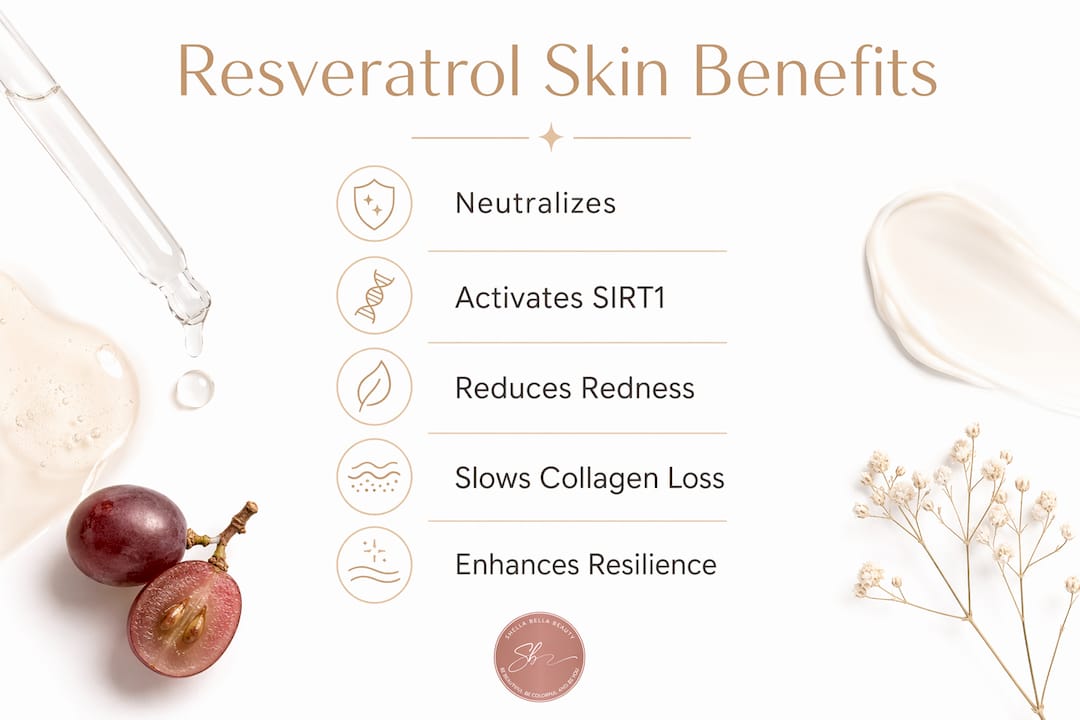
Resveratrol is a polyphenolic antioxidant that activates SIRT1 and Nrf2 signaling pathways in skin cells, helping to neutralize oxidative damage, quiet inflammation, and support the structural proteins that keep skin resilient. For anyone navigating early photoaging, persistent redness, or the gradual loss of elasticity that accompanies shifting estrogen levels, it is one of the more thoughtfully supported ingredients in modern skincare. Shellabellabeauty formulates with this science in mind, selecting stabilized delivery systems that allow resveratrol to reach the skin layers where it can do its most meaningful work.
A few things worth knowing from the start:
- Resveratrol functions as both a free-radical scavenger and a cellular signaling modulator, meaning it works on two levels simultaneously.
- Its anti-inflammatory effects make it particularly well suited to sensitive skin, rosacea-prone skin, and skin that reacts easily to environmental stressors.
- It offers measurable photoprotective support, though it works alongside sunscreen rather than replacing it.
- Formulation quality determines real-world results. A resveratrol product in a clear jar is unlikely to deliver the same benefit as one in an opaque, airless pump.
Table of Contents
- What is resveratrol and why does topical application matter?
- How does resveratrol actually work in your skin cells?
- What skin benefits does the research consistently support?
- What does the clinical evidence actually show?
- Why formulation and delivery systems determine whether resveratrol works
- How to add resveratrol to your daily routine
- What pairs well with resveratrol and what to avoid
- Is resveratrol safe, and when should you consult a professional?
- How to choose an effective resveratrol product
- What should you realistically expect from resveratrol?
- Key Takeaways
- Why resveratrol belongs in a considered skincare ritual
- Velvé™ Skin Renewal Serum: a stabilized antioxidant formula worth trying
- Useful sources and further reading
- FAQ
What is resveratrol and why does topical application matter?
Resveratrol is a naturally occurring polyphenol, specifically a stilbenoid, produced by plants under stress from UV exposure, fungal infection, or physical injury. The form that matters most for skincare is trans-resveratrol, the bioactive isomer that retains antioxidant activity and cellular signaling properties. You will find it naturally in grape skins, Japanese knotweed (Polygonum cuspidatum, the most concentrated botanical source), blueberries, cranberries, and peanuts.
The question of topical versus dietary resveratrol is worth addressing plainly. Eating grapes or drinking red wine will not deliver meaningful concentrations to your skin. Dietary resveratrol is rapidly metabolized after absorption, and the amounts reaching the epidermis and dermis through systemic circulation are negligible for cosmetic purposes. A well-formulated topical product, by contrast, deposits active resveratrol directly at the site where you want it to work.
When you scan a label, look for “trans-resveratrol” by name. Terms like “stabilized resveratrol,” “encapsulated resveratrol,” or named delivery systems such as liposomes or cyclodextrin complexes signal that the formulator has addressed the ingredient’s well-known instability. A product that simply lists “resveratrol” without any stabilization language may not preserve activity through its shelf life.
How does resveratrol actually work in your skin cells?
Resveratrol works by simultaneously neutralizing free radicals and activating two protective cellular pathways, SIRT1 and Nrf2, that govern how skin cells respond to oxidative stress and inflammation.
Think of SIRT1 as a cellular maintenance regulator. When resveratrol activates it, the pathway helps reduce the production of inflammatory signals and supports the repair processes that keep skin functioning well. Nrf2 is the skin’s internal antioxidant coordinator: once activated, it switches on a cascade of protective enzymes that neutralize reactive oxygen species before they can degrade collagen or trigger chronic low-grade inflammation. A PMC review of cutaneous functions describes how resveratrol upregulates SIRT1 expression, which in turn increases Nrf2 activity and the phase-2 antioxidant enzymes that protect skin from UV-induced and oxidative damage.
What this means at the surface of your skin: less visible redness over time, a slower rate of collagen breakdown, and improved elasticity as fibroblasts are supported rather than stressed. Resveratrol also inhibits matrix metalloproteinases (MMPs), the enzymes responsible for degrading the collagen and elastin fibers that give skin its firmness. When MMP activity is kept in check, the structural matrix holds together more gracefully.
This is a fundamentally different mechanism from retinol, which primarily stimulates cell turnover and collagen production. Resveratrol protects and repairs; retinol rebuilds. That distinction is precisely why the two can complement each other in a thoughtfully sequenced routine rather than competing for the same outcome.
What skin benefits does the research consistently support?
Resveratrol’s most well-documented benefits span anti-aging, photoprotection, inflammation reduction, and pigmentation support, with the strongest evidence coming from laboratory and preclinical studies and more modest but encouraging signals from small human trials.
-
Antioxidant defense and anti-aging. In vitro studies consistently show resveratrol scavenges free radicals and reduces oxidative stress markers in skin cells. Human trial data is limited in scale but supports improvements in visible elasticity and fine lines with consistent use of stable formulas.
-
Photoprotection. Cell studies demonstrate that resveratrol applied before or shortly after UV exposure reduces inflammatory cytokines (including IL-6, IL-8, and TNF-α) and lowers MMP-1 expression in dermal fibroblasts, while increasing procollagen and elastin. This positions it as a meaningful complement to SPF, not a replacement.
-
Calming inflammation and redness. Resveratrol’s anti-inflammatory and tolerability profile makes it one of the few active ingredients dermatologists commonly recommend for sensitive skin, rosacea, and eczema-prone skin. It soothes without the initial adjustment period associated with retinol or acids.
-
Pigmentation support. Resveratrol inhibits melanogenesis, the process by which melanin is produced, making it a useful supporting ingredient for uneven tone and post-inflammatory hyperpigmentation, particularly when paired with stable vitamin C derivatives or niacinamide.
-
Wound healing and barrier support. Preclinical studies indicate resveratrol accelerates wound healing and supports keratinocyte differentiation, which contributes to a more resilient skin barrier over time.
-
Elasticity in peri- and post-menopausal skin. Expert commentary highlights this subgroup as particularly responsive, given that declining estrogen accelerates collagen loss and oxidative stress. Resveratrol’s SIRT1-mediated support for fibroblast function aligns well with these specific needs.
The role of antioxidants in skincare more broadly helps contextualize why resveratrol stands out: it is one of the few antioxidants that also modulates cellular signaling rather than simply scavenging reactive oxygen species.
What does the clinical evidence actually show?
The honest answer is encouraging but measured. Resveratrol has strong preclinical signals and a growing body of small human trials, but large-scale, long-duration clinical studies are still limited.
A PMC narrative review summarizing preclinical and clinical research found meaningful evidence for photoprotection, reduced MMP activity, and improved repair, while noting that human trial data remains modest in scale and duration. A Frontiers in Nutrition review identified improving bioavailability and conducting larger clinical trials as the field’s primary research priorities.
The practical limitations worth understanding:
- Small sample sizes. Most human trials involve fewer than 50 participants, making it difficult to draw broad conclusions.
- Short follow-up periods. Many studies run for 8–12 weeks, which may not capture the full benefit of a long-term resilience ingredient.
- Formulation-dependent results. Studies using unstabilized or poorly delivered resveratrol show weaker effects, which complicates comparisons across trials.
- Dosage unknowns. Optimal topical concentrations have not been definitively established; effective ranges vary by delivery system.
The practical implication: expect gradual, incremental improvements over several months of consistent use, not a dramatic overnight shift. Resveratrol rewards patience and a steady routine more than any single application.
Why formulation and delivery systems determine whether resveratrol works

Resveratrol is a fragile molecule. Light, heat, and oxygen degrade it relatively quickly, and a product that has not been formulated with this in mind may deliver little active ingredient to your skin by the time you use it.
The most important formulation concepts to understand:
- Trans vs. cis isomers. Trans-resveratrol is the bioactive form. Cis-resveratrol, which can form when trans-resveratrol degrades, has significantly reduced activity. A quality product specifies “trans-resveratrol” on the label.
- Encapsulation systems. Liposomes and ethosomes wrap resveratrol in lipid bilayers that protect it from degradation and improve penetration into the epidermis and dermis.
- Cyclodextrin complexes. These molecular “cages” stabilize resveratrol by shielding it from environmental exposure while allowing controlled release at the skin surface.
- Pro-esters. Resveratryl triacetate is a pro-ester form that improves shelf life and reduces the color change that signals degradation, while converting back to active resveratrol on the skin.
Modern encapsulation and nanotechnology approaches have meaningfully addressed the historical bioavailability limitations that made earlier resveratrol products less reliable.
Pro Tip: Store your resveratrol product away from direct sunlight and heat. An opaque, airless pump or laminated tube preserves potency far better than a clear bottle or open jar, which expose the formula to the light and oxygen that degrade trans-resveratrol most rapidly.
A practical shopping checklist:
- Look for “trans-resveratrol” specifically named in the ingredient list.
- Prefer products that name a delivery system: liposomal, encapsulated, cyclodextrin-complexed, or a pro-ester form.
- Choose opaque, airless packaging. Avoid clear bottles and wide-mouth jars.
- Check for supporting antioxidants (vitamin E, vitamin C derivatives) that help stabilize the formula.
How to add resveratrol to your daily routine
Resveratrol can be used morning and evening, and dermatologists commonly recommend both, with the morning application focused on antioxidant defense before sun exposure and the evening application supporting overnight repair.
Morning routine
- Cleanse with a gentle, pH-balanced cleanser suited to your skin type.
- Apply your resveratrol serum to clean, slightly damp skin. A few drops pressed gently into the face and neck is sufficient.
- Layer a moisturizer to seal in the serum and support the skin barrier.
- Finish with broad-spectrum SPF 30 or higher. Resveratrol’s photoprotective properties work best when paired with sunscreen, not instead of it.
Evening routine
- Cleanse thoroughly to remove SPF, makeup, and the day’s environmental residue.
- Apply your resveratrol serum as the first active step on clean skin.
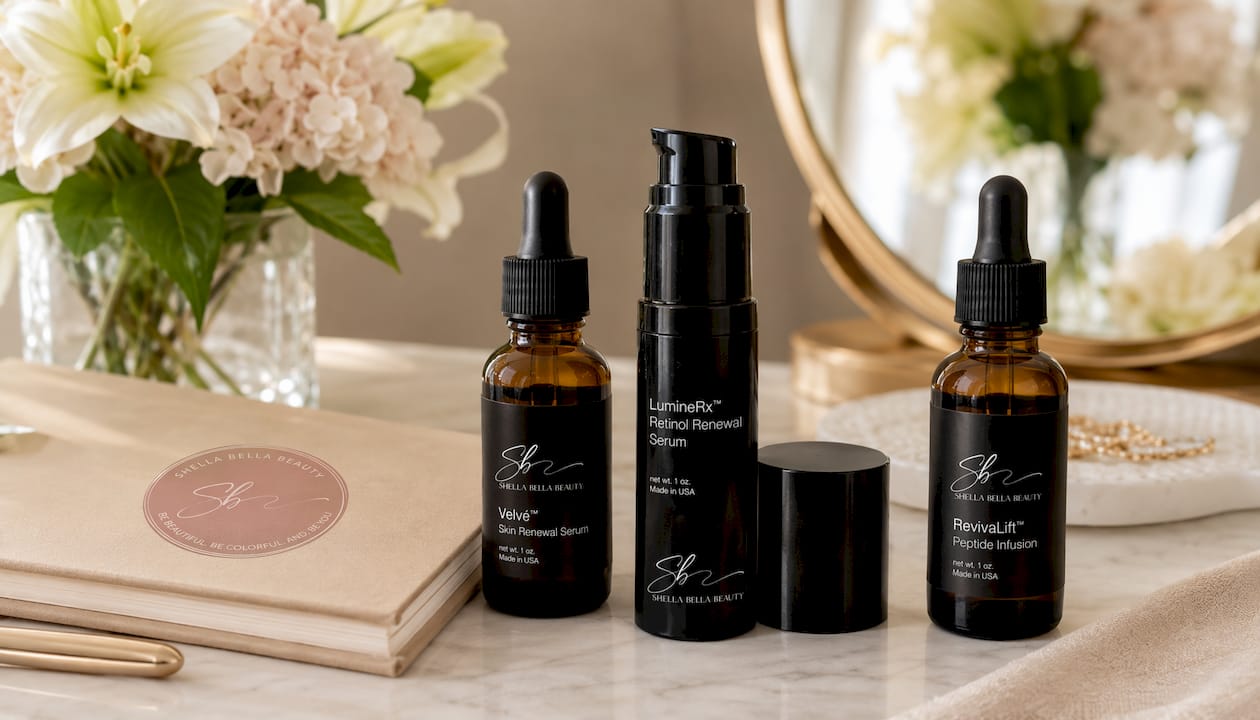
- If you use a retinol product such as the LumineRx™ Retinol Renewal Serum, apply it after the resveratrol serum has absorbed, or on alternating evenings if your skin is new to both actives. The two work on complementary pathways and can be used together once your skin has acclimated.
- Seal with a richer moisturizer or a peptide-based formula like the RevivaLift™ Peptide Infusion to support elasticity and overnight recovery.
For a more detailed approach to sequencing actives at night, the overnight skin renewal routine guide from Shellabellabeauty’s Glow Chronicles walks through layering order and timing.
Patch testing
Before incorporating any new active, apply a small amount to the inner forearm or behind the ear for two to three consecutive days. If no redness, itching, or swelling develops, proceed with facial use. Sensitive skin types should introduce resveratrol on alternate days for the first two weeks before moving to daily use.
Visible results typically require consistent use over several weeks to months. Treat it as a long-term investment in your skin’s resilience rather than a corrective treatment with a short timeline.
What pairs well with resveratrol and what to avoid
Resveratrol pairs well with most antioxidants and can complement retinol when layered thoughtfully, though a few actives warrant some care in sequencing.
| Active | Pairing guidance |
|---|---|
| Vitamin C (stable derivatives) | Pairs well. Complementary antioxidant action; look for ascorbyl glucoside or tetrahexyldecyl ascorbate for stability. |
| Niacinamide | Pairs well. Supports pigmentation goals and barrier function without conflict. |
| Peptides | Pairs well. Resveratrol’s protective role complements peptides’ collagen-stimulating action. |
| Retinol | Use with care. Apply resveratrol first, allow absorption, then apply retinol. Alternate evenings if new to both. |
| AHAs / BHAs | Use with care. Acids lower skin pH; apply resveratrol on a separate step or alternate evenings to avoid potential irritation. |
| Benzoyl peroxide | Separate or avoid combining. Oxidizing agents can degrade resveratrol and increase irritation risk. |
| Pure L-ascorbic acid (high concentration) | Use with care. Both are acidic; layering high-concentration vitamin C with resveratrol may cause sensitivity in reactive skin. |
A few practical notes on sequencing and combining:
- Apply resveratrol before heavier creams and oils; serums go on first, closest to clean skin.
- For pigmentation goals, pairing resveratrol with niacinamide and a stable vitamin C derivative in the morning, followed by SPF, is a well-regarded combination among dermatologists.
- Avoid mixing resveratrol with strong oxidizing actives in the same application step.
- If you are using renewal oil as a final step, apply it after your resveratrol serum and moisturizer have absorbed fully.
Dermstore’s ingredient guidance notes that stable resveratrol formulas can be used alongside retinol without conflict, provided the skin has been introduced to both gradually.
Is resveratrol safe, and when should you consult a professional?
Resveratrol is generally well tolerated across most skin types, and its gentle profile is one of the reasons it appears frequently in formulas designed for sensitive and reactive skin. That said, no active ingredient is universally without risk, and a few considerations deserve attention.
Watch for these signals that suggest your skin needs a slower introduction or a different formula:
- Persistent redness, stinging, or itching that does not resolve within 24 hours of application.
- A yellow or brown discoloration in the product itself, which signals oxidative degradation and reduced activity.
- Breakouts or increased congestion, which may indicate a formulation issue rather than resveratrol itself.
A few points worth clarifying:
- Resveratrol is not photosensitizing. Unlike retinol or AHAs, it does not increase UV sensitivity, though pairing it with SPF remains best practice for any antioxidant used in the morning.
- Resveratrol is a phytoestrogen, meaning it has a mild structural resemblance to estrogen. At typical topical concentrations, this is not considered clinically significant, but individuals with hormone-sensitive conditions should discuss it with their physician before use.
- If you are pregnant, nursing, or managing a systemic condition that involves medication interactions, consult a dermatologist or healthcare provider before adding any new active to your routine.
Seek professional guidance if you experience a severe allergic reaction (significant swelling, hives, or difficulty breathing), or if you are using prescription topicals and are uncertain about interactions.
How to choose an effective resveratrol product
Prioritize stabilized forms and protective packaging above all else. The ingredient name on a label means little if the formula has not been designed to keep resveratrol active through its shelf life and into your skin.
A practical checklist for evaluating any resveratrol product:
- Form: “Trans-resveratrol” should be named specifically, not just “resveratrol.”
- Delivery system: Look for liposomal, encapsulated, cyclodextrin-complexed, or pro-ester (resveratryl triacetate) language.
- Packaging: Opaque, airless pump or laminated tube. Avoid clear bottles and open jars.
- Supporting ingredients: Vitamin E, ferulic acid, or stable vitamin C derivatives help stabilize the formula and extend antioxidant benefit.
- Brand transparency: Brands that name their delivery technology and explain their stabilization approach are more likely to have invested in formulation quality.
- Concentration guidance: While optimal topical concentrations are not definitively established, products that name a percentage (typically 0.1%–1%) and explain their delivery system are more credible than those that do not.
As examples of how resveratrol fits into a complete routine, the Velvé™ Skin Renewal Serum represents a stabilized antioxidant serum designed for daily use, while the LumineRx™ Retinol Renewal Serum and RevivaLift™ Peptide Infusion illustrate how resveratrol can be sequenced alongside retinol and peptides for a layered, complementary approach to aging skin. A serum routine for fine lines offers additional guidance on how to layer these actives with intention.
What should you realistically expect from resveratrol?
Resveratrol is a long-term resilience ingredient, not a rapid corrective. With a stabilized formula used consistently over months, you can reasonably expect a quieter inflammatory baseline, gradual improvement in skin tone evenness, and a slower rate of visible aging. What it will not do is replace SPF, substitute for retinol’s cell-turnover effects, or produce visible change in a week.
The formulation insight that most consumer-facing coverage underemphasizes: the visible impact of resveratrol depends more on the delivery system than on the ingredient name itself. A well-encapsulated formula at a modest concentration will outperform a poorly stabilized product at a higher one, because active resveratrol that reaches the dermis is the only kind that matters.
Pro Tip: When reading a product label, treat “resveratrol” alone as a starting point, not a guarantee. The words “trans-resveratrol,” “liposomal,” “encapsulated,” or “resveratryl triacetate” are the signals that a brand has done the formulation work. Marketing language about “powerful antioxidants” without those specifics is worth questioning.
Dermatologists clarify what might be called the red wine myth: topical resveratrol uses concentrated, stabilized forms and creates no systemic effects. It is a targeted topical antioxidant, and its value lies in consistent, patient application rather than any single dramatic result.
Key Takeaways
Resveratrol’s real-world effectiveness depends on formulation quality, consistent use, and pairing with SPF, not on the ingredient name alone.
| Point | Details |
|---|---|
| Choose stabilized forms | Look for “trans-resveratrol” with a named delivery system (liposomal, encapsulated, or pro-ester). |
| Pair with SPF daily | Resveratrol supports photoprotection but does not replace broad-spectrum sunscreen. |
| Expect gradual results | Visible improvements in tone and elasticity typically emerge after eight to twelve weeks of consistent use. |
| Patch-test first | Apply to the inner forearm for two to three days before facial use, especially for sensitive skin. |
| Shellabellabeauty’s approach | The Velvé™ Skin Renewal Serum is formulated as a stabilized antioxidant serum for daily AM and PM use. |
Why resveratrol belongs in a considered skincare ritual
At Shellabellabeauty, we include resveratrol in our formulations because it aligns with a philosophy we hold deeply: that the most meaningful skincare works with the skin’s own intelligence rather than overriding it. Resveratrol does not force a result. It activates the pathways your skin already uses to protect and restore itself, and it does so gently enough to be welcomed by even the most reactive complexions. Our commitment to stabilized delivery systems reflects the understanding that an ingredient is only as valuable as its ability to arrive intact at the site where it is needed. Through the Glow Chronicles, we continue to share the science behind every choice we make, because we believe that an informed approach to skincare is the most luxurious one of all.
Velvé™ Skin Renewal Serum: a stabilized antioxidant formula worth trying
For those ready to bring resveratrol into their daily ritual, the Velvé™ Skin Renewal Serum from Shellabellabeauty offers a stabilized antioxidant formula designed for both morning and evening use. It is the kind of serum that earns its place quietly, working at the cellular level to support your skin’s natural defenses over time.
Before your first use, apply a small amount to the inner forearm for two to three days to confirm compatibility. Once introduced, use it as the first active step after cleansing, morning and evening, before moisturizer and SPF. Visit the product page to learn more about the formulation and find the routine that suits your skin’s particular needs.
Useful sources and further reading
The sources below represent peer-reviewed reviews, clinical studies, and dermatologist-reviewed resources that informed this guide. They are selected for authority and accessibility.
| Source | What it covers |
|---|---|
| Role of Resveratrol in Regulating Cutaneous Functions — PMC | Comprehensive review of resveratrol’s mechanisms and skin benefits, including SIRT1, Nrf2, UV protection, and anti-aging evidence. |
| Health Benefits and Molecular Mechanisms of Resveratrol — PMC | Narrative review covering antioxidant pathways, photoprotection, and the case for improved delivery systems. |
| Multidimensional Biological Activities of Resveratrol — Frontiers in Nutrition | Broad review identifying bioavailability and larger clinical trials as research priorities. |
| Resveratrol for Skin — Healthline | Accessible consumer summary of benefits, tolerability, and routine guidance. |
| What Is Resveratrol? — Dermstore | Dermatologist-reviewed ingredient explainer covering routine use, pairing, and the retinol distinction. |
| Resveratrol in Skincare — DrBeautiology | Expert formulation and delivery system guidance; topical vs. oral comparison; packaging advice. |
| Benefits of Resveratrol for Your Skin Care Routine — CNN Underscored | Consumer-facing coverage with dermatologist commentary and product context. |
FAQ
What does resveratrol do for your face?
Resveratrol neutralizes free radicals, reduces inflammation, supports collagen integrity by inhibiting MMP activity, and helps protect skin from UV-related damage. With consistent use of a stabilized formula, it can improve visible elasticity, even skin tone, and calm persistent redness over time.
Which is better for skin, retinol or resveratrol?
They serve different purposes and work best together rather than in competition. Retinol primarily stimulates cell turnover and collagen production, while resveratrol protects against oxidative stress and inflammation. Layering a resveratrol serum before retinol in an evening routine allows both to contribute their distinct benefits.
What is the downside of resveratrol in skincare?
The main limitation is instability: resveratrol degrades with light, heat, and oxygen, so a poorly formulated or packaged product may deliver little active ingredient. Human clinical trials also remain small in scale, meaning long-term efficacy data is still developing. Rare irritation is possible, particularly with unstabilized formulas.
What should you not mix with resveratrol?
Avoid combining resveratrol with strong oxidizing agents like benzoyl peroxide in the same application step, as these can degrade the ingredient and increase irritation risk. High-concentration L-ascorbic acid may cause sensitivity in reactive skin when layered directly with resveratrol; stable vitamin C derivatives are a gentler pairing.
Recommended
- Prebiotics in Skincare Explained: Science and Benefits – Shella Bella Beauty™
- The Role of Antioxidants in Skincare Explained – Shella Bella Beauty™
- What Is Probiotic Skincare? Your 2026 Science Guide – Shella Bella Beauty™
- The Role of Collagen Skincare in Healthy, Radiant Skin – Shella Bella Beauty™
- Join Glow Chronicles™ — Continue the Glow™ with editor’s picks, seasonal beauty rituals, exclusive skincare insights, and new editions delivered to your inbox.