

Wellbeing is a multifaceted state of thriving that encompasses physical, mental, emotional, and social health — and according to the Centers for Disease Control and Prevention, it extends well beyond the mere absence of disease to include your capacity to cope, work productively, and contribute meaningfully to the people around you. The World Health Organization (WHO), the CDC, the National Institutes of Health (NIH), and Merriam-Webster all frame it as a dynamic, multi-dimensional state rather than a fixed condition.
- Wellbeing spans at least four core domains: physical, mental, emotional, and social health.
- Strong wellbeing buffers the effects of stress, supports faster recovery, and is linked to longer, more productive lives.
- WHO reports that mental disorders account for 1 in 6 years lived with disability globally, underscoring how central mental health is to overall wellbeing.
- Daily habits — sleep, movement, mindfulness, and social connection — are among the most modifiable influences on personal wellbeing.
- When self-care practices are not enough, professional support is available; in the U.S., the 988 Suicide and Crisis Lifeline offers immediate help.
Key Takeaways
Wellbeing is a dynamic, multidimensional state — and the most durable improvements come from attending to several of its domains with consistency and care.
| Point | Details |
|---|---|
| Wellbeing spans four core domains | Physical, mental, emotional, and social health all interact; neglecting one affects the others. |
| Mental health carries enormous global weight | WHO data shows mental disorders account for a substantial portion of years lived with disability worldwide. |
| Daily habits are the most modifiable lever | Sleep, movement, mindfulness, and social connection yield measurable wellbeing benefits. |
| Know when to seek professional help | Persistent distress lasting more than two weeks warrants clinical support; call or text 988 in the U.S. |
| Shellabellabeauty supports the practice | Curated rituals and Glow Chronicles content help translate wellbeing knowledge into consistent daily care. |
Table of Contents
- What does “wellbeing” actually mean?
- What are the core components of wellbeing?
- Why does wellbeing matter so much?
- What shapes your wellbeing most?
- How can you improve your wellbeing, practically?
- How is wellbeing measured?
- How do global frameworks and national policy address wellbeing?
- How mindful beauty rituals can support your wellbeing
- Wellbeing rituals, curated with intention
- Sources
- FAQ
What does “wellbeing” actually mean?
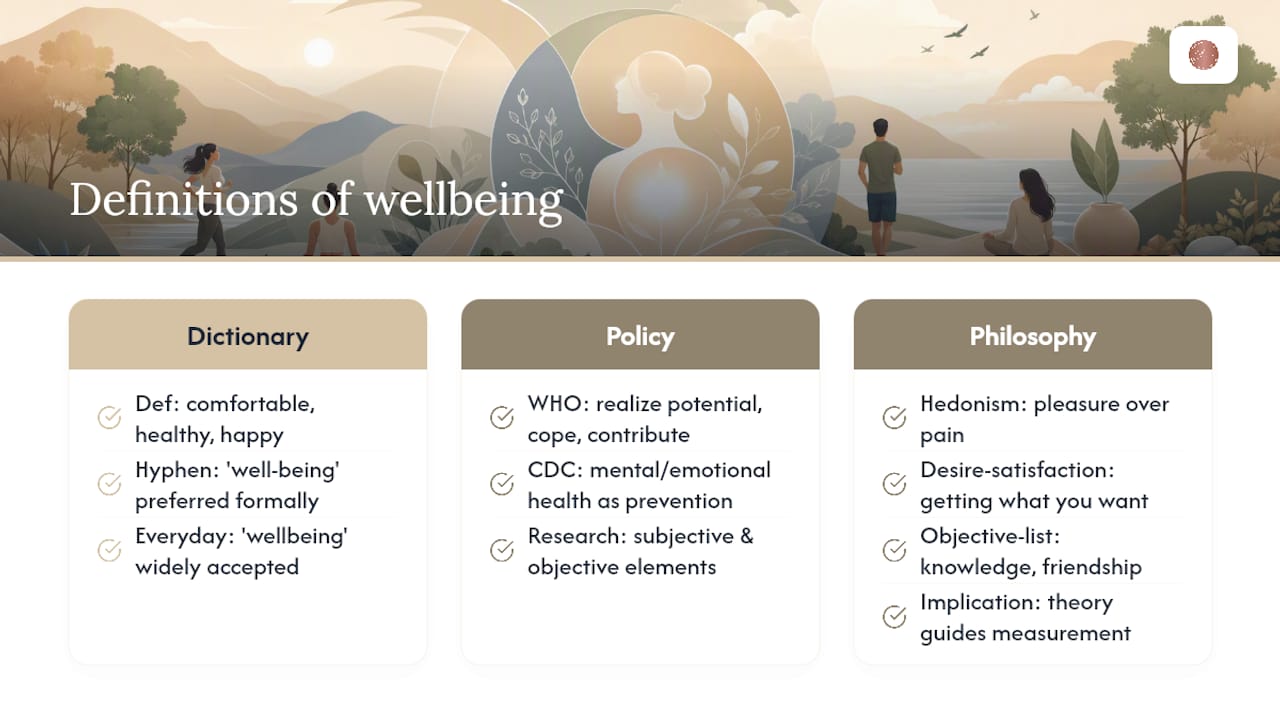
The word itself carries more precision than most people realize. Cambridge Dictionary defines wellbeing as the state of being comfortable, healthy, or happy, and notes that the hyphenated form “well-being” is preferred in formal and academic writing, while “wellbeing” as a single word is increasingly accepted in everyday and editorial contexts. Neither form is wrong; the choice reflects register rather than correctness.
Policy bodies add considerably more depth. The WHO frames it as a condition in which individuals realize their potential, cope with normal life stresses, work productively, and contribute to their communities. The CDC echoes this, positioning emotional and mental health as preventive resources — not merely clinical concerns. A scoping review published in PMC confirmed that wellbeing is used across disciplines with diverse operational definitions, though subjective and objective elements appear consistently across them.
Philosophically, three major theories compete for dominance. Hedonism equates wellbeing with the balance of pleasure over pain. Desire-satisfaction theories hold that wellbeing means getting what you want. Objective-list theories argue that certain things — knowledge, friendship, achievement — contribute to a good life regardless of whether you desire them. The Stanford Encyclopedia of Philosophy traces these distinctions carefully, and they matter practically: which theory you accept shapes which indicators you use to measure wellbeing in research or policy.
Pro Tip: When writing formally — in academic papers, policy briefs, or clinical documents — use “well-being” with a hyphen. In blog posts, editorial content, and everyday communication, “wellbeing” as one word reads naturally and is widely accepted.
What are the core components of wellbeing?
Wellbeing is not a single dial you can turn up. It is better understood as a constellation of interconnected domains, each of which can be assessed and, with intention, strengthened.
Primary domains:
- Physical wellbeing refers to the body’s functional capacity — sleep quality, nutrition, movement, and freedom from chronic pain. A practical indicator: waking most mornings feeling rested rather than depleted.
- Mental wellbeing covers cognitive function, emotional regulation, and the absence of debilitating psychological distress. Mood stability across a typical week is a useful everyday signal.
- Emotional wellness is the ability to identify, express, and process feelings constructively. Someone with strong emotional wellness can name what they feel and respond rather than react.
- Social wellbeing reflects the quality and depth of your relationships and sense of belonging. A reliable support network — even a small one — is one of the most consistent predictors of resilience.
Secondary domains that researchers and policy bodies increasingly recognize:
- Economic wellbeing: financial security sufficient to meet needs without chronic anxiety.
- Environmental wellbeing: access to safe, clean surroundings that support health.
- Spiritual wellbeing: a sense of meaning, purpose, or connection to something larger than oneself.
The interplay between domains is where things get interesting. Chronic sleep deprivation, for example, measurably impairs emotional regulation — meaning a physical deficit directly undermines emotional wellness. Conversely, strong social support has been shown to accelerate physical recovery after illness, illustrating how the social domain feeds back into the physical. Treating any single domain in isolation tends to produce limited results; the most durable improvements come from attending to several at once.
Why does wellbeing matter so much?
The evidence is both sweeping and specific. WHO data shows that more than a billion people globally live with a mental health condition, and that people with severe mental health conditions have a notably reduced life expectancy compared to the general population. That gap is not primarily explained by suicide; it reflects the physical toll of untreated psychological distress on the body.
Statistic to hold: Mental disorders account for 1 in 6 years lived with disability worldwide, making mental health one of the leading contributors to the global burden of disease.
At the individual level, the practical implications are tangible:
- Higher wellbeing correlates with stronger immune response, lower rates of cardiovascular disease, and faster recovery from acute illness.
- People who report greater life satisfaction tend to perform better at work, maintain relationships more effectively, and show greater persistence when facing setbacks.
- Emotional wellness, specifically, is linked to improved sleep quality and lower risk of chronic disease, as health research consistently notes.
Wellbeing also functions as a buffer. When stress arrives — and it always does — people with higher baseline wellbeing tend to return to equilibrium faster. The CDC positions this buffering capacity as a core reason to treat emotional wellbeing as a preventive resource, not a luxury.
What shapes your wellbeing most?
Determinants of wellbeing operate at several levels simultaneously, and understanding which levers you can actually reach is the first step toward meaningful change.
Individual determinants include sleep duration and quality, physical activity, coping skills, diet, and income. These are the factors most directly within personal reach, though income is shaped by structural forces as much as individual effort.
Interpersonal factors include the quality of close relationships, family dynamics, and workplace culture. Social support is particularly powerful: having people you can call in a crisis is one of the strongest individual predictors of resilience, according to NIH guidance on emotional wellness.
Structural determinants are the conditions that shape whole populations: access to affordable healthcare, neighborhood safety, exposure to discrimination, housing stability, and environmental quality. These factors explain why wellbeing is not evenly distributed across communities, and why individual-level interventions alone cannot close population-level gaps. WHO’s policy frameworks consistently emphasize that multisector action — across health, education, housing, and employment — is necessary to shift population wellbeing at scale.
Pro Tip: If you are looking for the highest personal return on limited time, research consistently points to two levers: sleep and social connection. Protecting seven to nine hours of sleep and maintaining at least one or two close relationships yields measurable benefits across nearly every other domain.
How can you improve your wellbeing, practically?
Evidence-based improvement does not require a complete life overhaul. Small, consistent practices compound over time, and the NIH and CDC have both identified the specific actions most likely to move the needle.
- Prioritize sleep hygiene. NIH recommends that most adults get sufficient sleep each night for optimal wellbeing, typically a moderate amount of hours. A consistent sleep and wake time — even on weekends — stabilizes mood and cognitive function more reliably than any supplement.
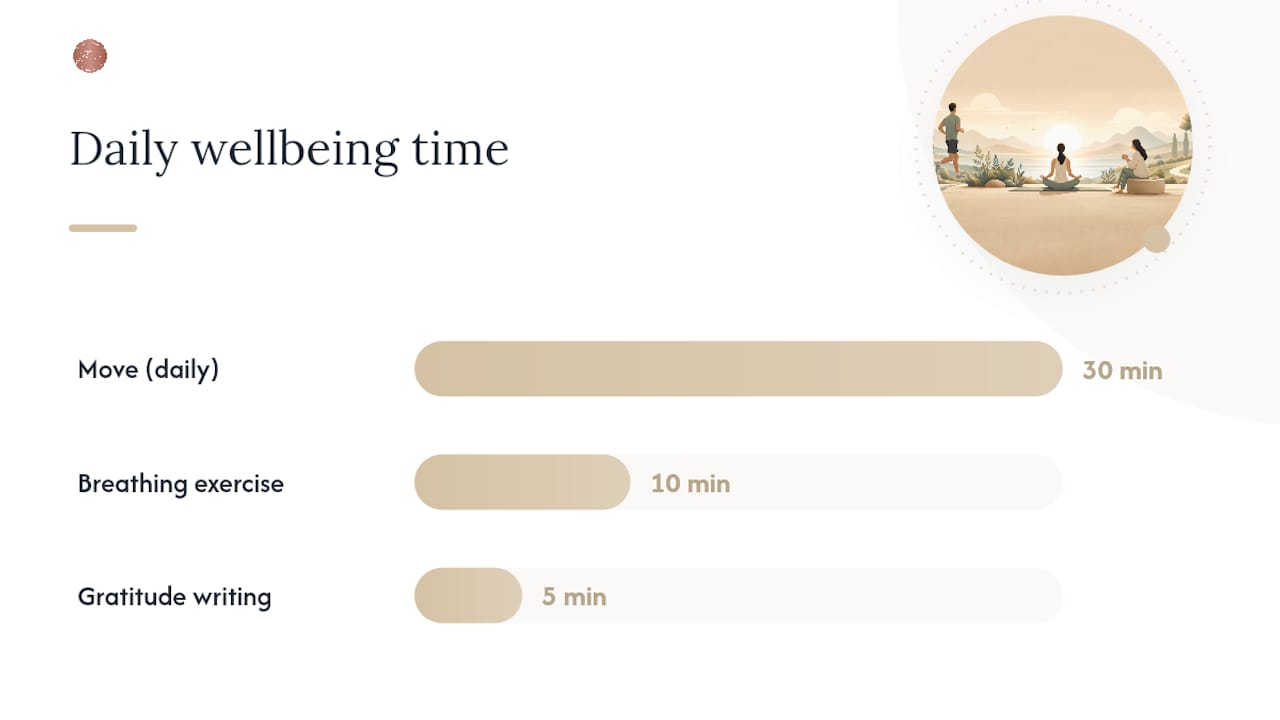
- Move your body for at least 30 minutes daily. Walking, cycling, swimming, or any sustained movement reduces cortisol, supports cardiovascular health, and improves mood through well-documented neurochemical pathways.
- Practice mindfulness or intentional presence. This does not require formal meditation. CDC guidance notes that mindfulness can be woven into daily self-care — a deliberate, sensory-focused skincare routine, for example, can serve as a grounding practice that downregulates the nervous system.
- Keep a brief gratitude practice. Five minutes of writing down three specific things you appreciated that day has a measurable effect on positive affect over time, according to NIH emotional wellness recommendations.
- Strengthen at least one relationship. A single phone call, a shared meal, or a consistent check-in with someone you trust contributes meaningfully to social wellbeing.
- Seek professional support when needed. Self-care practices are genuinely useful, but they are not a substitute for clinical care.
Red flags that signal it is time to contact a clinician:
- Persistent low mood, hopelessness, or loss of interest lasting more than two weeks.
- Sleep disruption, appetite changes, or physical symptoms without a clear medical cause.
- Difficulty functioning at work, in relationships, or in daily tasks.
- Thoughts of self-harm or suicide — in the U.S., call or text 988 (Suicide and Crisis Lifeline) for immediate support.
Pro Tip: Micro-practices matter. A 10-minute breathing exercise before bed, a five-minute gratitude note in the morning, or a mindful self-care beauty ritual in the evening are all legitimate entry points into a more intentional relationship with your own wellbeing.
How is wellbeing measured?
Measurement is where the concept becomes genuinely complex. Wellbeing is dynamic rather than fixed, which means a single snapshot rarely captures the full picture.
Subjective measures ask individuals to report their own experience. Common tools include:
- The Satisfaction With Life Scale (SWLS), a five-item questionnaire assessing global life satisfaction.
- The Positive and Negative Affect Schedule (PANAS), which measures the balance of positive and negative emotional states.
- PERMA elements (Positive emotion, Engagement, Relationships, Meaning, Accomplishment), drawn from Martin Seligman’s positive psychology framework.
Objective and population-level indicators include income, employment rates, educational attainment, life expectancy, and access to healthcare. These are measurable without self-report and allow comparisons across communities and countries.
| Indicator type | Example measures | Key limitation |
|---|---|---|
| Subjective (individual) | Life satisfaction score, PANAS, SWLS | Shaped by mood, cultural norms, and reference points |
| Objective (population) | Life expectancy, income, employment rate | May miss how people actually experience their conditions |
The PMC scoping review found that operational definitions of wellbeing vary considerably across disciplines, which means two studies using the word “wellbeing” may be measuring quite different things. For individuals, repeated brief self-assessments over time tend to be more informative than a single measure. For populations, longitudinal tracking across multiple indicators gives the most reliable signal.
How do global frameworks and national policy address wellbeing?
Wellbeing has moved from a philosophical concept to a policy priority. The WHO’s Comprehensive Mental Health Action Plan and its Special Initiative for Mental Health set concrete targets for expanding mental health services, reducing treatment gaps, and integrating mental health into primary care systems worldwide.
WHO’s promoting well-being framework identifies social determinants — poverty, discrimination, lack of safe housing — as the upstream drivers of population wellbeing, and recommends policy levers across health, education, employment, and environment. Community-based care models and school-based mental health programs are among the approaches with the strongest evidence base for improving wellbeing at scale.
Policy signal: WHO’s Special Initiative for Mental Health targets coverage of quality mental health services for at least 100 million more people across priority countries, reflecting the scale of the treatment gap documented in its own data.
Implementation gaps remain significant. Even in high-income countries, many people with diagnosable mental health conditions never receive treatment. Structural barriers — cost, stigma, provider shortages, and geographic access — explain much of this gap, and closing it requires sustained investment rather than awareness campaigns alone.
How mindful beauty rituals can support your wellbeing
There is a biological rationale for treating your skincare routine as a wellbeing practice, not merely a cosmetic one. Chronic stress produces physiological effects — immune suppression, sleep disruption, elevated cortisol — that show up visibly in skin and felt experience alike. A deliberate, sensory-focused ritual creates a brief but meaningful pause in the nervous system’s stress response.
Practical examples of rituals that support presence and calm:
- Cleansing as a reset. Applying a gentle cleanser with slow, intentional strokes shifts attention from mental noise to physical sensation, a form of informal mindfulness the CDC recognizes as accessible and effective.
- Facial massage during moisturizer application. Light upward strokes stimulate circulation and, more importantly, anchor attention in the body rather than in anxious thought.
- A consistent evening routine. Predictable, sensory-rich rituals signal to the nervous system that the day is closing, supporting the transition into restful sleep.
These practices work best when they are consistent rather than elaborate. A five-minute mindful beauty ritual practiced daily builds more genuine calm than an occasional hour-long treatment. Shellabellabeauty’s Glow Chronicles offers detailed guidance on building these rituals in a way that honors both skin health and emotional wellness — you can explore the holistic beauty approach as a starting point.
Pro Tip: Pair your skincare routine with a single intentional breath before you begin. That one pause is enough to shift the ritual from automatic habit to a genuine act of self-care.
A note on scope: the practices described here support general wellbeing and are not a substitute for clinical mental health care. If you are experiencing persistent distress, please consult a qualified healthcare provider.
A note on how this guide was assembled
This guide draws on primary sources from the WHO, CDC, NIH, Cambridge Dictionary, and peer-reviewed literature, with the aim of being practical and non-prescriptive. The goal was to synthesize evidence accurately while keeping the guidance accessible to readers at different stages of their wellbeing knowledge. All recommendations reflect general information for a U.S. audience; specific health concerns should be discussed with a licensed clinician or local health services provider. Readers are encouraged to adapt any suggestion here to their own context, rhythm, and circumstances — wellbeing is personal, and no single framework fits every life.
This article provides general information only and is not a substitute for professional medical, psychological, or clinical advice. Please consult a qualified healthcare provider for guidance specific to your situation.
Wellbeing rituals, curated with intention

Knowing what supports wellbeing and building it into daily life are two different things. Shellabellabeauty was created for exactly that space between understanding and practice — offering premium skincare, haircare, and wellness products formulated to make mindful self-care feel less like a task and more like a quiet act of restoration. Where generic wellness advice offers broad strokes, Shellabellabeauty’s curated rituals and Glow Chronicles editorial content offer the specific, sensory guidance that turns intention into consistency.
Every product in the collection is chosen to support the kind of deliberate, present-moment ritual that research links to nervous-system calm and emotional balance. Whether you are building your first intentional routine or refining one you already love, the Shellabellabeauty collection is a considered place to begin. Browse the full range and find the ritual that fits your rhythm.
Sources
These are the primary sources cited throughout this guide, organized by purpose:
- Cambridge Dictionary — wellbeing
- NIH — Emotional Wellness toolkit
- WHO — Mental health: strengthening our response
- What is well-being? A scoping review of the conceptual and operational definitions of occupational well-being — PMC
FAQ
Is “well-being” one word or two?
Both forms are correct depending on context. Cambridge Dictionary notes that “well-being” with a hyphen is standard in formal and academic writing, while “wellbeing” as a single word is widely accepted in everyday and editorial use.
What do we mean by wellbeing?
Wellbeing refers to a multidimensional state of thriving that includes physical health, mental health, emotional wellness, and social connection. The CDC defines it as more than the absence of disease — it includes the capacity to cope, work productively, and contribute to community.
Is “wellness” the same as “wellbeing”?
Not exactly. Wellness tends to refer to active lifestyle choices and health behaviors, while wellbeing is a broader term that includes subjective experience, life satisfaction, and social and environmental conditions. Wellbeing encompasses wellness but extends further into psychological and social dimensions.
What is a word for wellbeing?
Common synonyms include flourishing, thriving, welfare, and health. In philosophical and academic contexts, “flourishing” (from the Greek eudaimonia) is often used to capture the fuller, multidimensional meaning that “wellbeing” carries in policy and research.
When should self-care give way to professional support?
When low mood, persistent anxiety, sleep disruption, or difficulty functioning lasts more than two weeks, or when thoughts of self-harm arise, professional support is the appropriate next step. In the U.S., call or text 988 to reach the Suicide and Crisis Lifeline at any time.
Recommended
- Holistic Beauty: What It Means and Why It Works – Shella Bella Beauty™
- Benefits of Mindful Beauty Rituals for True Well-Being – Shella Bella Beauty™
- Wellness Rituals for Glowing Skin: Your Daily Guide – Shella Bella Beauty™
- Why Hydration Affects Skin: What You Need to Know – Shella Bella Beauty™
- Join Glow Chronicles™ — Continue the Glow™ with editor’s picks, seasonal beauty rituals, exclusive skincare insights, and new editions delivered to your inbox.