

Dull skin is defined as skin that has lost its ability to reflect light evenly, resulting in a flat, lifeless, and uneven complexion. This condition, clinically described as hyperpigmentation-related radiance loss or simply impaired luminosity, rarely stems from one cause. Collagen and elastin decline naturally after your mid-twenties, weakening the structural support that gives skin its reflective quality. Dehydration, slowed cellular turnover, UV damage, and environmental stress all compound this process. Understanding why skin looks dull is the first step toward restoring the clarity your skin already holds within it.
What internal factors cause dull skin?
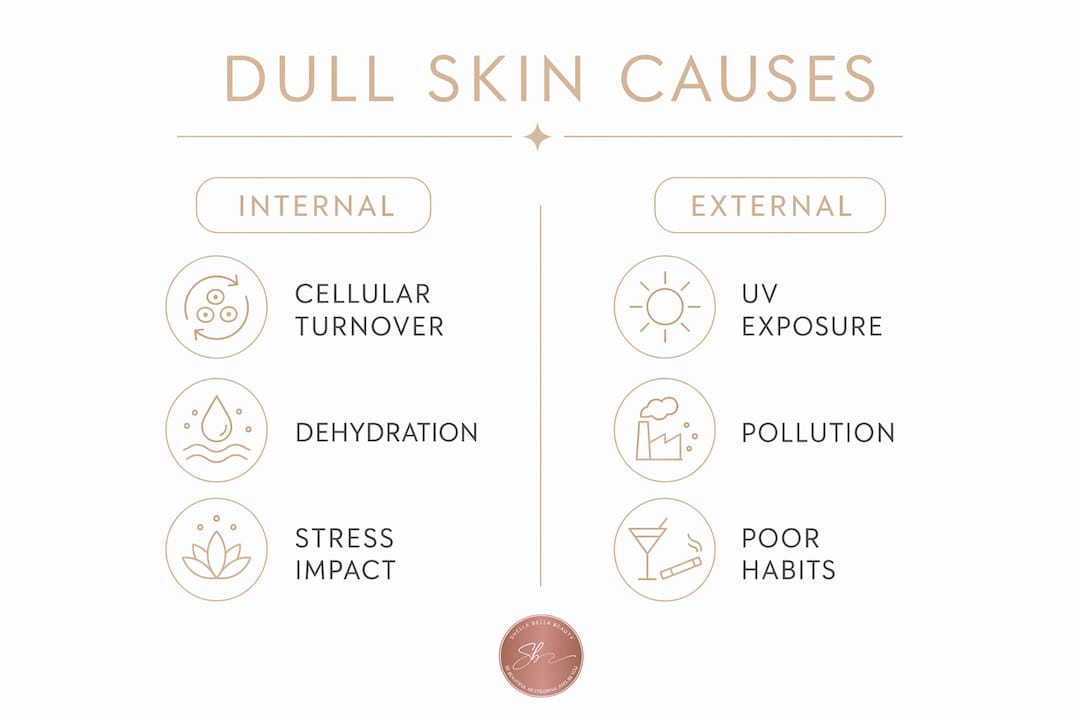
Dull skin most often begins from within, where biological processes quietly shift before any visible change appears on the surface. Four internal factors account for the majority of radiance loss, and they tend to work together rather than in isolation.
-
Dehydration. Lack of water reduces skin’s surface smoothness, directly diminishing its ability to reflect light. Dehydrated skin looks flat regardless of skin type, whether oily, dry, or combination. Even well-moisturized skin can be dehydrated at the cellular level if water intake is insufficient.
-
Slowed cellular turnover. Skin renews itself by shedding dead cells and generating fresh ones. When this cycle slows with age or stress, dead cells accumulate on the surface and scatter light unevenly. The result is the gray, muted tone many people associate with a dull complexion.
-
Collagen and elastin decline. These proteins form the scaffolding beneath your skin. As production decreases after your mid-twenties, skin loses the firmness and internal structure that support an even, luminous surface. This is why a 35-year-old’s skin can look noticeably less radiant than it did at 22, even with an identical routine.
-
Lymphatic stagnation and reduced microcirculation. Poor microcirculation impairs the delivery of oxygen and nutrients to skin cells, leaving skin looking tired and reactive. The lymphatic system also clears cellular waste; when it stagnates, that waste lingers and dulls the surface.
Pro Tip: Gentle facial massage for two to three minutes each morning stimulates microcirculation and lymphatic flow, offering a meaningful boost to radiance that no serum alone can replicate.
Chronically dull skin often signals impaired cellular turnover and tissue fatigue rather than a simple product deficit. Addressing these internal factors requires restoring function, not simply layering more products onto the surface.

Which external factors contribute to skin dullness?
External stressors accelerate every internal process described above. They are largely within your control, which makes understanding them particularly worthwhile.
-
Chronic UV exposure. Ultraviolet rays trigger oxidative stress that breaks down collagen and creates pigmentation irregularities. These dark spots and uneven patches scatter light rather than reflecting it, producing the patchy, uneven tone that defines a dull complexion.
-
Air conditioning and low humidity. Climate-controlled indoor air strips moisture from the skin surface, weakening the hydration barrier over time. Spending long hours in air-conditioned offices or heated rooms without compensating with topical hydration is one of the most overlooked causes of dull skin.
-
Pollution. Airborne particles deposit on skin and clog pores while generating free radicals that damage collagen. Urban skin exposed to daily pollution ages faster at the cellular level than skin in low-pollution environments.
-
Poor sleep and chronic stress. Sleep deprivation and stress reduce skin’s overnight repair efficiency, leading to sallowness and reduced vitality. Cortisol, the stress hormone, also breaks down collagen and impairs the skin barrier, compounding dullness over time.
-
Poor diet and smoking. Diets low in antioxidants deprive skin of the raw materials it needs to fight oxidative damage. Smoking constricts blood vessels, reducing the microcirculation that delivers oxygen and nutrients to skin cells.
Recognizing these factors matters because they often operate simultaneously. A person working long hours in an air-conditioned office, sleeping poorly, and commuting through urban pollution faces a compounding effect on skin brightness that no single remedy can address alone.
How do skincare routines and product use affect dull skin?
Skincare habits can either restore radiance or quietly worsen it, depending on how they are applied. The most common mistake is treating dullness as a deficit that requires more product rather than a signal that skin function needs support.
Over-exfoliation is the clearest example of this error. Excessive exfoliation damages the barrier lipids that hold moisture in and protect against environmental stress. Skin that is over-exfoliated becomes inflamed, reactive, and paradoxically duller than before. Physical scrubs carry the highest risk because their mechanical action is difficult to control and often too aggressive for compromised skin.
The current clinical direction favors skin cycling, a method that alternates active acids with hydration and barrier repair nights. This approach reduces irritation and gives skin the recovery time it needs between exfoliation sessions.
| Approach | Effect on skin radiance |
|---|---|
| Physical scrubs used daily | Disrupts barrier, increases inflammation, worsens dullness |
| Chemical exfoliation (AHAs) twice weekly | Removes dead cell buildup gently, improves light reflection |
| Skin cycling (actives + hydration alternated) | Supports barrier health while enabling renewal |
| Layering multiple actives simultaneously | Overwhelms barrier, triggers sensitivity and fatigue |
| Ceramide and niacinamide barrier support | Strengthens barrier, retains moisture, improves tone |
Barrier-fortifying ingredients like ceramides and niacinamide are not optional additions to a brightening routine. They are foundational. Ceramides restore the lipid matrix that holds skin cells together, while niacinamide reduces inflammation and supports skin barrier wellness. Without these, even the best exfoliation routine will produce diminishing returns.
Pro Tip: Antioxidant serums containing vitamin C applied in the morning neutralize free radicals from UV and pollution before they can damage collagen. Apply vitamin C before sunscreen for maximum protective effect.
What are practical methods to brighten dull skin effectively?
Restoring radiance follows a clear sequence. Each step builds on the one before it, and skipping foundational steps in favor of advanced treatments consistently produces disappointing results.
-
Prioritize hydration, inside and out. Drink adequate water throughout the day and apply a hydrating serum immediately after cleansing, while skin is still slightly damp. Hyaluronic acid draws moisture into the skin and holds it there, creating the plump, smooth surface that reflects light well. Shellabellabeauty’s RadiantRevive™ Hyaluronic Serum is formulated specifically for this purpose, delivering layered hydration that restores surface smoothness.
-
Introduce gentle chemical exfoliation. Clinical dermatology recommends starting with 5% lactic acid applied twice weekly for dull skin management. Lactic acid dissolves the bonds holding dead cells to the surface without the mechanical abrasion of physical scrubs. Start with two applications per week and assess your skin’s response before increasing frequency.
-
Build a barrier repair foundation. Apply a ceramide-rich moisturizer on nights when you are not exfoliating. This is the core principle of skin cycling: active nights followed by recovery nights. Your skin repairs itself most actively between 11:00 PM and 3:00 AM, so a nourishing barrier cream applied before bed works with your skin’s natural rhythm.
-
Add antioxidant protection daily. A vitamin C serum applied each morning protects collagen from UV and pollution-related oxidative damage. Consistent use over four to six weeks visibly brightens uneven tone and reduces the appearance of dark spots. Pair it with broad-spectrum SPF 30 or higher to prevent new UV-triggered pigmentation.
-
Incorporate facial massage. Improving tissue oxygenation and lymphatic drainage through gentle facial massage supports radiance beyond what topical products can achieve alone. Use upward strokes along the jawline and cheekbones for two to three minutes during your evening cleanse. A gua sha tool or clean fingertips both work well for this purpose.
-
Protect skin from UV every single day. Sunscreen is the single most effective tool for preventing accelerated dullness. UV exposure is the primary external driver of collagen breakdown and pigmentation unevenness. Apply SPF 30 or higher every morning, regardless of cloud cover or season.
These six steps address dullness at its root causes rather than masking it. Consistency over four to eight weeks produces measurable improvement in skin clarity, texture, and the quality of light reflection.
Key Takeaways
Dull skin results from a combination of internal biological decline and external stressors, and restoring radiance requires addressing both through consistent, barrier-respecting care.
| Point | Details |
|---|---|
| Dullness has multiple causes | Dehydration, slowed cell turnover, collagen decline, and UV damage all contribute simultaneously. |
| Internal factors come first | Microcirculation, hydration, and cellular renewal must be supported before topical treatments can work fully. |
| Over-exfoliation worsens dullness | Disrupting the barrier with harsh actives increases inflammation and reduces radiance over time. |
| Skin cycling is the current standard | Alternating exfoliation nights with barrier repair nights protects skin while enabling renewal. |
| Consistency outperforms intensity | Gentle, sustained routines restore radiance more reliably than aggressive short-term treatments. |
What I’ve learned about dull skin that most articles get wrong
Most conversations about dull skin frame it as a product problem. The assumption is that if your skin looks flat, you need a brighter serum, a stronger acid, or a new routine entirely. After years of working closely with skincare formulations and the science behind them, I find that framing genuinely misleading.
Dull skin is most often a signal of biological dysfunction, not a product deficit. When cellular turnover slows, when microcirculation is impaired, when the barrier is compromised, adding more active ingredients to the mix tends to make things worse. The skin is already under stress. Piling on retinoids, acids, and brightening actives simultaneously is like asking an exhausted person to run faster.
The shift I find most meaningful in current skincare thinking is the move toward restoring skin function rather than forcing results. Skin cycling, barrier repair, and microbiome balance are not trends. They reflect a more honest understanding of how skin actually works. Radiance is not manufactured by products. It is returned to skin that has been given the conditions to function well.
The other thing I would push back on is the urgency that surrounds dull skin. Skin does not lose its glow overnight, and it does not recover overnight either. The readers I see making the most meaningful progress are the ones who commit to a measured, consistent routine and give it eight weeks before evaluating. Patience is not passive. It is the most active choice you can make for your skin.
— Marshella
Shellabellabeauty’s approach to restoring skin radiance
Radiance is not something you add to skin. It is something you return to it by removing the obstacles that dim it.

Shellabellabeauty’s Renewal and Smoothing Skincare Rituals collection is built around this principle. Each formulation addresses the core drivers of dullness: dehydration, barrier disruption, and uneven texture. The collection pairs barrier-fortifying ingredients with gentle renewal actives, following the skin cycling approach that clinical guidance now recommends. For those whose dullness is rooted in dehydration, the deep hydration ritual offers a targeted path back to a smooth, light-reflecting surface. Every product is designed for consistent, gentle use that respects your skin’s natural rhythm rather than working against it.
FAQ
What is the main reason skin looks dull?
Dull skin results from a combination of reduced cellular turnover, dehydration, collagen decline, and environmental damage, all of which impair the skin’s ability to reflect light evenly. No single cause acts alone.
Can dehydration alone cause a dull complexion?
Yes. Dehydration reduces surface smoothness and elasticity, creating a flat, lifeless appearance regardless of skin type. Restoring hydration with topical hyaluronic acid and adequate water intake visibly improves radiance.
How often should I exfoliate dull skin?
Clinical guidance recommends starting with 5% lactic acid applied twice weekly. Over-exfoliation disrupts the skin barrier and worsens dullness, so less frequent, gentler exfoliation consistently outperforms aggressive approaches.
Does stress really affect skin brightness?
Sleep deprivation and chronic stress reduce skin’s overnight repair efficiency and elevate cortisol, which breaks down collagen and impairs the barrier. The effect on skin tone and vitality is measurable and visible over time.
What is skin cycling and does it help with dullness?
Skin cycling alternates exfoliation nights with barrier repair nights, reducing irritation while supporting renewal. This method protects barrier health and is currently one of the most recommended approaches for restoring a dull complexion safely.